Stanford University's Human-Centered Artificial Intelligence (HAI) institute has released its annual AI Index Report for 2026, a comprehensive 423-page analysis of the global AI landscape. The report, a primary source for policymakers and industry leaders, documents a field in hyperdrive: frontier models are now achieving human-level performance on elite benchmarks, adoption is spreading at unprecedented speed, and the geopolitical competition between the U.S. and China is entering a new, tighter phase.
Key Takeaways
- The 423-page Stanford 2026 AI Index Report reveals frontier AI models now match or exceed human baselines on hard coding, science, and math tests.
- Global AI adoption has hit ~53% in just three years, while the U.S.-China capability gap shrinks.
Key Findings: The State of AI in 2026

The report synthesizes data from academia, industry, and government to outline eight major trends shaping AI development. The central narrative is one of explosive capability growth paired with significant and lagging challenges in safety, infrastructure, and societal impact.
Key Numbers from the 2026 Report:
Model Performance Top systems hit/beat human baselines on hard coding, science, and math tests. Benchmark saturation is making some older evaluations less useful. Global Adoption ~53% of global population using AI tools within 3 years of broad availability. Unusually fast technology diffusion, creating large estimated consumer surplus. AI Incidents Documented incidents rose to 362. Responsible AI development is lagging behind capability advances. U.S. vs. China Very small gap at the model frontier; U.S. leads in top models & investment, China leads in papers, patents, deployment. Bipolar technological competition is intensifying.Model Progress: No Plateau in Sight
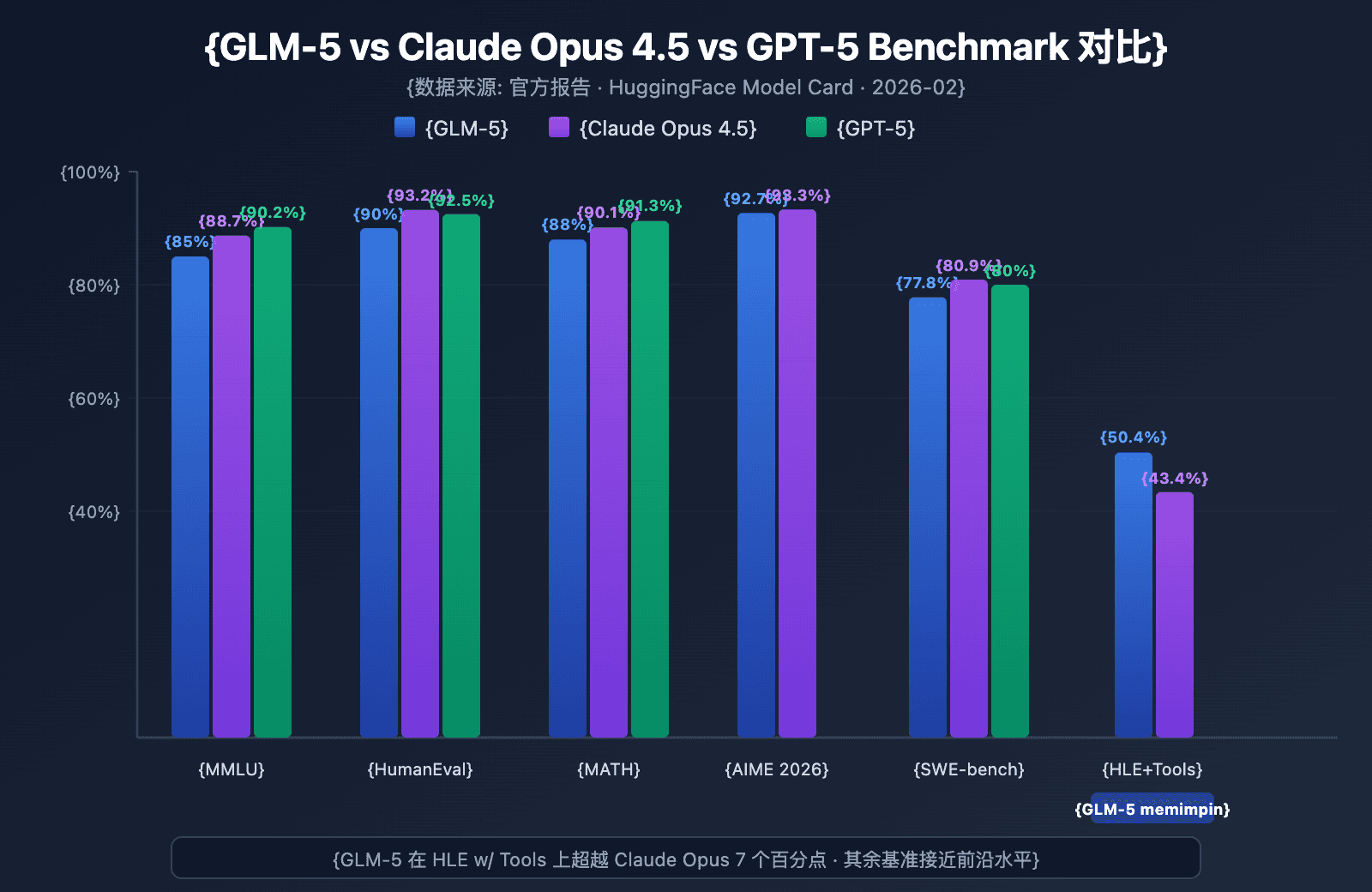
Contrary to speculation about diminishing returns, the report finds model progress is not flattening. The most advanced systems are now achieving or surpassing human expert baselines on "hard" benchmarks in domains like code generation (e.g., SWE-bench), scientific reasoning, and advanced mathematics. This success is creating a new problem: benchmark saturation. Many established evaluations are becoming less discriminative as top models "bunch together" near the ceiling of performance, pushing the research community to develop more challenging, real-world assessments.
The Geopolitical Landscape: A Tightening Race
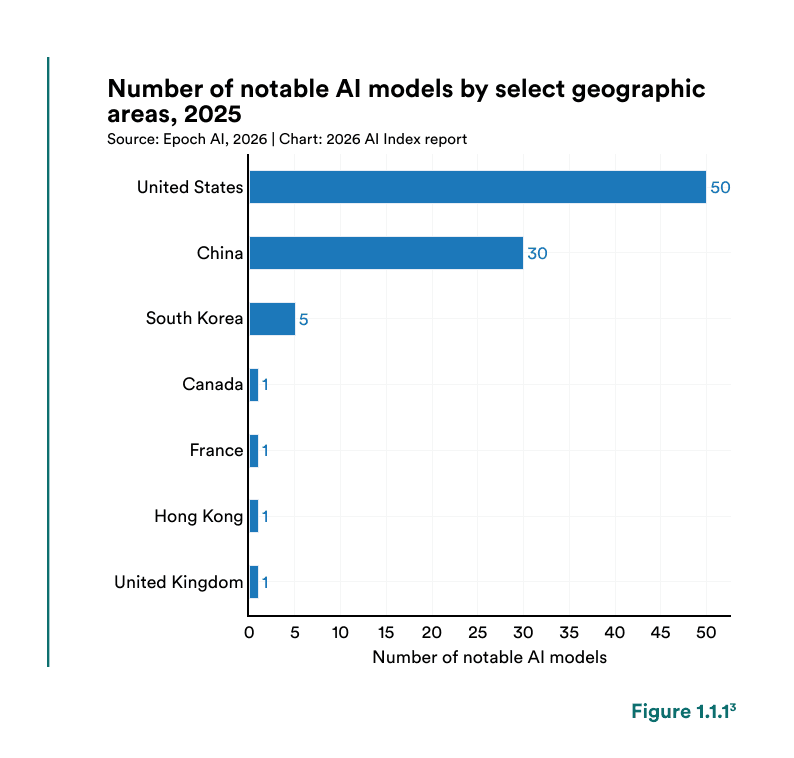
The report details a dramatically narrowed gap between the United States and China at the cutting edge of AI. While the U.S. maintains a lead in producing the absolute top-tier frontier models and attracts the lion's share of private investment, China now dominates in sheer volume of research papers, citations, and patent filings. Critically, China has built a substantial lead in industrial deployment base, integrating AI into manufacturing, logistics, and urban systems at scale. This suggests a bifurcated ecosystem: the U.S. and its allies (like the UK, which the 2023 report noted as a key player) may drive fundamental breakthroughs, while China excels at rapid application and commercialization.
Adoption, Hardware, and Labor: Mixed Signals
- Adoption Velocity: AI tools have reached approximately 53% of the global population in just three years—a diffusion rate remarkable for a general-purpose technology. Business uptake is strong, and the report notes a significant consumer surplus even for freely available tools, highlighting their perceived value.
- The Hardware Foundation: The report underscores that AI advancement is now inextricably tied to a fragile hardware stack. Progress depends on massive data centers, soaring energy consumption, and a concentrated chip supply chain critically reliant on TSMC. This creates systemic vulnerabilities.
- Labor Impact: The signal on jobs is complex. AI is demonstrating real productivity gains in fields like technical support and software engineering. However, the report notes softening demand for some entry-level software roles, indicating that AI is beginning to reshape, not just augment, certain job markets.
The Responsible AI Gap

A consistent theme is the growing disconnect between capability and safety. The rise in documented AI incidents (to 362) points to real-world harms and failures. Safety reporting remains weak, and the report identifies real trade-offs in model development, where improving one safety dimension (e.g., reducing toxic output) can degrade another (e.g., overall helpfulness). This aligns with ongoing debates about the feasibility of "alignment" for highly capable systems.
The Near-Term Frontier: AI in Medicine
One of the most concrete near-term success stories is in medicine. AI-powered clinical note-taking and administrative tools are showing clear benefits in reducing clinician paperwork and burnout. The report tempers this optimism by noting that strong, real-world clinical evidence for diagnostic or treatment AI systems remains thin, highlighting the gap between promising tools and validated medical devices.
gentic.news Analysis
The 2026 Index confirms and quantifies trends our reporting has tracked since the 2024 edition. The closing U.S.-China gap mirrors our coverage of China's focused industrial policy and the U.S. response through export controls and initiatives like the National AI Research Resource (NAIRR). The finding that older benchmarks are saturating validates the community's shift toward agentic, real-world evaluations, a move pioneered by projects like Google's Gemini Advanced and Anthropic's Claude 3.5 Sonnet, which pushed the envelope on coding and reasoning.
The report's highlight on medical AI as a practical win connects directly to our deep-dive on companies like Abridge and Nuance DAX, which have commercialized ambient documentation tools. However, the Index's caution about thin clinical evidence echoes concerns raised in our analysis of FDA clearance processes for AI/ML-based SaMD (Software as a Medical Device).
Most critically, the hardware fragility warning is a through-line in our coverage of the semiconductor industry. The dependence on TSMC and the immense energy demands of data centers—topics we explored in pieces on NVIDIA's Blackwell platform and the rising compute needs of multimodal models—are now recognized as central constraints, not peripheral concerns. The AI ecosystem is hitting physical and geopolitical limits that software innovation alone cannot solve.
Frequently Asked Questions
What is the Stanford AI Index Report?
The Stanford AI Index Report is an annual, independent study initiated by the Stanford Institute for Human-Centered AI (HAI). It tracks, collates, distills, and visualizes data related to artificial intelligence to provide a unbiased, rigorous resource for policymakers, researchers, executives, and the public to develop intuitions about the complex AI landscape.
Which AI benchmarks are models now beating humans on?
According to the 2026 report, top frontier AI models are matching or exceeding human expert performance on challenging benchmarks in coding (like SWE-bench), scientific reasoning (such as tasks from the arXiv dataset), and advanced mathematics (including competition-level problems). This saturation is prompting the creation of newer, more difficult benchmarks.
How is China catching up to the U.S. in AI?
While the U.S. still leads in creating the most capable frontier models and private investment, China has surpassed it in several key metrics: volume of AI research publications, total citations, patent filings, and the scale of industrial deployment. China's strength lies in integrating AI across its massive manufacturing and digital infrastructure, while the U.S. leads in foundational breakthroughs.
What does "53% global adoption" of AI mean?
This statistic indicates that approximately 53% of the global population has used an AI-powered tool or service (like a chatbot, image generator, or AI-assisted search) within the first three years of these technologies becoming widely accessible. It reflects an exceptionally rapid uptake compared to other general-purpose technologies like the internet or smartphones at similar stages.