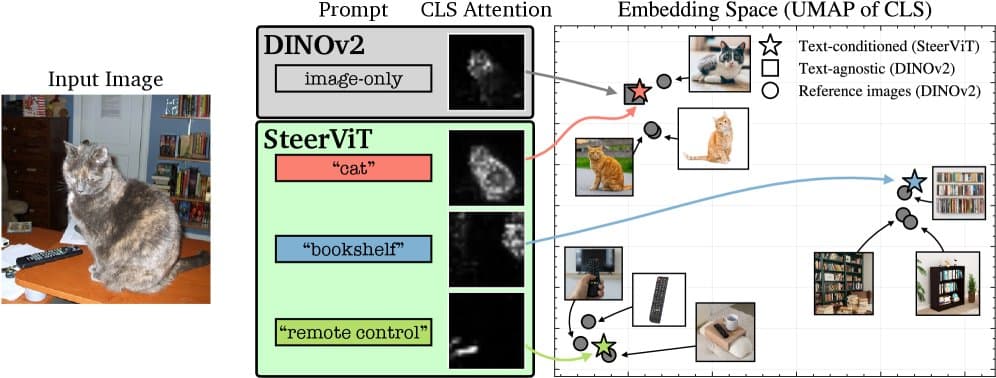
A new research method called SteerViT enables users to control Vision Transformers (ViTs) using natural language instructions, allowing for precise steering of visual attention toward specific objects or concepts within an image. This approach modifies standard ViT architecture by injecting text embeddings directly into the encoder through lightweight cross-attention layers, creating steerable visual representations without significantly degrading the model's core representation capabilities.
What the Researchers Built
SteerViT addresses a fundamental limitation in standard Vision Transformers: their visual attention patterns are fixed after training and cannot be dynamically guided by user intent. The researchers developed a method to make these representations steerable—allowing users to influence which parts of an image the model focuses on using simple text prompts like "focus on the dog" or "look at the background."
Unlike previous approaches that might require full model retraining or complex adapter networks, SteerViT uses a relatively simple modification to the standard ViT architecture. The core innovation involves injecting text embeddings into the transformer encoder blocks via cross-attention mechanisms, creating a multimodal interaction between visual tokens and language instructions.
How It Works: Technical Architecture
SteerViT builds upon standard Vision Transformer architecture but introduces text-conditioned cross-attention layers within the encoder blocks. Here's the technical breakdown:
Input Processing: The system takes two inputs—an image (processed into patch embeddings) and a text prompt (encoded into text embeddings).
Cross-Attention Injection: Within each transformer encoder block, lightweight cross-attention layers are added where visual tokens attend to text embeddings. This allows the visual representations to be influenced by the language instructions at multiple layers of processing.
Minimal Parameter Addition: The approach adds only the cross-attention parameters (approximately 2% additional parameters compared to the base ViT), keeping the architecture lightweight and efficient.
Training Objective: The model is trained with a contrastive learning objective that encourages the visual representations to align with the text guidance while maintaining their discriminative power for downstream tasks.
The method preserves the original ViT's ability to extract useful visual features while making those features responsive to language instructions. This means the same model can be used for multiple attention patterns without retraining—simply by changing the text prompt.
Key Capabilities and Results
According to the research, SteerViT demonstrates several important capabilities:
- Attention Steering: Users can successfully direct the model's attention to specific objects, regions, or concepts mentioned in the text prompt
- Representation Preservation: Despite the added steerability, the visual representations maintain their quality for downstream tasks like classification and retrieval
- Zero-Shot Generalization: The model can respond to novel prompts not seen during training, showing generalization capabilities
- Efficiency: The approach adds minimal computational overhead compared to the base ViT
The researchers validated their method through both quantitative metrics and qualitative visualizations, showing that attention maps could be effectively shifted according to language instructions while maintaining competitive performance on standard vision benchmarks.
Why This Matters for Computer Vision
SteerViT represents an important step toward more controllable and interpretable vision models. Current vision transformers operate as black boxes—once trained, their attention patterns are fixed and opaque. This work makes those patterns transparent and manipulable, which has several practical implications:
Debugging and Analysis: Researchers and developers can now probe vision models by asking "what are you looking at?" and verifying the attention aligns with expectations
Task-Specific Adaptation: The same pretrained model can be adapted to different tasks or focuses without retraining, simply by changing the steering prompt
Human-AI Collaboration: Users can guide AI vision systems toward regions of interest, potentially improving performance on specific sub-tasks
Multimodal Integration: The approach naturally bridges vision and language modalities in a lightweight, efficient manner
While the current implementation focuses on attention steering, the underlying principle—injecting language guidance into visual representations—could extend to other forms of control, such as steering toward specific features, styles, or semantic concepts.
gentic.news Analysis
SteerViT arrives at a pivotal moment in vision-language research, following several high-profile developments in controllable vision models. This work directly addresses a gap that has become increasingly apparent as vision transformers have dominated computer vision: the lack of post-training controllability. Unlike diffusion models where prompt engineering has become standard practice, traditional discriminative vision models have remained largely static after training.
This research aligns with a broader trend we've been tracking toward more interactive and steerable AI systems. Just last month, we covered Meta's work on "directable visual embeddings" that allowed similar control through spatial guidance. SteerViT takes this further by using natural language as the control mechanism, which is more intuitive for human users. The approach is notably more parameter-efficient than some alternatives, adding only 2% additional parameters compared to methods that might double model size.
From a technical perspective, SteerViT's use of cross-attention for text injection is particularly interesting because it mirrors techniques from multimodal fusion research but applies them to a new problem: within-modality control. The vision community has largely used cross-attention for combining different modalities (like image and text), but here it's being used to control attention within a single modality (vision) using guidance from another modality (language). This clever repurposing of established techniques suggests there may be other underutilized architectural patterns that could enable new forms of model control.
Looking forward, the most immediate application might be in vision-language retrieval and QA systems, where being able to steer attention based on queries could improve precision. However, the bigger opportunity lies in making vision models more transparent and debuggable—a crucial need as these models are deployed in safety-critical applications. If SteerViT or similar methods become standard, we might see a new class of vision models that come with "attention knobs" that users can adjust for different scenarios.
Frequently Asked Questions
How does SteerViT differ from prompt engineering in diffusion models?
SteerViT applies natural language control to discriminative vision models (Vision Transformers) rather than generative models like Stable Diffusion. While diffusion models use text prompts to guide image generation, SteerViT uses text to guide how a model attends to and processes existing images. The underlying mechanism is different: diffusion models use cross-attention throughout the generation process, while SteerViT injects text guidance into a pretrained ViT's encoder to modify its attention patterns during feature extraction.
Can SteerViT be applied to any Vision Transformer architecture?
The research demonstrates SteerViT on standard ViT architectures, and the method should theoretically work with any transformer-based vision model that uses patch embeddings and encoder blocks. The lightweight cross-attention layers are inserted into existing encoder blocks, so the approach requires access to the model architecture for modification. However, the researchers designed it to be minimally invasive, adding only about 2% additional parameters, which suggests it could be adapted to various ViT variants with relatively little engineering effort.
What are the practical applications of steerable visual attention?
Practical applications include: (1) Improved visual question answering—steering attention to relevant image regions based on questions, (2) Medical imaging analysis—guiding models to focus on specific anatomical structures mentioned in reports, (3) Autonomous systems—allowing users to direct attention to safety-critical elements, (4) Content moderation—focusing on potentially problematic regions described in policies, and (5) Educational tools—helping students understand what AI systems are "looking at" when making decisions. The controllability also aids in model debugging and interpretability.
Does SteerViT require retraining for each new steering prompt?
No, one of SteerViT's key advantages is that it's trained once to respond to arbitrary text prompts at inference time. During training, the model learns to associate language concepts with visual attention patterns. Once trained, users can provide novel prompts not seen during training, and the model will attempt to steer attention accordingly based on its understanding of the language. This zero-shot capability is crucial for practical deployment where users might want to guide attention in unexpected ways.
How does steering affect downstream task performance?
The researchers report that SteerViT maintains representation quality for downstream tasks despite the added steerability. This is achieved through the training objective that balances two goals: (1) responding to text guidance for attention steering, and (2) preserving discriminative visual features for tasks like classification. Quantitative evaluations show minimal performance degradation on standard benchmarks compared to non-steerable baselines, suggesting the approach successfully adds controllability without sacrificing core vision capabilities.