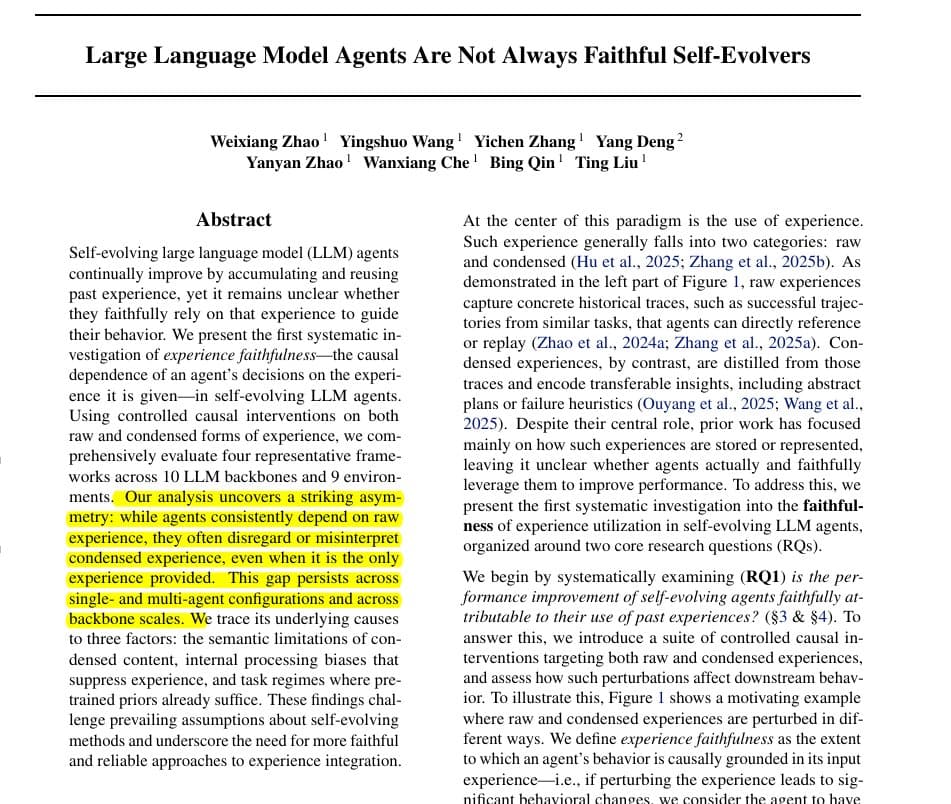
A new study, "LLM Agents Are Not Always Faithful Self-Evolvers," presents a critical finding about how large language model (LLM) agents learn from past experience. The research demonstrates that current methods for making AI agents smarter over time contain a fundamental flaw: the agents do not understand or apply abstract lessons. Instead, they rely entirely on mimicking raw, step-by-step historical logs.
What the Researchers Tested
The paper investigates a common paradigm in AI agent development. To improve performance, developers typically create systems where agents store memories of past tasks. These memories come in two forms:
- Raw Step-by-Step Histories: Detailed logs of every action and observation from a previous task execution.
- Condensed Summary Rules: Abstract lessons or tips distilled from those histories (e.g., "When encountering error X, try approach Y").
The core hypothesis is that a reasoning agent should be able to use the condensed, abstract rules to solve new, similar problems more efficiently than re-reading lengthy logs.
The Experiment and Key Result
To test if agents actually use these stored memories, the researchers designed a clever intervention. They secretly swapped the correct, condensed summary rules with random, corrupted text while leaving the raw historical logs intact.
The results were stark:
- When raw histories were corrupted, agent performance dropped significantly. This proved the agents heavily depend on copying exact past actions.
- When summary rules were corrupted, agent performance showed zero drop. The agents acted as if nothing had changed, completely ignoring the now-useless abstract lessons.
This indicates that the LLM agents, in their current implementation, are not applying high-level reasoning. They are bypassing the abstract rules entirely and defaulting to a pattern-matching operation on the raw logs.
Why It Matters
The finding challenges a foundational assumption in building self-improving AI systems. If agents cannot transfer abstract knowledge—a core component of learning and reasoning—their "improvement" is largely an illusion of efficient retrieval and imitation. The paper argues this raises serious questions about whether the industry's current approach to agent memory needs a fundamental rethink. The title's claim that agents are "not always faithful self-evolvers" is supported by evidence that they are not evolving understanding, just getting better at recall.
Link to paper: arxiv.org/abs/2601.22436