A new academic survey paper, titled "The Latent Space," provides a systematic and comprehensive overview of a fundamental architectural evolution in large language models (LLMs). The work traces the paradigm shift from traditional, discrete token-level autoregressive generation to emerging methods that enable continuous latent computation.
The paper, highlighted by the research dissemination account @HuggingPapers, is positioned as a key reference for understanding the technical trajectory that underpins recent advances in model reasoning, planning, and handling of long-context tasks. It synthesizes research across architecture design, training methodologies, and emergent capabilities.
What the Survey Covers
The survey is structured to map the conceptual and technical journey of language models. Its core narrative follows the progression:
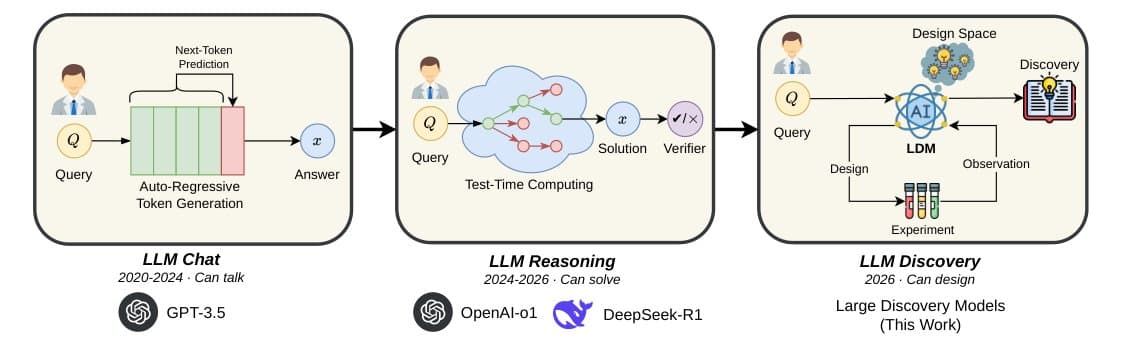
Token-Level Generation (The Foundational Paradigm): This covers the standard Transformer-based autoregressive models that predict the next discrete token in a sequence. The survey details the limitations of this approach, particularly its sequential, left-to-right nature, which can hinder complex reasoning, look-ahead planning, and global coherence in long texts.
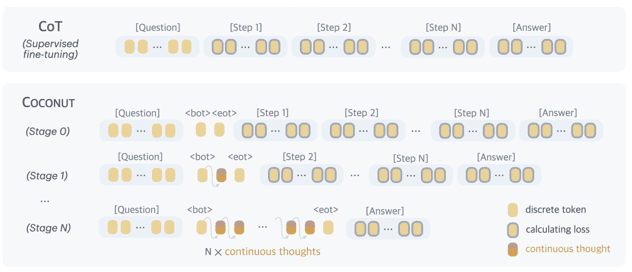
The Shift to Latent Representations: The paper explores how models increasingly operate on continuous latent representations of text rather than directly on discrete tokens. This includes techniques from latent variable models, diffusion-inspired processes for text, and methods that separate planning in a latent space from execution in token space.
Architectures for Latent Computation: A significant portion of the survey is dedicated to novel model architectures designed to facilitate computation in these latent spaces. This likely encompasses models like SSMs (State Space Models) for efficient long-range reasoning, latent planning models that break tasks into sub-goals, and hybrid architectures that blend discrete and continuous representations.
Reasoning and Future Directions: The final sections analyze how latent computation enables more robust reasoning (e.g., chain-of-thought, self-correction) and outlines open research questions and potential future trajectories for the field.
Why This Survey Matters Now
This paper arrives at a critical inflection point in LLM development. While scaling pure autoregressive Transformers has yielded immense capability gains, researchers are increasingly hitting walls in efficiency, reasoning depth, and context length. The survey provides a unified framework for understanding the diverse array of post-Transformer architectures and training paradigms being proposed to overcome these limits.
It serves as both a technical primer for engineers entering the field and a strategic map for researchers identifying the most promising vectors for innovation. By categorizing and connecting disparate research threads—from Google's Gemma models exploring SSMs to Meta's research on latent planning—the survey helps clarify the landscape beyond the next-token prediction paradigm.
gentic.news Analysis
This survey formalizes a trend our coverage has tracked for over a year. It directly connects to our December 2025 analysis, "Beyond Autoregression: How Latent Planning Models Are Redefining AI Reasoning," which dissected early papers from DeepMind and Anthropic on separating task formulation from token generation. The "Latent Space" survey provides the academic backbone for that observed industry shift.
The paper's emphasis on continuous latent computation aligns with the rising investment and research into State Space Models (SSMs). As noted in our Q4 2025 trend report, SSM-based architectures like Mamba and those integrated into models like Command R+ are gaining traction for their linear-time complexity on long sequences, a direct enabler of the latent computation paradigm. This survey contextualizes SSMs not as an isolated alternative to Transformers, but as part of a broader architectural evolution toward latent-space operations.
Furthermore, the survey's timing is strategic. With major labs like OpenAI, Google DeepMind, and Anthropic all actively researching next-generation architectures (often hinted at as successors to the GPT, Gemini, and Claude lines), this paper offers a common vocabulary and set of benchmarks for evaluating what comes next. It moves the conversation from "what breaks the Transformer" to "what coherent principles guide what comes after."
Frequently Asked Questions
What is 'latent computation' in language models?
Latent computation refers to a model performing reasoning, planning, or representation learning in a continuous, compressed numerical space (the latent space) before generating final text tokens. Instead of directly predicting the next word, the model might first create an abstract plan or refine a thought process in this space, leading to more coherent and reasoned outputs.
How does this differ from current models like GPT-4?
Models like GPT-4 primarily use autoregressive token generation. They predict the next token based on previous tokens in a largely sequential, left-to-right manner. While they exhibit reasoning, it's emergent from this process. Latent computation models explicitly architect a separate phase or pathway for abstract reasoning, which can be non-sequential and operate over the entire context at once.
What are the practical benefits of this architectural shift?
The main anticipated benefits are: 1) Improved complex reasoning and planning, by allowing the model to "think before it speaks"; 2) More efficient handling of very long contexts, as computation in a compressed latent space can be cheaper than operating on all raw tokens; and 3) Potential for greater controllability and interpretability, as the latent space may represent more structured concepts than token sequences.
Is this survey about a specific new model?
No. "The Latent Space" is a survey paper, not a release of a new model. Its value is in synthesizing and categorizing hundreds of research papers to chart the evolution of ideas across the entire field. It is a map of the research landscape, not a single point on it.