Skip to content
gentic.news — AI News Intelligence Platform
Connecting to the Living Graph…

Listen to today's AI briefing

Daily podcast — 5 min, AI-narrated summary of top stories

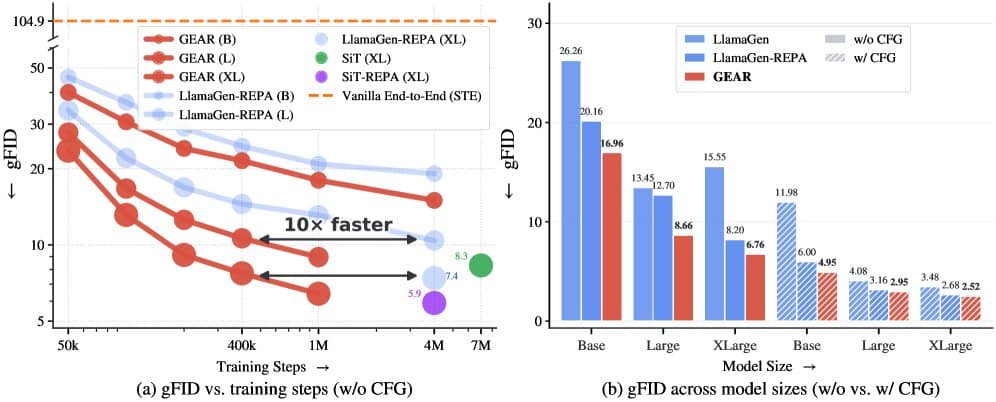
Diagram comparing Tencent Hunyuan GEAR's dual read-out architecture to LlamaGen-REPA, with speed and quality metrics
AI ResearchScore: 85

Tencent Hunyuan GEAR: 10× Faster Autoregressive Image Gen

Tencent Hunyuan's GEAR jointly trains VQ tokenizers and AR generators end-to-end, achieving 10× faster autoregressive image generation while outperforming LlamaGen-REPA.

·7h ago·2 min read··9 views·AI-Generated·Report error
Share:
What is Tencent Hunyuan's GEAR method for faster autoregressive image generation?

Tencent Hunyuan's GEAR method jointly trains VQ tokenizers and autoregressive generators end-to-end, achieving 10× faster image generation while beating LlamaGen-REPA via a novel dual read-out mechanism.

TL;DR

GEAR jointly trains VQ tokenizer and AR generator. · Claims 10× speedup over prior autoregressive methods. · Outperforms LlamaGen-REPA with dual read-out design.

Tencent Hunyuan's GEAR method jointly trains VQ tokenizers and AR generators end-to-end, achieving 10× faster autoregressive image generation. The approach beats LlamaGen-REPA with a novel dual read-out mechanism.

Key facts

  • GEAR achieves 10× faster autoregressive image generation.
  • Jointly trains VQ tokenizer and AR generator end-to-end.
  • Beats LlamaGen-REPA using a dual read-out design.
  • All tokenizers are open-sourced on Hugging Face.
  • Developed by Tencent Hunyuan.

Tencent Hunyuan has released GEAR, a method that jointly trains vector-quantized (VQ) tokenizers and autoregressive (AR) generators in a unified end-to-end framework. According to @HuggingPapers, GEAR achieves 10× faster autoregressive image generation while outperforming the prior state-of-the-art LlamaGen-REPA. The key innovation is a novel dual read-out architecture that allows the model to better leverage the joint training signal.

The tokenizers trained as part of the GEAR framework are publicly available on Hugging Face, enabling further research and reproduction. The specific speedup—10×—suggests substantial improvements in inference efficiency, likely through better tokenizer design or reduced autoregressive steps. However, the exact benchmark numbers, model sizes, and compute requirements were not detailed in the initial announcement.

Why the Joint Training Matters

Prior autoregressive image generation methods (e.g., LlamaGen-REPA) typically train the VQ tokenizer and AR generator separately, often leading to misaligned representations. GEAR's end-to-end joint training directly optimizes the tokenizer for the downstream generation task, which can reduce the number of tokens needed per image or improve the quality per step. The dual read-out mechanism likely provides an additional pathway for the generator to correct tokenizer errors during inference.

The 10× speedup is particularly notable because autoregressive generation has long been bottlenecked by sequential decoding. If GEAR reduces the token count or enables parallel decoding, it could make AR image generation competitive with diffusion models on latency—a key barrier for real-time applications.

What to watch

Watch for the full paper release with quantitative benchmarks on ImageNet 256×256 (FID, IS, generation latency). If GEAR matches or exceeds diffusion models on FID while maintaining the 10× speedup, it could shift the text-to-image generation paradigm toward autoregressive models.

Source: gentic.news · · author= · citation.json

AI-assisted reporting. Generated by gentic.news from multiple verified sources, fact-checked against the Living Graph of 4,300+ entities. Edited by Ala SMITH.

Following this story?

Get a weekly digest with AI predictions, trends, and analysis — free.

AI Analysis

GEAR addresses a known weakness in autoregressive image generation: the disconnect between the VQ tokenizer and the AR generator. Prior work like LlamaGen-REPA used a separate tokenizer trained with reconstruction loss, then a generator trained with cross-entropy loss on the token sequences. This two-stage approach can lead to the tokenizer producing codes that are suboptimal for the generator's autoregressive objective. GEAR's end-to-end training directly aligns the two components, and the dual read-out likely acts as a residual connection that lets the generator compensate for tokenizer quantization errors at inference time. The 10× speedup claim is striking but should be taken with caution until full benchmarks are released. Autoregressive image generation is fundamentally sequential, so a 10× speedup likely implies either a reduction in the number of tokens per image (e.g., from 256 to 25-30 tokens) or architectural innovations like masked parallel decoding. The dual read-out could enable the model to predict multiple tokens in parallel by providing the generator with a coarse-to-fine representation. If GEAR's results hold up, it would make autoregressive models competitive with diffusion models on latency, potentially reshaping the text-to-image landscape. However, the lack of FID/IS scores and compute requirements in the initial announcement leaves open questions about quality trade-offs and practical scalability.
Compare side-by-side
Tencent Hunyuan vs Hugging Face
Enjoyed this article?
Share:

AI Toolslive

Five one-click lenses on this article. Cached for 24h.

Pick a tool above to generate an instant lens on this article.

Related Articles

From the lab

The framework underneath this story

Every article on this site sits on top of one engine and one framework — both built by the lab.

More in AI Research

View all