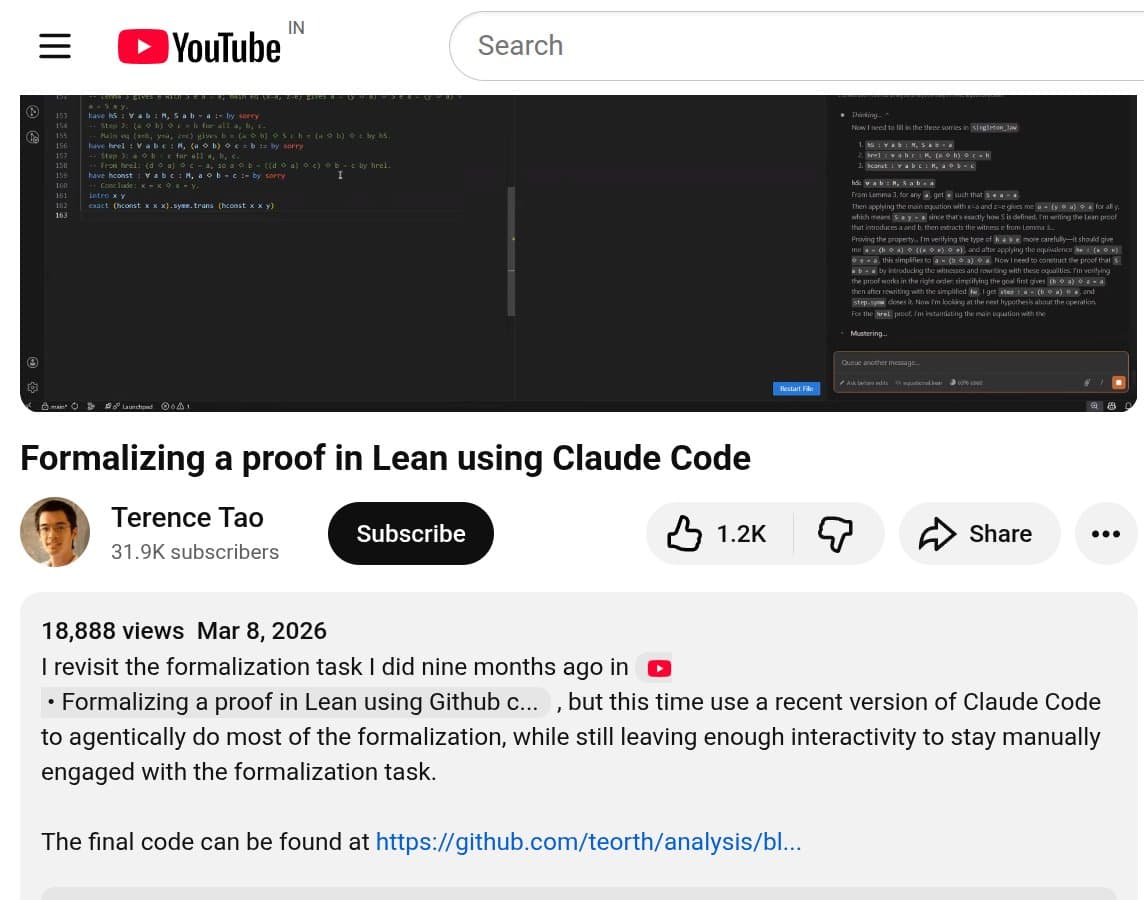
Fields Medalist and renowned mathematician Terence Tao has released a new video on his YouTube channel titled "Formalizing (Math) proof in Lean using Claude Code," showcasing a significant development at the intersection of artificial intelligence and professional mathematics. The demonstration represents what observers are calling "a massive leap into the highest levels of professional mathematics" for AI systems.
The Demonstration: Claude Code Meets Lean Theorem Prover
In the video, Tao demonstrates how Claude Code—the coding-focused version of Anthropic's Claude AI—can be used to formalize mathematical proofs within the Lean theorem prover. Lean is an interactive theorem prover and programming language that allows mathematicians to write and verify mathematical proofs with computer assistance, ensuring absolute correctness.
While the specific mathematical content of the demonstration isn't detailed in the source material, the significance lies in the collaboration between one of the world's most prominent mathematicians and cutting-edge AI technology. Tao's involvement suggests the demonstration likely involves non-trivial mathematical concepts rather than elementary exercises.
The Context: AI's Gradual Infiltration of Mathematics
This development comes amid increasing interest in how AI can assist with mathematical reasoning. Unlike previous AI applications in mathematics that focused on computational tasks or pattern recognition, formal proof verification represents a more sophisticated challenge requiring logical rigor and precise expression.
Lean has gained popularity in recent years among mathematicians interested in formal verification, with projects like the Lean Mathematical Library (mathlib) accumulating thousands of formalized theorems. However, writing Lean code requires specialized knowledge that creates a barrier to entry for many mathematicians.
Claude Code's ability to assist with this process potentially lowers this barrier, allowing more mathematicians to participate in formal verification efforts while reducing the tedium of writing detailed proof code.
Why This Matters: Beyond Proof Verification
The implications extend beyond mere convenience. First, AI-assisted formalization could accelerate the process of verifying complex proofs that might otherwise take human experts months or years to formalize. This is particularly valuable for exceptionally long or intricate proofs where human verification is challenging.
Second, this development suggests AI systems are developing better mathematical reasoning capabilities—not just pattern matching but understanding logical structures and formal systems. The ability to work within Lean's strict formal framework requires comprehension of mathematical logic at a sophisticated level.
Third, Tao's public demonstration lends credibility to these tools. When a mathematician of his stature invests time in exploring and showcasing AI tools, it signals to the broader mathematical community that these technologies have matured beyond experimental curiosities.
The Broader Trend: AI as Mathematical Collaborator
This demonstration fits within a growing trend of AI systems moving from calculation assistants to reasoning partners in mathematics. Other systems like Google's AlphaGeometry have shown promise in solving Olympiad-level geometry problems, while various research groups are exploring how large language models can contribute to mathematical discovery.
What makes Tao's demonstration particularly noteworthy is its focus on formal verification—the gold standard for mathematical certainty. While AI-generated mathematical insights still require careful human scrutiny, AI-assisted formal verification provides a pathway to computer-checked certainty for those insights.
Challenges and Limitations
Despite the excitement, significant challenges remain. Formalizing proofs in systems like Lean requires extreme precision, and AI systems still struggle with consistency in logical reasoning. There's also the question of whether AI-assisted formalization might obscure mathematical understanding rather than enhance it—if mathematicians rely too heavily on AI to handle formal details, they might lose touch with the nuances of proof construction.
Additionally, the trustworthiness of AI-generated formal proofs requires careful verification. While Lean itself verifies the final code, ensuring that the AI's translation from mathematical ideas to formal code is correct remains a concern.
The Future of Mathematical Practice
Tao's video suggests we may be approaching a future where AI-assisted formalization becomes a standard part of mathematical practice, particularly for complex proofs where human verification is most challenging. This could lead to more rigorous mathematics with fewer errors slipping through peer review.
As these tools improve, we might see them integrated into mathematical education, helping students learn both traditional proof techniques and formal verification methods. They could also make mathematics more accessible to researchers in fields that rely on advanced mathematics but lack formal verification expertise.
Conclusion
Terence Tao's demonstration of using Claude Code with the Lean theorem prover represents a meaningful step in AI's journey into advanced mathematics. While not replacing human mathematicians, such tools promise to augment mathematical practice by handling the tedious aspects of formal verification while allowing mathematicians to focus on creative insight and understanding.
The video serves as both a practical demonstration and a symbolic milestone—showing that AI systems are now capable enough to earn the attention and interest of mathematicians working at the highest levels. As these technologies continue to develop, the collaboration between human mathematical intuition and AI-assisted formalization may well define the next era of mathematical discovery.
Source: Terence Tao's YouTube video "Formalizing (Math) proof in Lean using Claude Code" as reported by @rohanpaul_ai.