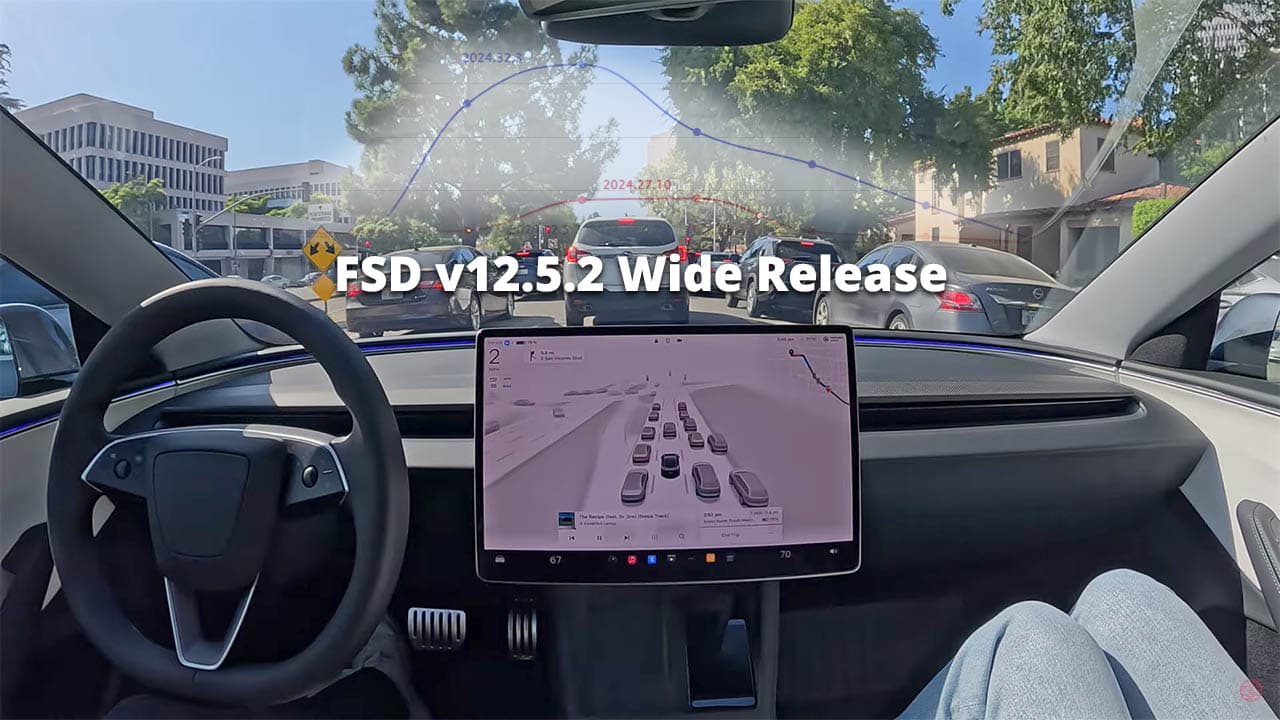
Tesla AI has announced via social media that a new release of its Full Self-Driving (FSD) Supervised software is now starting to roll out to customer vehicles. The primary claim for this update, presumed to be version 12.5, is a 20% faster reaction time, aimed at further increasing the safety of the advanced driver-assistance system.
What Happened
On April 15, 2026, Tesla's AI team posted that the "New release of FSD Supervised" is beginning its deployment. The post states the update brings "20% faster reaction time to further increase safety." No additional technical details, benchmark comparisons, or specific safety metrics were provided in the brief announcement.
Context
This rollout represents the latest incremental update to Tesla's FSD Supervised stack, which transitioned to an end-to-end neural network architecture with the landmark FSD v12 release in early 2024. The "Supervised" designation indicates the system still requires active driver monitoring and intervention. Tesla's development cycle for FSD has typically involved frequent point releases (v12.1, v12.2, etc.) that refine the core v12 model with improvements to driving smoothness, intervention rates, and edge-case handling.
A "20% faster reaction time" likely refers to the latency between sensor input (primarily camera vision) and the execution of a driving decision by the vehicle's control systems. In the context of autonomous driving, reduced latency can improve the system's ability to handle sudden events, such as a pedestrian stepping into the road or a car braking abruptly.
What This Means in Practice
For drivers using FSD Supervised, a 20% reduction in system reaction time could translate to a marginally more confident and responsive driving experience, particularly in complex urban environments. However, the real-world impact on safety is difficult to quantify without published data on disengagement rates or specific scenario testing.
gentic.news Analysis
This announcement is a classic example of Tesla's continuous deployment strategy for its autonomy software. Unlike traditional automakers or AV companies like Waymo that release monolithic, validated versions, Tesla uses its fleet of millions of vehicles to iteratively test and refine its neural network. The focus on "reaction time" is a logical progression following years of work on perception accuracy and planning logic. Faster reactions are a direct lever for improving safety margins, but they are just one component. The system's accuracy in interpreting scenes and predicting actor intent remains equally, if not more, critical.
This update follows Tesla's Q1 2026 earnings call where Elon Musk reiterated that autonomy remains the company's primary technological focus and value driver. The incremental nature of v12.5 suggests Tesla is in a phase of optimization and hardening of its v12 architecture, rather than pursuing another architectural overhaul. This aligns with our previous coverage on the industry's shift from model-centric to data-centric AI development, where the quality and breadth of training data become the primary bottleneck after a capable architecture is established.
However, the announcement lacks the concrete, third-party-verifiable metrics that the broader AV research community relies on. Claims of percentage improvements are meaningful only with context: a 20% improvement from what baseline, measured on which test suite? Competitors like Wayve, Waymo, and Mobileye typically accompany progress reports with detailed results on benchmarks like nuScenes or specific disengagement rates in defined operational design domains (ODDs). Tesla's opaque, fleet-based validation makes direct comparisons difficult.
Frequently Asked Questions
What is Tesla FSD Supervised v12.5?
It is the latest point-release update to Tesla's Full Self-Driving Capability software. Building on the end-to-end neural network architecture introduced in v12, v12.5 claims to deliver a 20% faster reaction time. The "Supervised" label means the driver must remain attentive and ready to take control at any moment.
How does Tesla measure "20% faster reaction time"?
The announcement does not specify the measurement methodology. It likely refers to the reduction in latency between the vehicle's vision system detecting an object or event and the control system executing a corresponding maneuver (e.g., braking or steering). This could be measured internally on a proprietary dataset of challenging scenarios.
When will I get the FSD v12.5 update?
Tesla states the update is "now starting to roll out." Tesla software updates typically deploy in waves over days or weeks, often prioritizing vehicles based on hardware configuration, region, and whether the owner is enrolled in the "Early Access Program." There is no single release date for all users.
Is FSD v12.5 a fully autonomous (Level 4) system?
No. FSD Supervised, including v12.5, is a Level 2 advanced driver-assistance system (ADAS) as defined by the SAE. The driver is legally responsible for the vehicle's operation and must supervise the system at all times. It is not a robotaxi-ready, driverless system.