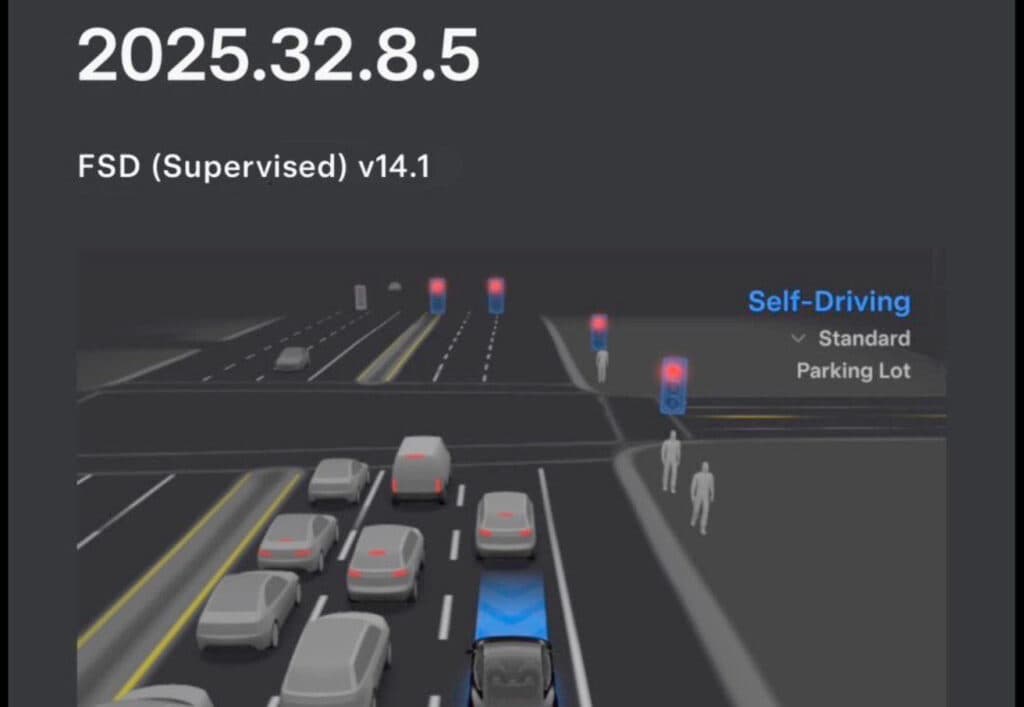
Tesla has officially released version 14.3 of its Full Self-Driving (Supervised) software, initiating its deployment to the customer fleet. The update was confirmed via social media by Tesla watchers, with users reporting the download beginning on their vehicles.
What Happened
On April 10, 2026, Tesla began pushing the FSD V14.3 software update to eligible vehicles. This follows a period of internal testing and a limited external beta. The release appears to be a standard staggered rollout, where the software is deployed to an increasing percentage of the fleet over time to monitor performance and stability.
The source indicates the update is being downloaded on a Tesla Model Y, confirming it is a genuine over-the-air (OTA) release to customer vehicles, not just a test fleet deployment.
Context
FSD V14 represents a continuation of the foundational architectural shift that began with FSD V12, which Tesla CEO Elon Musk famously described as moving from "over 300,000 lines of explicit C++ code" to a single end-to-end neural network trained on millions of video clips. This approach replaced hard-coded rules for driving scenarios with a system that learns driving behavior directly from data.
FSD V13, released in late 2025, focused on refining this end-to-end model, particularly improving smoothness in complex urban environments and handling unprotected left turns. The progression to V14.3 suggests iterative improvements on this core architecture.
Tesla's FSD development operates on a rapid iteration cycle, with major version numbers (V12, V13, V14) indicating significant milestones and point releases (e.g., V14.1, V14.2, V14.3) addressing bugs, edge cases, and performance refinements based on fleet data.
What This Means in Practice
For Tesla owners with the FSD capability package, this update will download automatically when their vehicle is connected to Wi-Fi. After installation, they will be able to engage the FSD (Supervised) system on supported roads. As the name implies, the system requires an attentive driver ready to take over at any moment.
The specific release notes and detailed feature changes for V14.3 are not included in the source. Based on Tesla's historical pattern, these notes typically become available once the update is more widely installed and are shared by users on forums and social media. Expected areas of improvement could include: reduced disengagement rates, better handling of construction zones, more natural interactions with pedestrians and cyclists, and enhanced performance in adverse weather conditions.
gentic.news Analysis
This release is a critical data-gathering step for Tesla's autonomy ambitions. Every mile driven with V14.3 by the customer fleet—which numbers in the hundreds of thousands of vehicles in North America alone—generates valuable telemetry and, when drivers intervene, crucial disengagement data. This data is the fuel for Tesla's next training cycle. As we covered in our analysis of "The Data Flywheel in Autonomous Driving," this iterative loop of deployment, data collection, model retraining, and redeployment is the core competitive moat Tesla is attempting to build. No other company has a comparable fleet of sensor-equipped vehicles gathering real-world driving data at this scale.
The timing is also noteworthy. This follows increased regulatory scrutiny and competitive launches in the autonomous vehicle space throughout early 2026. A stable, widely deployed V14.3 demonstrates progress to regulators and counters narratives from competitors like Waymo and Cruise, which operate geofenced robotaxi services. Tesla's approach remains fundamentally different: a general-purpose driving assistant intended to work everywhere, improving gradually.
However, the key metric to watch will not be the version number, but the disengagement rate per mile. Tesla has historically been opaque with this data, but third-party aggregators and anecdotal reports from the user community will provide the first indicators of whether V14.3 represents a meaningful step toward the elusive goal of unsupervised autonomy. The transition from V12 to V13 showed incremental gains; the industry will be watching to see if V14 begins to demonstrate the exponential improvement curve Tesla's strategy requires.
Frequently Asked Questions
What is Tesla FSD V14.3?
FSD V14.3 is the latest point-release version of Tesla's Full Self-Driving (Supervised) software suite. It is an iterative update built upon the V14 architecture, which itself continues the end-to-end neural network approach introduced in V12. It is a driver-assistance system that requires active supervision.
How do I get the Tesla FSD V14.3 update?
If you own a Tesla with the FSD capability package and your car is eligible, the update will be pushed to your vehicle over-the-air (OTA) when connected to Wi-Fi. Tesla uses a staggered rollout, so not all vehicles receive it simultaneously. You can check for updates in your car's touchscreen menu under 'Software'.
What's new in FSD V14.3?
The source announcement does not include specific release notes. Based on Tesla's development patterns, V14.3 likely contains bug fixes, performance refinements, and improvements to edge-case handling for the core V14 autonomous driving stack. Detailed feature changes are typically revealed once the update is widely installed and users share the official release notes from their vehicles.
Is Tesla FSD V14.3 fully autonomous?
No. The system is officially called "Full Self-Driving (Supervised)." It is a Level 2+ advanced driver-assistance system (ADAS) as defined by the SAE. The driver must remain attentive, keep their hands on the wheel, and be prepared to take over immediately. It is not a robotaxi and does not make the vehicle autonomous.