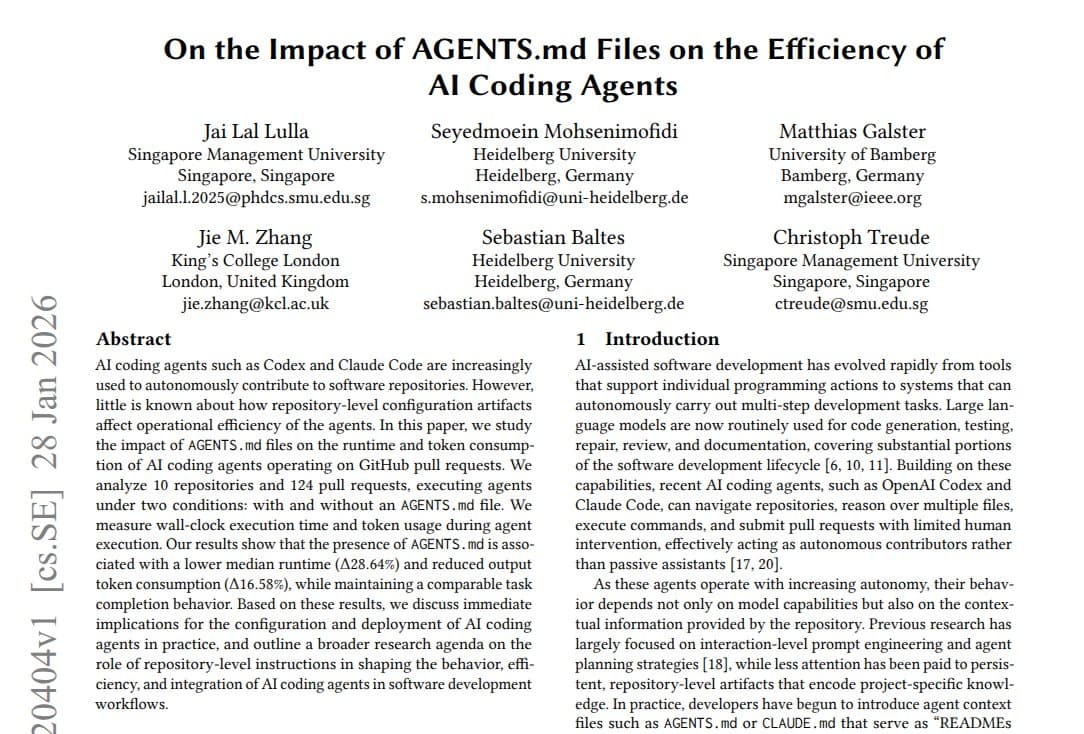
In the rapidly evolving world of AI-assisted software development, a surprisingly simple breakthrough has emerged from recent research. According to a study titled "On the Impact of AGENTS.md Files on the Efficiency of AI Coding Agents," adding a single plain text file called AGENTS.md to software projects can make AI coding assistants complete tasks 28% faster while consuming significantly fewer tokens. This finding addresses a fundamental inefficiency in how developers currently interact with AI coding tools and suggests a more sustainable approach to human-AI collaboration in software engineering.
The Problem: AI's Costly Project Navigation
Currently, when developers use AI assistants like GitHub Copilot, Claude Code, or other coding agents, they face a persistent challenge: the AI lacks context about their specific project structure. Each time a developer asks an AI to write or fix code, the assistant must essentially rediscover how the project is organized—what frameworks are used, where different components are located, what naming conventions apply, and how the architecture is designed.
This context-gathering process happens repeatedly, even within the same project, leading to what researchers have identified as significant inefficiencies. Developers often attempt to compensate by writing lengthy, detailed prompts each time they interact with the AI, essentially providing the same project context over and over. This approach not only wastes developer time but also consumes substantial computational resources as the AI processes redundant information.
The Solution: A Single Source of Truth
The research demonstrates that instead of embedding project context in every prompt, developers can create a single AGENTS.md file in their project's main directory. This plain text document contains essential information about the project's architecture, rules, conventions, and organization. When an AI coding agent encounters this file, it reads it once and immediately gains a comprehensive understanding of the project structure.
This approach mirrors how human developers benefit from good documentation but applies it specifically to AI collaborators. The AGENTS.md file serves as a reference manual that the AI can consult, eliminating the need to repeatedly explain project fundamentals. According to the study, this simple intervention reduces task completion time by nearly 30% and significantly decreases the number of tokens generated during coding sessions.
Implementation and Best Practices
While the research paper doesn't prescribe exact contents for AGENTS.md files, the concept suggests they should include information that helps AI understand project context quickly. This might include:
- Project architecture overview
- Key directory structures and their purposes
- Technology stack and framework information
- Coding conventions and style guidelines
- Important dependencies and their relationships
- Testing strategies and patterns
- Deployment considerations
The beauty of this approach lies in its simplicity. Unlike complex prompt engineering techniques that require specialized knowledge, creating an AGENTS.md file is accessible to any developer familiar with their own project. The file format—plain text Markdown—is universally readable by both humans and AI systems, creating a shared reference point for collaboration.
Broader Implications for AI-Assisted Development
This research has significant implications beyond immediate efficiency gains. First, it suggests a more sustainable model for AI-assisted development, where computational resources are used more efficiently. Fewer tokens mean lower costs and reduced environmental impact, especially as AI coding tools become more widespread.
Second, the AGENTS.md approach represents a shift toward treating AI collaborators more like team members who benefit from proper onboarding and documentation. Just as human developers need project documentation to work effectively, AI assistants perform better when they have access to structured context.
Third, this discovery could influence how AI coding tools are designed and integrated into development workflows. Future tools might automatically look for and prioritize AGENTS.md files, or even help generate them based on project analysis. Development platforms might incorporate this concept into their project templates and best practices.
The Future of Developer-AI Collaboration
The AGENTS.md research points toward a future where human developers and AI assistants collaborate more seamlessly through shared documentation. As AI coding tools become more sophisticated, establishing clear communication protocols and shared context will become increasingly important.
This approach also has potential applications beyond coding. Similar documentation files could help AI assistants in other domains—design systems for UI/UX work, research protocols for academic writing, or process documentation for business operations. The fundamental insight—that structured context improves AI efficiency—likely applies across many AI-assisted tasks.
For now, developers can immediately benefit from this research by creating AGENTS.md files for their current projects. The minimal effort required to document project basics could yield substantial efficiency gains, making AI coding assistants more effective partners in the development process.
Source: "On the Impact of AGENTS.md Files on the Efficiency of AI Coding Agents" (arXiv:2601.20404)