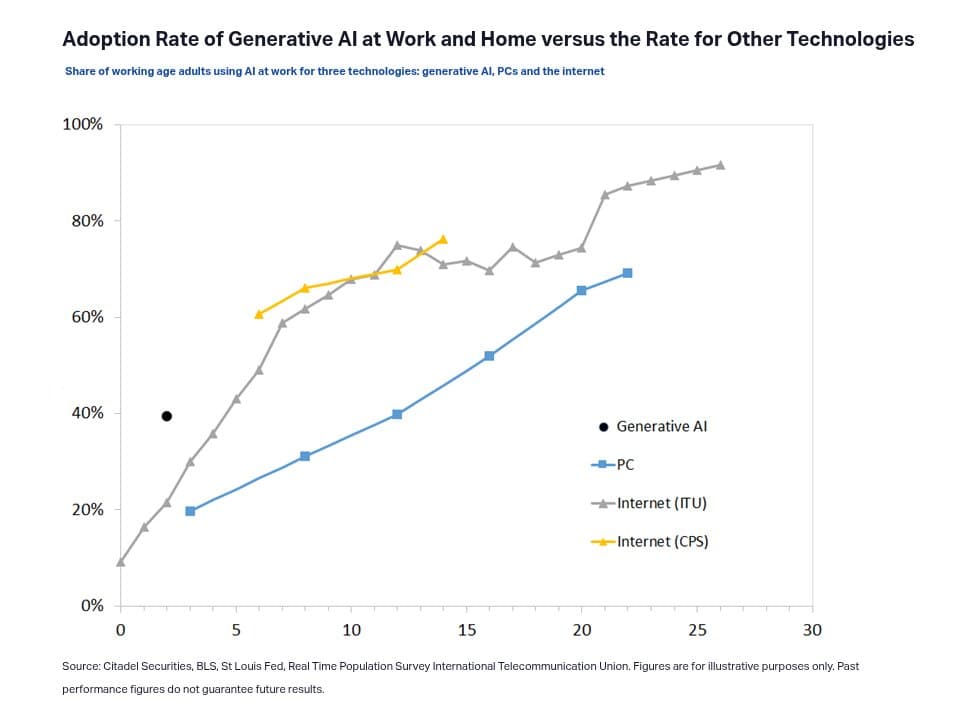
In a world captivated by narratives of exponential technological growth, one of finance's most influential quantitative trading firms has delivered a sobering counter-narrative. Citadel Securities, the market-making powerhouse founded by billionaire Ken Griffin, has published analysis suggesting that generative artificial intelligence adoption will follow a classic S-curve pattern—eventually plateauing rather than growing exponentially without bound.
This perspective, detailed in their "2026 Global Intelligence Crisis" report, challenges the dominant discourse surrounding AI's limitless potential and introduces critical physical and economic constraints into the conversation.
The S-Curve vs. Exponential Growth Debate
For years, AI enthusiasts have pointed to Moore's Law and similar technological acceleration patterns to support claims of exponential AI advancement. The narrative suggests that as AI systems improve, they'll recursively enhance themselves, creating a feedback loop of ever-increasing capabilities. This vision underpins both utopian dreams of artificial general intelligence and dystopian fears of uncontrollable superintelligence.
Citadel Securities offers a different framework rooted in economic history. The S-curve, or sigmoid function, describes how most technologies evolve: slow initial adoption, rapid acceleration during a growth phase, and eventual saturation as the technology matures and approaches natural limits. From automobiles to personal computers to smartphones, transformative technologies have followed this pattern rather than indefinite exponential growth.
"Economic and physical boundaries will halt exponential growth," the firm asserts, introducing tangible constraints to what has often been treated as a purely digital phenomenon.
The Physical Constraints of Digital Intelligence
The most compelling aspect of Citadel's analysis lies in its focus on the physical infrastructure required for AI advancement. While AI algorithms exist in the digital realm, their operation depends entirely on physical systems with real-world limitations:
Compute Power and Data Centers: Training and running large language models requires massive computational resources. The latest frontier models reportedly cost hundreds of millions of dollars to train, with inference costs adding ongoing operational expenses. As AI systems grow more sophisticated, their computational demands increase dramatically.
Energy Consumption: AI data centers are becoming significant energy consumers. Recent estimates suggest AI could account for 3-5% of global electricity consumption within a few years. This creates both economic constraints (energy costs) and physical ones (grid capacity, cooling requirements).
Economic Thresholds: Citadel introduces a crucial economic principle: "Once AI's operating costs exceed human labor costs, they expect businesses will stop substituting workers." This creates a natural ceiling for AI adoption in many applications. If automating a task costs more than paying a human to perform it, businesses have no economic incentive to pursue automation, regardless of how sophisticated the AI might be.
The Labor Displacement Paradox
Citadel's analysis reveals what might be called the "labor displacement paradox." While AI theoretically could replace vast numbers of human workers, actually achieving this displacement at scale requires overcoming significant physical and economic barriers:
Massive Infrastructure Investment: Replacing human workers with AI systems requires building out enormous computational infrastructure. Each displaced worker represents not just software but hardware, energy, and maintenance costs.
Diminishing Returns: As AI tackles more complex tasks, the computational requirements increase disproportionately. Simple automation might be cost-effective, but sophisticated cognitive tasks may remain economically unfeasible to automate.
Integration Costs: Beyond raw compute, integrating AI systems into existing workflows requires additional investment in compatibility, training, and oversight.
Implications for AI Investment and Development
This perspective has significant implications for how we think about AI's future:
Investment Realism: Venture capital and corporate investment in AI may need to adjust expectations from "infinite growth" to "managed growth with natural limits." This doesn't mean AI won't be transformative, but rather that its transformation will follow predictable economic patterns.
Policy Considerations: Governments planning for AI's impact on employment might find that displacement happens more slowly than anticipated, allowing more time for workforce transitions and retraining programs.
Environmental Impact: The energy demands of AI growth could become a limiting factor, potentially accelerating renewable energy adoption but also creating conflicts over resource allocation.
Geopolitical Dimensions: Nations with abundant, cheap energy and favorable conditions for data centers (cool climates, political stability) might gain competitive advantages in the AI era.
The 2026 Horizon
Citadel's reference to a "2026 Global Intelligence Crisis" suggests they see this transition happening relatively soon. While the exact timing is speculative, the underlying principle—that physical and economic constraints will shape AI adoption—represents a crucial corrective to more breathless AI narratives.
This doesn't diminish AI's transformative potential but grounds it in reality. Generative AI will likely revolutionize numerous industries, create new capabilities, and displace certain types of work. But it will do so within the boundaries of physics, economics, and human social systems.
A More Balanced AI Future
The value of Citadel Securities' perspective lies in its balance. It acknowledges AI's revolutionary potential while recognizing that revolutions eventually encounter countervailing forces. This more nuanced view allows for:
- More realistic business planning around AI adoption
- Better policy frameworks for managing AI's societal impact
- More sustainable investment strategies in AI infrastructure
- A clearer understanding of which applications will be economically viable
As we stand at what many believe is the beginning of the AI era, this grounded perspective offers a valuable alternative to both utopian and dystopian extremes. The future of AI may be transformative without being exponential, revolutionary without being limitless.
Source: Citadel Securities via @rohanpaul_ai on X/Twitter and citadelsecurities.com/news-and-insights/2026-global-intelligence-crisis/