What Happened
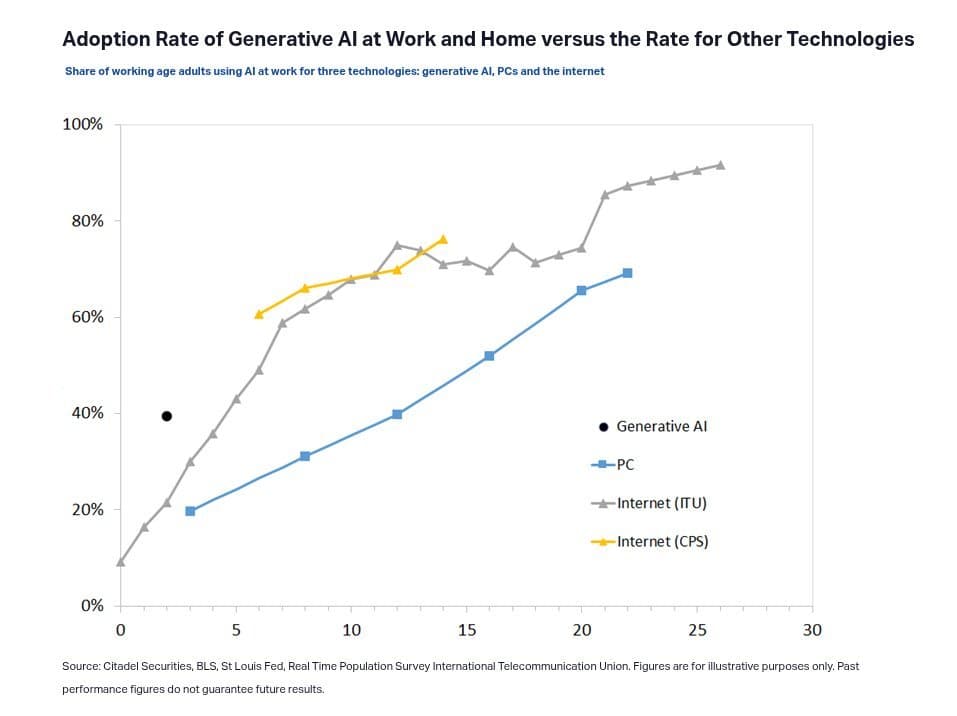
Citadel Securities, the quantitative trading and market-making firm, has published analysis arguing that the adoption of generative AI in the economy will follow a historical S-curve pattern—characterized by initial rapid growth, followed by a slowdown and eventual plateau—rather than continuing on an exponential trajectory indefinitely.
The firm's core thesis, shared in a post on X (formerly Twitter) by AI commentator Rohan Pandey and linked to a Citadel Securities insights page, is that economic and physical boundaries will act as a brake on exponential growth.
The Core Argument: Physical and Economic Constraints
Citadel Securities identifies three primary constraints that will limit the scale and speed of AI-driven automation:
- Massive Infrastructure Requirements: Displacing human labor at scale demands enormous compute power, data centers, and energy. The report suggests that if automation expands rapidly, the surging demand for compute will drive up its marginal cost.
- The Cost Crossover Point: The analysis posits a critical economic threshold: once the operating costs of AI systems exceed the cost of the human labor they are meant to replace, businesses will halt further substitution. This creates a natural ceiling for adoption based on pure economics, not just technical capability.
- Recursive Improvement vs. Physical Capital: Even if AI algorithms continue to improve recursively (a concept often associated with AI self-improvement leading to runaway intelligence), the report argues that physical capital limits and energy availability will prevent "infinite, frictionless economic adoption."
In essence, the argument shifts the focus from the software (algorithms) to the hardware (the physical world required to run them). The potential of AI may be vast, but its practical, economic deployment is bounded by the laws of physics, supply chains, and cost accounting.
Context and the "2026 Global Intelligence Crisis"
The analysis is linked to a Citadel Securities page titled "2026 Global Intelligence Crisis," which suggests the firm is modeling a near-term inflection point related to AI compute demand. While the full report details are not provided in the source, the title implies a forecast where the global demand for AI compute outstrips supply or economic viability around that timeframe, creating a "crisis" in scaling intelligence.
This perspective stands in contrast to more bullish, long-term forecasts of AI progress that often emphasize software breakthroughs and network effects while downplaying physical constraints. It aligns more closely with analyses from chip industry experts and energy researchers who highlight the growing material footprint of large-scale AI.