In an era where artificial intelligence systems grow increasingly complex, a surprising solution to one of AI's most persistent problems—context management—has emerged from computing history. According to research highlighted by AI developer Akshay Pachaar, the most effective approach to managing AI context might be treating everything like a file system, a concept borrowed directly from 50-year-old Unix philosophy.
The Fragmentation Problem in Modern AI
Most contemporary AI agent frameworks suffer from what Pachaar describes as a fundamental architectural flaw: memory is "bolted on as an afterthought," tools exist in separate layers, and everything remains "fragmented, short-lived, and impossible to audit when things go wrong." This fragmentation creates systems where information disappears silently between sessions, reasoning processes remain opaque, and debugging becomes nearly impossible when agents produce unexpected or incorrect outputs.
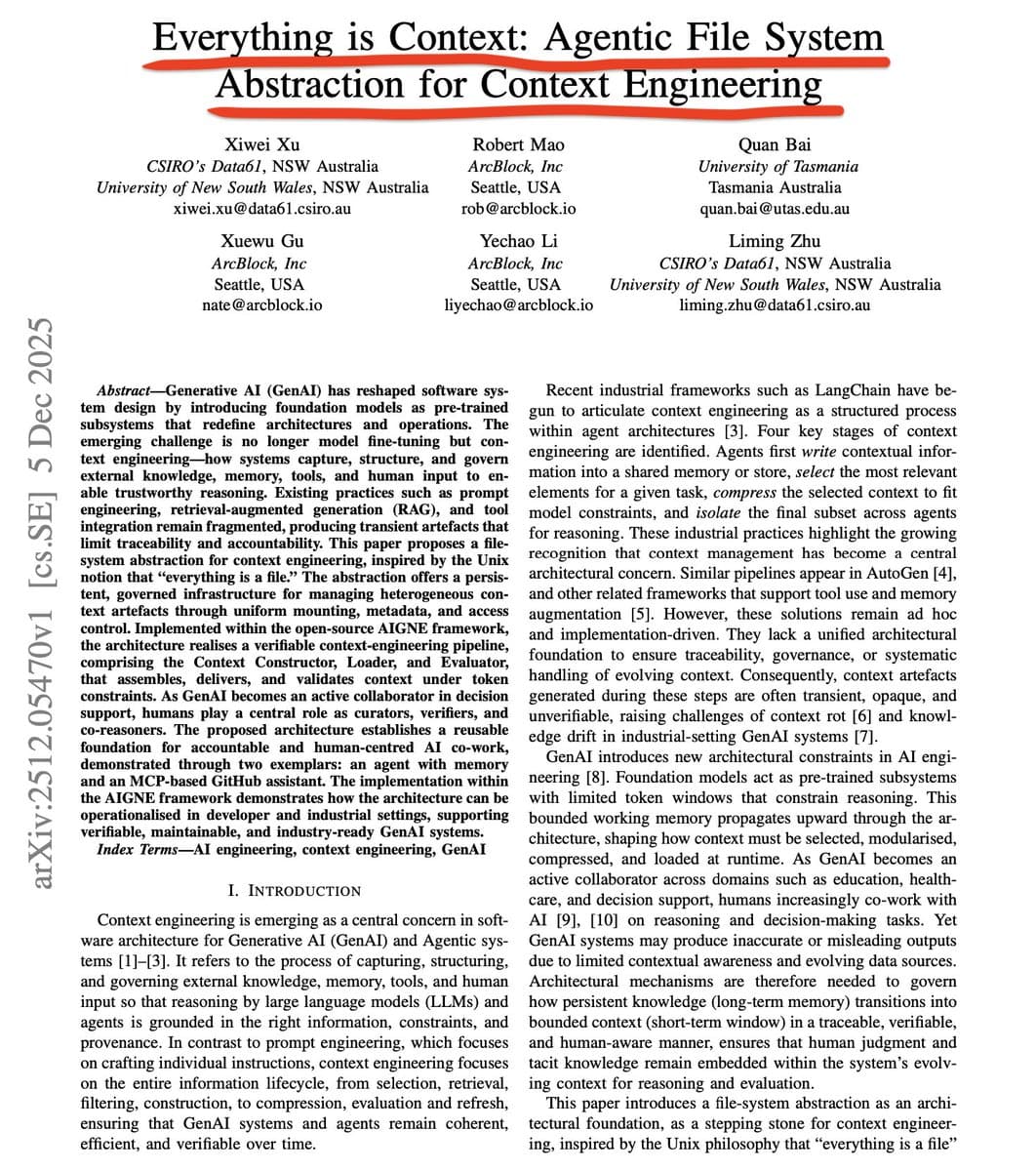
The paper "Everything is Context" proposes a radical simplification: instead of maintaining separate systems for memory, tools, and knowledge, store all of it as files. This approach, already implemented in the OpenClaw framework, creates AI systems where every piece of knowledge has a path, metadata, and version history, and every reasoning step becomes a logged, traceable transaction.
How the File System Approach Works
OpenClaw demonstrates this philosophy in practice. When you open an OpenClaw directory, you'll find plain Markdown files like SOUL.md, MEMORY.md, AGENTS.md, and HEARTBEAT.md sitting right there in the file system. These aren't just documentation files—they represent the actual operational components of the AI system.
The research formalizes OpenClaw's approach into three distinct stages:
The Context Constructor selects what's relevant from the file system and compresses it to fit within the model's token window constraints. This addresses the practical limitation of context length that plagues even the most advanced language models.
The Context Updater refreshes context as conversations and tasks evolve, ensuring the AI maintains coherence over extended interactions without losing track of important information.
The Context Evaluator writes verified knowledge back to disk, creating a persistent record of what the system has learned and confirmed through its operations.
Underneath this three-stage process, the file system organizes information into distinct categories: raw history, long-term memory, and short-lived scratchpads. Crucially, the model's prompt only loads the specific slice of information it needs at any given moment, optimizing performance while maintaining access to the complete historical record.
The Transparency Revolution
The most significant advantage of this approach might be its inherent transparency. Every access and transformation is logged with timestamps, creating a comprehensive trail showing exactly how information, tools, and human feedback shaped any given answer. When an AI agent forgets something or produces incorrect output, developers can simply open the relevant files and see exactly what the system knew at that moment.
This represents a fundamental shift from current approaches where AI reasoning often occurs in a "black box" that's difficult to inspect or understand. With the file system approach, nothing disappears silently between sessions—the complete operational history remains accessible for review, debugging, and improvement.
Implications for AI Development
This research suggests several important implications for the future of AI development:
Debugging and Auditing: The ability to trace exactly how an AI arrived at a particular conclusion could revolutionize debugging and make AI systems more trustworthy for critical applications.
Knowledge Persistence: By storing knowledge as files, AI systems can maintain continuity across sessions and even across different instantiations of the same system.
Tool Integration: Treating tools as files creates a more unified architecture where tools, memory, and reasoning processes exist within the same conceptual framework.
Human-AI Collaboration: The transparent file structure makes it easier for humans to understand, correct, and collaborate with AI systems.
Challenges and Considerations
While promising, this approach does present challenges. File system operations can introduce latency compared to in-memory operations, though clever caching strategies could mitigate this. Additionally, the approach requires rethinking how we architect AI systems from the ground up rather than incrementally improving existing frameworks.
Security considerations also become more complex when sensitive information is stored persistently in files rather than transiently in memory, though this also creates opportunities for more sophisticated access control and encryption at the file level.
The Broader Trend
This research fits within a broader trend of returning to proven computing paradigms to solve modern AI challenges. Just as containerization drew inspiration from earlier virtualization concepts, and microservices echoed earlier modular programming approaches, the file system approach to AI context represents another instance of computing history informing cutting-edge development.
The success of OpenClaw in implementing this philosophy suggests that sometimes the most innovative solutions aren't entirely new concepts but rather the thoughtful application of proven ideas to new domains. As AI systems grow more complex and integrated into critical applications, such approaches that prioritize transparency, auditability, and simplicity may become increasingly valuable.
For developers building with AI agents, this research offers both a practical framework and a philosophical shift in how we think about AI architecture. By embracing the Unix philosophy that "everything is a file," we might just solve some of the most persistent problems in modern AI development.