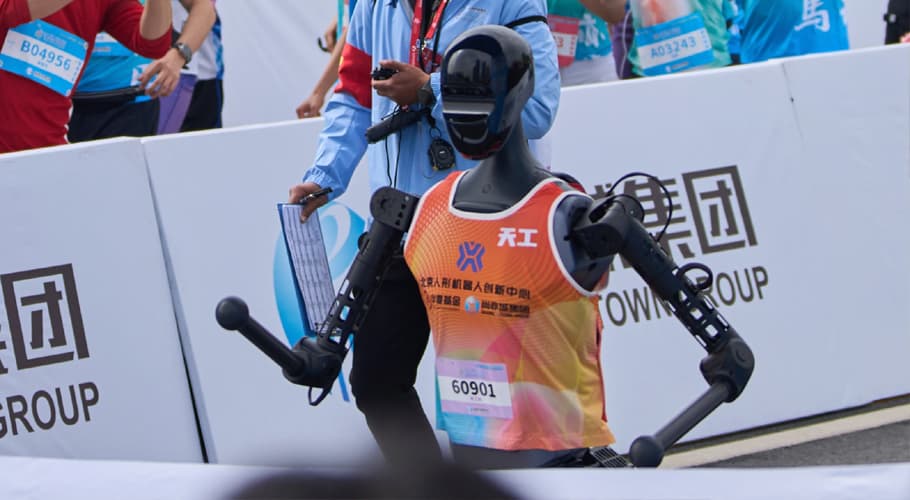
A humanoid robot named TienKung Ultra has won the “Best Design” award at the Beijing Humanoid Robot Half-Marathon, a competitive event showcasing the latest advancements in bipedal locomotion. The award specifically recognized that its motion "looks closer to natural human running than most competitors."
The robot successfully completed the full 21.1-kilometer (13.1-mile) half-marathon distance in 1 hour and 15 minutes. This public demonstration represents a significant benchmark for the endurance, stability, and energy efficiency of humanoid robots operating in unstructured, real-world environments.
Key Takeaways
- The TienKung Ultra humanoid robot won the 'Best Design' award at the Beijing Humanoid Robot Half-Marathon, recognized for its natural running motion.
- It completed the full 21.1 km course in 1 hour and 15 minutes.
What Happened
The Beijing Humanoid Robot Half-Marathon is an event designed to push the physical limits of bipedal robots. Unlike controlled lab tests or short demonstrations, a long-distance run over varied terrain presents a profound challenge for balance, joint actuation, power management, and gait control algorithms.
The TienKung Ultra robot distinguished itself not merely by finishing but by the quality of its movement. The "Best Design" award, as cited in the announcement, was granted based on the perception that its running kinematics more closely resemble natural human biomechanics compared to other entrants. This suggests advancements in its mechanical design and the underlying control software that generates its gait.
The Technical Benchmark: 21.1 km in 1:15:00
The core performance metric from the event is the completion time. Covering 21.1 km in 75 minutes translates to an average speed of approximately 16.9 km/h (10.5 mph). This pace is far beyond a walking speed and firmly in the realm of a sustained running gait, highlighting the robot's dynamic capabilities.
For context, a elite human male runner completes a half-marathon in roughly 60-65 minutes, while a good amateur time is around 1 hour 45 minutes. TienKung Ultra's performance sits meaningfully between these markers, representing a major leap from the hesitant, shuffling walks that characterized humanoid robots just a few years ago.
Why "Natural" Motion Matters
The emphasis on "natural" human-like motion is critical for several practical reasons:
- Energy Efficiency: Biomechanically inspired gaits tend to be more energy-efficient, leveraging passive dynamics like pendulum motion. This is essential for extending operational battery life.
- Stability and Adaptability: A natural, fluid gait can better handle minor irregularities in the ground surface and recover from perturbations.
- Social Acceptance & Safety: For robots intended to share human spaces (e.g., factories, homes, public areas), movement that is predictable and human-like is less likely to startle or collide with people.
- Hardware Durability: Jerky, unnatural motions place higher stress on actuators and joints. Smoother motion can reduce mechanical wear and tear.
Achieving this requires tight integration of hardware (lightweight yet strong limbs, high-torque actuators, efficient power systems) and software (reinforcement learning-trained control policies, real-time balance correction).
The Competitive Landscape for Humanoid Robots
This event occurs within a period of intense global competition in the humanoid robotics sector. While the source does not name the TienKung Ultra's developer, the performance places it as a notable contender. The field includes well-funded companies like Boston Dynamics (Atlas), Tesla (Optimus), Figure AI, Agility Robotics (Digit), and Sanctuary AI (Phoenix), alongside several prominent Chinese robotics firms.
Public endurance challenges like this marathon serve as a tangible, easy-to-understand metric for comparing progress, much like benchmark leaderboards (e.g., MMLU, GPQA) do in the AI language model space. They move beyond curated video clips to demonstrate sustained, real-world capability.
gentic.news Analysis
The TienKung Ultra's performance is a concrete data point in the accelerating trend toward capable, general-purpose humanoid robots. Completing a half-marathon is a systems engineering triumph that validates progress in mechanical design, actuator efficiency, and—most importantly—the AI control policies governing locomotion. The award for "natural" motion suggests its developers are prioritizing biomimetic control strategies, potentially using large-scale reinforcement learning in simulation, as pioneered by teams like Google DeepMind with its RT-2 and RoboCat work, before transferring to physical hardware.
This event aligns with the surge in investment and prototypes we've been tracking. For instance, our recent coverage of Figure AI's $2.75 billion valuation and partnership with BMW highlighted the auto industry's bet on humanoids for manufacturing. Similarly, Tesla's Optimus demonstrations have focused on dexterous manipulation, but endurance running is a different, equally vital pillar of physical competence. The Beijing marathon creates a public performance benchmark that other companies, including those in the West, will now be measured against.
The 1-hour 15-minute time sets a new public bar for sustained bipedal mobility. The next competitive frontiers will likely involve completing the course faster, on more challenging outdoor terrain, or while performing secondary tasks. This development directly pressures other labs and companies to publish similar end-to-end endurance results, moving the industry from hype videos to verifiable, quantitative benchmarks.
Frequently Asked Questions
Who built the TienKung Ultra robot?
The source material from the Beijing event does not specify the developing company or institution behind the TienKung Ultra robot. The focus of the announcement was on its award-winning performance. It is likely a project from a Chinese university lab, a research institute, or a robotics startup.
How does a 1 hour 15 minute half-marathon time compare to other robots?
This is one of the first publicly reported completion times for a humanoid robot over a standard half-marathon distance, making direct comparisons difficult. Most public benchmarks for humanoids focus on walking speed, manipulation tasks, or short agility courses. TienKung Ultra's time establishes a significant endurance benchmark that future competitors will aim to surpass.
What is the significance of a "natural" running gait for robots?
A natural, human-like gait is important for energy efficiency, stability on uneven ground, and safety when operating around people. Robots that move in a jerky or unnatural way waste more power, are more prone to falling, and can be unsettling or dangerous in shared environments. The award suggests TienKung Ultra's movement is mechanically smoother and more dynamically stable than its competitors.
What are the main challenges in getting a robot to run a half-marathon?
The primary challenges are power management (carrying enough battery capacity to run for over an hour), thermal management (preventing motors and electronics from overheating), dynamic balance (maintaining stability through thousands of running strides without falling), and hardware resilience (ensuring joints and actuators don't fail under prolonged, high-intensity use). Solving these requires advances across mechanical, electrical, and software engineering.