OpenAI publicly acknowledged early signs of recursive self-improvement (RSI) in current AI systems. The admission, shared via @kimmonismus, warns that AI development accelerated by AI itself will strain existing governance institutions.
Key facts
- OpenAI claims early signs of recursive self-improvement now.
- RSI means AI development accelerated by AI itself.
- OpenAI warns existing governance institutions are not ready.
- No specific systems, metrics, or timeline were disclosed.
- No other major lab has publicly confirmed RSI in production.
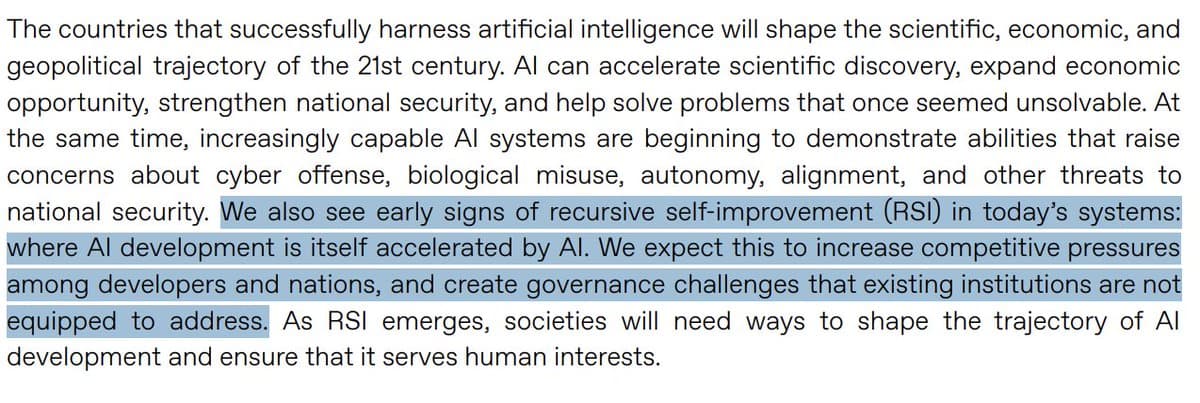
OpenAI has shifted its public posture on the trajectory of AI capabilities. In a statement shared by @kimmonismus on X, the company wrote: "We also see early signs of recursive self-improvement (RSI) in today’s systems: where AI development is itself accelerated by AI." According to @kimmonismus
The statement marks a rare explicit acknowledgment of a dynamic that researchers have long theorized but few labs have publicly confirmed in operational systems. OpenAI added: "We expect this to increase competitive pressures among developers and nations, and create governance challenges that existing institutions are not equipped to address."
RSI refers to a feedback loop where AI systems assist in designing, training, or improving subsequent AI systems, potentially accelerating progress beyond human-led development curves. The concept has been central to discussions of intelligence explosion and AI alignment for decades, but concrete evidence of its emergence has been sparse.
OpenAI did not provide specific examples, metrics, or a timeline for the RSI it claims to observe. The statement did not name which systems exhibit the behavior, how much acceleration has been measured, or whether the phenomenon is confined to OpenAI's internal research or observed across the broader field. The company's blog post or internal memo from which the quote originated has not been published publicly.
The timing is notable. OpenAI's admission comes amid intensifying competition from Anthropic, Google DeepMind, and Meta, each racing toward frontier models. If RSI is indeed measurable, it would imply that the gap between current capabilities and AGI could narrow faster than governance frameworks can adapt.
What the statement doesn't say
The absence of technical detail leaves significant ambiguity. RSI could range from LLMs helping write training infrastructure code to fully autonomous AI research agents proposing and running experiments. The difference in impact is orders of magnitude. OpenAI's phrasing — "early signs" — suggests the former, but the warning about governance implies they believe the trajectory is steep.
Governance implications
OpenAI's reference to "governance challenges that existing institutions are not equipped to address" echoes arguments made by alignment researchers since at least 2015. The novelty is that the company is now grounding that warning in claimed empirical observation rather than theoretical risk. If RSI is real and accelerating, traditional regulatory timelines — measured in years — may be irrelevant.
Industry context
No other major AI lab has publicly confirmed observing RSI in production systems. Anthropic has discussed the concept theoretically, and DeepMind has published research on AI-assisted AI design, but neither has issued a comparable operational warning. OpenAI's statement therefore represents a unilateral escalation of public risk framing, potentially intended to preempt regulation or to justify internal safety measures that would otherwise appear excessive.
What to watch
Watch for OpenAI to publish the full internal memo or blog post from which the RSI statement was excerpted. If Anthropic or DeepMind issue a comparable acknowledgment within 60 days, the dynamic is confirmed as industry-wide. If not, OpenAI's statement may be preemptive positioning ahead of regulatory hearings or fundraising.