What Happened
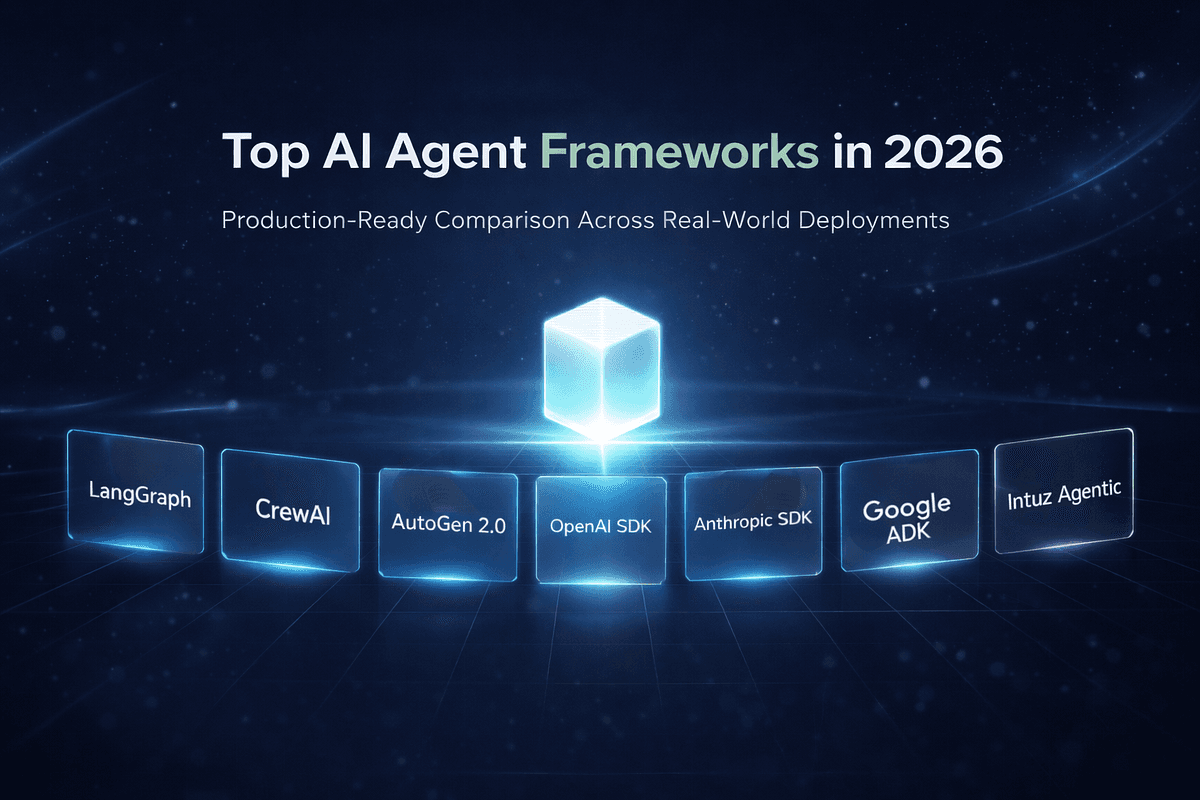
A new, production-focused evaluation of AI agent frameworks has been published, moving beyond toy examples to assess how these systems perform under real enterprise conditions. The analysis is based on deployments across seven enterprise clients in healthcare, logistics, fintech, and e-commerce during 2025-2026, testing frameworks against criteria that matter when systems go live: production reliability, observability, cost predictability, human-in-the-loop capability, ecosystem longevity, and team adoption speed.
The landscape has evolved dramatically from just six months ago when the conversation centered on LangGraph, CrewAI, and AutoGen. Today, every major AI lab ships its own agent SDK—OpenAI, Anthropic, and Google all launched agent development kits in 2026—resulting in over 120 agentic AI tools across 11 categories.
Technical Details: The 8 Frameworks That Matter
1. LangGraph — The Production Standard
LangGraph is LangChain's graph-based agent orchestration layer where agents are nodes and state flows through edges with conditional logic determining routing. The framework's key advantage is deterministic execution—every state transition is explicit, making compliance audits straightforward. In a healthcare deployment processing insurance prior authorizations, accuracy increased from 71% to 93% after implementing context isolation at the graph node level.
Strengths: Full control over agent flow, native human-in-the-loop capabilities, first-class streaming, LangSmith observability with full trace per graph run, state persistence across sessions, and massive ecosystem growth (126,000+ GitHub stars).
Weaknesses: Steeper learning curve, more boilerplate for simple use cases, and debugging complex graphs requires tracing skills most teams don't have initially.
2. CrewAI — The Fastest Path to a Working Demo
CrewAI uses a role-based abstraction where agents have names, goals, backstories, and tools. A crew of agents collaborates to complete tasks, passing outputs between roles and delegating when appropriate. This mental model clicks immediately with non-technical stakeholders. In an e-commerce content analysis pipeline deployment, time from concept to working demo was just three days.
Strengths: Fastest time-to-working-demo, role definitions readable by non-engineers, built-in delegation, sequential and hierarchical process modes, and growing ecosystem.
Weaknesses: Less control over exact execution flow compared to LangGraph, debugging delegation chains is non-trivial at scale, limited state management across long-running workflows, and no institutional backing comparable to other frameworks.
3. Microsoft AutoGen 2.0 — The Enterprise Async Engine
AutoGen is Microsoft Research's multi-agent conversation framework, rebuilt from scratch in version 2.0. The core concept involves agents communicating by exchanging messages in a conversation loop until they converge on a result. The 2.0 release introduced async-first architecture and a modular runtime.
Strengths: Async-first design for high-throughput workflows, modular runtime allowing custom execution engines, Microsoft's enterprise support and Azure integration, and strong academic foundation with research backing.
Weaknesses: Conversation-based debugging can be challenging, less intuitive for developers accustomed to sequential workflows, and the 2.0 ecosystem is still maturing compared to established alternatives.
4. OpenAI Agents SDK — The GPT-Native Solution
OpenAI's entry into the agent framework space leverages their models' native capabilities with tight integration to GPT-4o and other OpenAI models. The SDK emphasizes simplicity and rapid development for teams already committed to the OpenAI ecosystem.
Strengths: Seamless integration with OpenAI models and APIs, lower learning curve for OpenAI-centric teams, built-in tool calling patterns optimized for GPT models, and strong documentation with extensive examples.
Weaknesses: Vendor lock-in to OpenAI's ecosystem, limited flexibility for multi-model deployments, and less mature observability tooling compared to LangGraph's LangSmith.
5. Anthropic Agent SDK — The Claude-Optimized Approach
Following Anthropic's development of Claude Agent as a standalone product, their SDK provides a framework optimized for Claude models with a focus on safety and controlled execution. This aligns with Anthropic's constitutional AI principles and emphasis on building trustworthy systems.
Strengths: Optimized for Claude model capabilities, built-in safety controls and constitutional AI principles, strong focus on predictable execution patterns, and Anthropic's enterprise support structure.
Weaknesses: Newer to the market with less community adoption, primarily designed for Claude models rather than multi-model environments, and smaller ecosystem of pre-built tools and integrations.
6. Google ADK — The Vertex AI Integration
Google's Agent Development Kit (ADK) integrates tightly with Vertex AI and Google Cloud services, offering a cloud-native approach to agent development with built-in scalability and MLOps integration.
Strengths: Deep integration with Google Cloud services and Vertex AI, built-in scalability and MLOps tooling, support for Gemini models and embeddings, and enterprise-grade security and compliance features.
Weaknesses: Heavy Google Cloud dependency, less flexibility for hybrid or multi-cloud deployments, and steeper learning curve for teams not already in the Google ecosystem.
7. LlamaIndex Workflows — The Data-First Framework
LlamaIndex, traditionally focused on RAG and data indexing, has expanded into agent workflows with a data-first approach that emphasizes structured data handling and retrieval-augmented agentic patterns.
Strengths: Excellent data integration and structured data handling, strong RAG capabilities built-in, good for data-intensive agent workflows, and growing community around data-centric AI applications.
Weaknesses: Less mature as a general-purpose agent framework, narrower focus on data-heavy use cases, and smaller overall ecosystem compared to broader frameworks.
8. Intuz Agentic Framework — The Enterprise-First Contender
A newer entrant focusing specifically on enterprise requirements with built-in compliance tooling, audit trails, and governance controls designed for regulated industries.
Strengths: Enterprise-focused features out of the box, strong compliance and audit capabilities, designed for regulated industry workflows, and responsive to enterprise customer feedback.
Weaknesses: Smallest ecosystem and community, limited third-party integrations, unproven long-term viability, and higher cost for enterprise features.
Retail & Luxury Implications
For retail and luxury companies exploring AI agents, this comparison reveals several critical considerations:
E-commerce Deployment Patterns: The article specifically mentions using CrewAI for an e-commerce content analysis pipeline—a research agent, competitor analysis agent, and recommendation agent working as a crew. This demonstrates that multi-agent systems are already being deployed in retail contexts, particularly for market intelligence and content generation workflows.
Production Requirements for Retail: Luxury brands handling high-value transactions, customer personal data, or brand-sensitive communications need frameworks that offer:
- Deterministic execution for audit trails (LangGraph's strength)
- Human-in-the-loop capabilities for high-stakes decisions like personalized recommendations or customer service escalations
- Cost predictability given the volume of customer interactions in retail
- Observability to debug why a recommendation was made or a customer interaction failed
Framework Selection Strategy: The analysis suggests that retail teams should:
- Use CrewAI for rapid prototyping of customer service agents, product recommendation systems, or market analysis tools
- Graduate to LangGraph when scaling to production with requirements for audit trails, compliance, or complex multi-step workflows
- Consider vendor-specific SDKs (OpenAI, Anthropic) only if already deeply committed to that ecosystem and willing to accept vendor lock-in
- Evaluate AutoGen 2.0 for high-throughput async workflows like processing thousands of customer inquiries or social media mentions
Cost Considerations: With inference accounting for 55% of AI cloud spending ($37.5 billion in early 2026), retail companies must evaluate frameworks based on their cost control mechanisms. Frameworks that allow unbounded LLM calls in loops could lead to unpredictable expenses when deployed at retail scale.
Implementation Priorities: For luxury brands where brand voice consistency and customer experience quality are paramount, the human-in-the-loop capabilities and observability features become non-negotiable. The ability to pause agent workflows for human review and to trace exactly why an agent made a specific recommendation aligns with luxury's emphasis on quality control and personalized service.