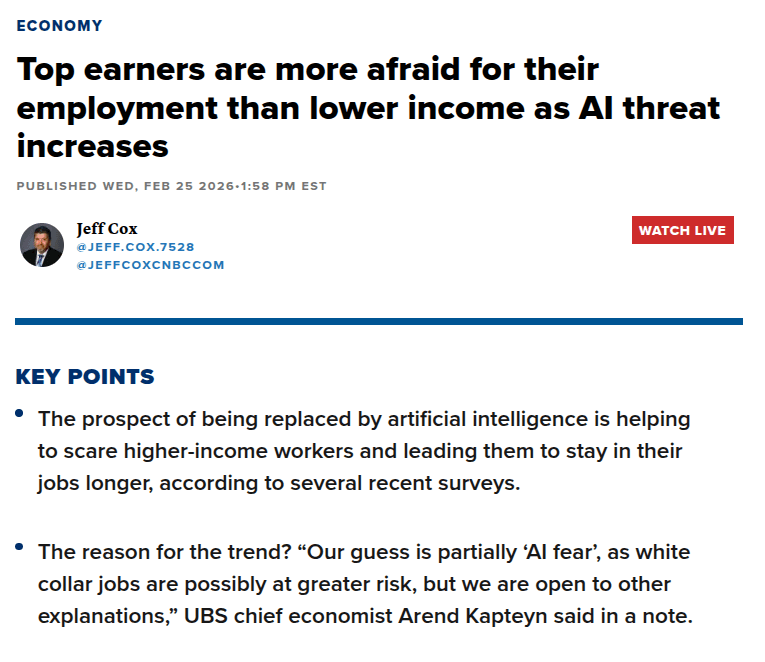
Recent survey and payroll data reveal a significant shift in white-collar worker behavior: high-income professionals are becoming increasingly anxious about job security as AI capabilities expand, leading to unprecedented declines in voluntary turnover.
What the Data Shows
Multiple economic indicators point to growing anxiety among top earners:
- University of Michigan Survey of Consumers: Confidence in the labor market among the top 33% of earners has fallen to levels not seen since the 1970s.
- New York Federal Reserve: Fear of becoming unemployed is hitting record highs for high-income workers.
- ADP Payroll Data: Quit rates in office-based roles like finance and business services have reached the lowest levels ever recorded as of February 2026.
The AI Connection
Economists at UBS attribute this trend directly to AI anxiety. High-paying professional roles typically involve data analysis, writing, and information processing—precisely the types of tasks where large language models and other AI systems have demonstrated rapid capability improvements.
This psychological impact persists despite favorable macroeconomic conditions. Unemployment in finance remains very low at 2.1%, suggesting that actual job losses haven't yet materialized at scale, but the perception of imminent technological displacement is changing worker behavior.
Behavioral Consequences
The data indicates workers are responding to perceived AI threats by becoming more risk-averse:
- Professionals are staying in current roles longer rather than seeking new opportunities
- Voluntary turnover has declined significantly in knowledge-work sectors
- Job market confidence has deteriorated despite strong employment numbers
This represents a reversal from previous economic cycles where higher-paid workers typically exhibited greater job mobility and confidence during periods of technological change.