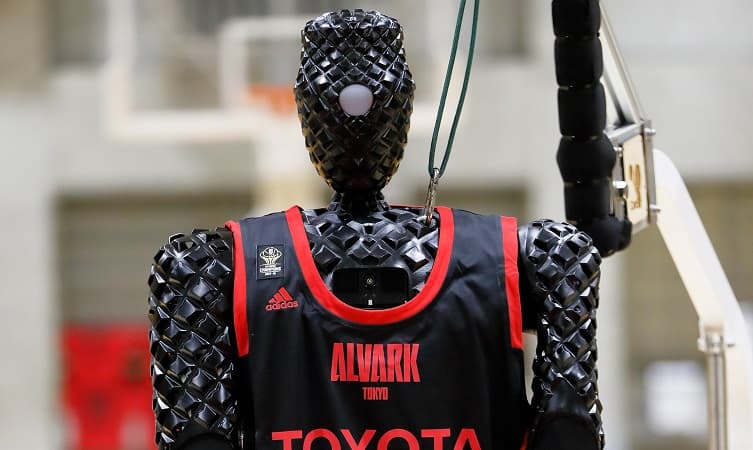
During halftime of a professional basketball game in Tokyo, Toyota's CUE7 robot rolled onto the court in front of 8,400 fans. The robot transitioned from a seated position to standing, dribbled a basketball smoothly, and successfully made free throws. The demonstration was a public showcase of the robot's mobility and dexterity in a dynamic, real-world environment.
Key Takeaways
- Toyota's CUE7 robot successfully performed dribbling and free throws during a live halftime show in Tokyo.
- The demonstration highlights advances in real-world, dynamic bipedal/wheeled robotics.
What Happened

The event took place at a halftime show for the Alvark Tokyo basketball team. The CUE7 robot, which stands 220 cm tall (approximately 7 feet 2 inches) and weighs 74 kg (163 lbs), used its wheeled base to navigate onto the court. Its core tasks—standing up, dribbling, and shooting—were executed autonomously, representing a significant step beyond controlled lab demos.
Technical Context of the CUE Series
The CUE7 is the latest iteration in Toyota's CUE robot basketball project, which began in 2018 with CUE1, a robot designed solely for free throws. Subsequent versions added capabilities like three-point shooting and dribbling. The series has served as a public-facing development platform for Toyota's robotics division, focusing on balance, precision actuator control, and sensor integration for dynamic tasks.
Key to this demonstration is the hybrid mobility system: a wheeled base for efficient navigation combined with a humanoid upper body and arms capable of complex, basketball-specific maneuvers. The robot's AI systems process real-time sensor data to adjust its balance and shooting trajectory.
Why This Demonstration Matters
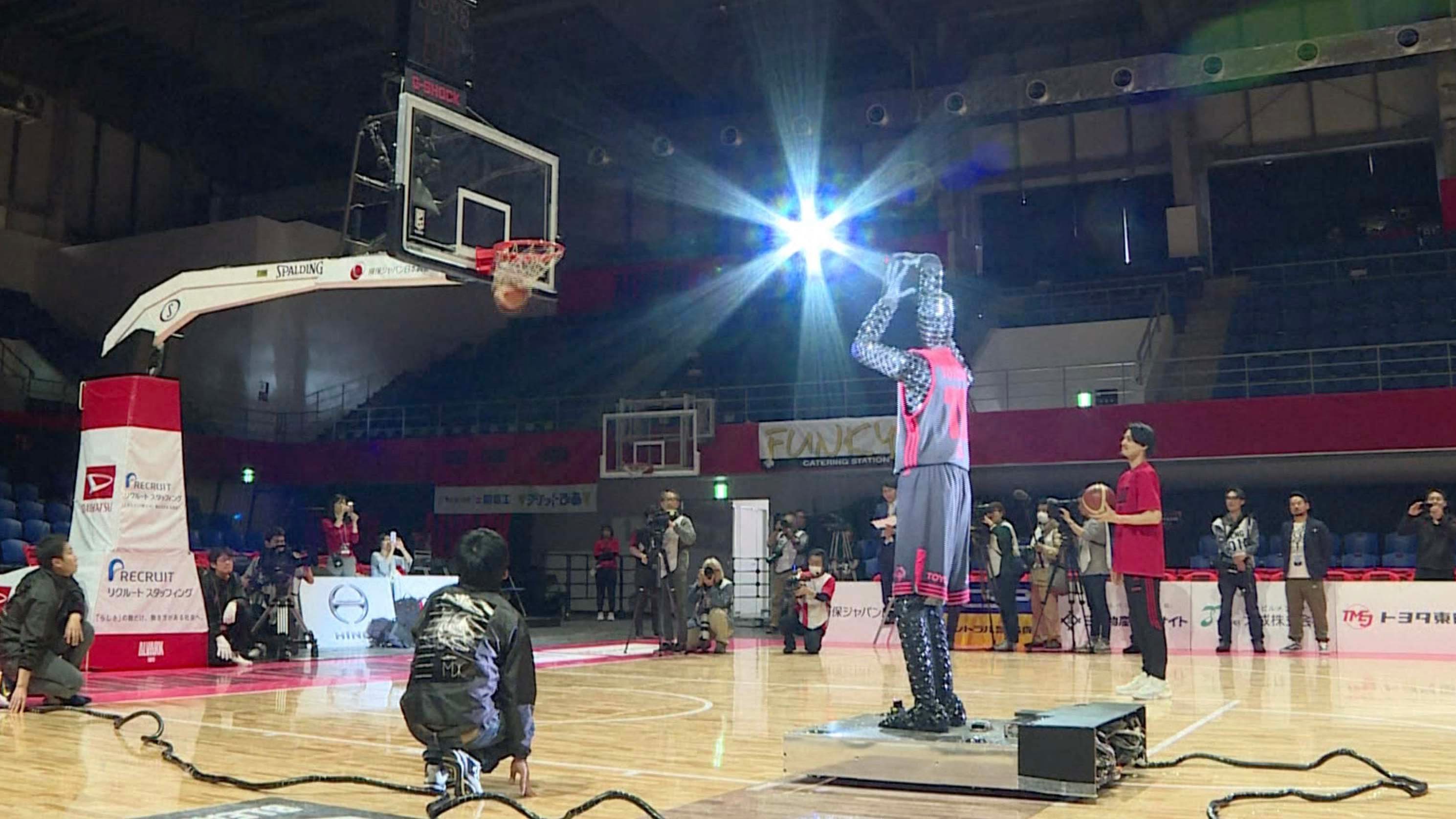
Public, one-shot demonstrations in noisy, unpredictable environments like a sports arena are high-stakes tests for robotic systems. Successfully performing a sequence of precise physical actions (standing, dribbling, shooting) under those conditions validates robustness in several areas:
- Balance and Stability: Transitioning from seated to standing on a wheeled base requires sophisticated weight distribution control.
- Object Manipulation: Dribbling a basketball involves continuous, adaptive force feedback, unlike a single gripping action.
- Target Accuracy: The free throw is a repeatable but high-precision task, testing the consistency of the robot's vision and motor control systems.
For Toyota, this serves a dual purpose: advancing core robotics research applicable to future mobility and assistive devices, and generating public engagement and brand visibility in advanced technology.
gentic.news Analysis
This public demo fits squarely within Toyota's established strategy of using athletic challenges to drive and showcase robotics innovation, a path also taken by Boston Dynamics with parkour and dancing. The CUE project has evolved from a single-task machine to a more integrated platform capable of multi-step routines. The choice of a live sports event as a testbed is notable; it introduces variables like crowd noise, arena lighting, and the pressure of a single-take performance that are absent from lab environments.
This event is a data point in the broader trend of humanoid and mobile robots transitioning from research prototypes to public ambassadors. While the tasks are niche, the underlying technologies—dynamic balance, real-time path planning, and dexterous manipulation—have direct read-across to more utilitarian applications Toyota is pursuing, such as home assistance and logistics support. The demonstration suggests Toyota's robotics software stack is maturing to handle longer, more complex action chains reliably.
It also serves as a soft counter-narrative to the purely humanoid form factor dominating current commercial hype. CUE7's wheeled base is a pragmatic design choice for indoor environments, prioritizing function over biomimicry. As the industry debates the optimal platform for general-purpose robots, Toyota continues to explore a spectrum of solutions.
Frequently Asked Questions
What is the Toyota CUE robot?
The Toyota CUE is a series of humanoid robots specifically designed to play basketball. The project started in 2018, with each iteration adding new skills like three-point shots and dribbling. The CUE7 is the latest model, demonstrated in April 2026.
How does the CUE7 robot make a free throw?
The robot uses a combination of computer vision to locate the basket and precise motor control in its arms and torso to execute a consistent shooting motion. Its AI calculates the necessary trajectory and force to score, adjusting for its own posture and balance.
Is Toyota building robots for basketball?
Not commercially. The CUE project is a research and development platform. The challenges of shooting and dribbling a basketball drive innovation in balance, object manipulation, and sensor integration—skills that are transferable to assistive, industrial, and logistics robots.
What are the specs of the Toyota CUE7 robot?
According to the demonstration, the CUE7 robot is 220 centimeters (7.2 feet) tall, weighs 74 kilograms (163 pounds), and uses a wheeled base for mobility. It features a humanoid upper body with articulated arms and hands designed for ball handling.