A new automated framework called "Recovered in Translation" is making waves in the machine translation community by applying test-time compute scaling to benchmark translation tasks. The system generates multiple translation candidates and intelligently ranks them using USI (Uncertainty Sampling Integration) and T-RANK (Translation Ranking) techniques, producing outputs that large language model judges prefer 4:1 over existing translation resources.
The Core Innovation: Test-Time Compute Scaling
Traditional machine translation systems typically generate a single output for each input sentence, with quality limited by the model's architecture and training data. The "Recovered in Translation" framework fundamentally changes this approach by applying test-time compute scaling—essentially investing more computational resources during the inference phase rather than just during training.
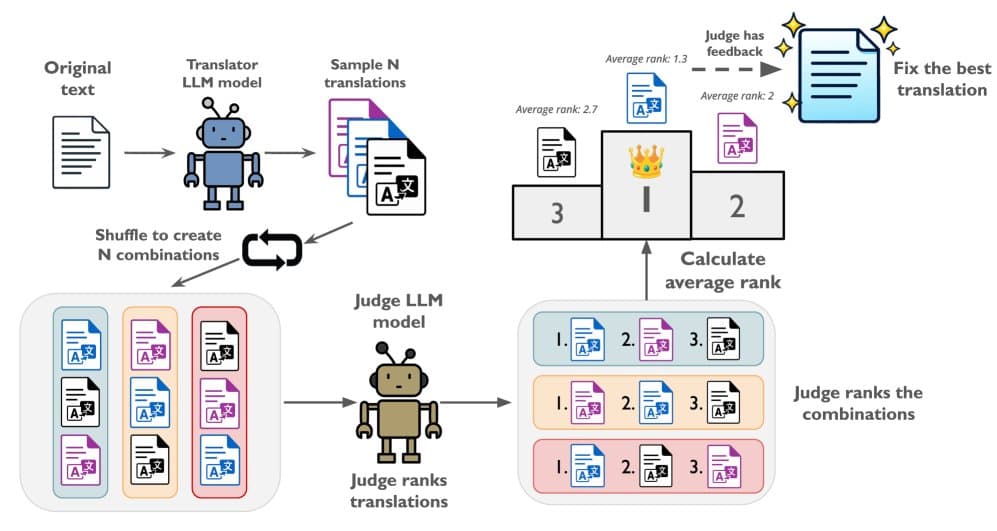
The system works by generating multiple potential translations for each source sentence, then applying sophisticated ranking algorithms to select the best candidate. This approach recognizes that translation is inherently ambiguous—there are often multiple valid ways to express the same meaning in another language—and leverages this ambiguity to produce higher quality outputs.
Technical Architecture: USI & T-RANK Ranking Systems
The framework employs two key ranking methodologies:
USI (Uncertainty Sampling Integration) evaluates translation candidates based on their confidence scores and linguistic uncertainty metrics. This helps identify translations that are not only accurate but also stylistically appropriate and contextually aware.
T-RANK (Translation Ranking) uses more sophisticated linguistic analysis, potentially incorporating semantic similarity measures, fluency assessments, and domain-specific appropriateness criteria. The combination of these ranking systems allows the framework to select translations that excel across multiple dimensions of quality.
Performance Metrics: 4:1 Preference Ratio
The most striking result from the framework is the 4:1 preference ratio reported by LLM judges. When presented with translations from the "Recovered in Translation" system alongside those from conventional translation resources, large language models consistently preferred the new framework's outputs four times more often.
This preference ratio suggests significant improvements in translation quality across multiple dimensions, including:
- Accuracy: More faithful representation of source content
- Fluency: More natural-sounding target language output
- Style: Better preservation of tone, register, and stylistic elements
- Contextual appropriateness: Better adaptation to domain and situational context
Implications for Machine Translation
The success of "Recovered in Translation" has several important implications for the field of machine translation:
1. Paradigm Shift in Resource Allocation: The framework demonstrates that investing computational resources at test time (during translation) can yield greater quality improvements than equivalent investments in model size or training data alone.
2. Quality Benchmarking: The 4:1 preference ratio establishes a new benchmark for translation quality that existing systems will need to match or exceed.
3. Practical Applications: Higher quality translation has immediate applications in global communication, content localization, cross-cultural research, and multilingual business operations.
Challenges and Considerations
Despite its impressive performance, the "Recovered in Translation" framework faces several challenges:
Computational Cost: Generating and ranking multiple translation candidates requires significantly more computational resources than single-output systems. This could limit real-time applications or deployment in resource-constrained environments.
Evaluation Methodology: While LLM judges provide valuable quality assessments, human evaluation remains the gold standard for translation quality. Further validation with human translators and bilingual speakers would strengthen the framework's claims.
Generalization: The framework's performance across different language pairs, domains, and text types needs further investigation to determine its broad applicability.
Future Directions
The "Recovered in Translation" framework opens several promising research directions:
Hybrid Approaches: Combining test-time compute scaling with improvements in model architecture and training methodologies could yield even greater quality gains.
Efficiency Optimization: Developing more efficient candidate generation and ranking algorithms could reduce computational costs while maintaining quality improvements.
Specialized Applications: Adapting the framework for specific domains (legal, medical, literary translation) or challenging language pairs could address current limitations in specialized translation tasks.
Conclusion
The "Recovered in Translation" framework represents a significant advancement in machine translation methodology. By shifting computational investment to the inference phase and leveraging intelligent ranking of multiple translation candidates, it achieves quality improvements that LLM judges prefer 4:1 over existing resources.
This approach challenges conventional wisdom about where to allocate resources in translation system development and suggests that test-time compute scaling may be an underutilized strategy for improving AI system performance more broadly. As the framework undergoes further development and validation, it could establish new standards for translation quality and inspire similar approaches in other natural language processing tasks.
Source: HuggingPapers/X post about "Recovered in Translation" framework (https://x.com/HuggingPapers/status/2028443595905151462)