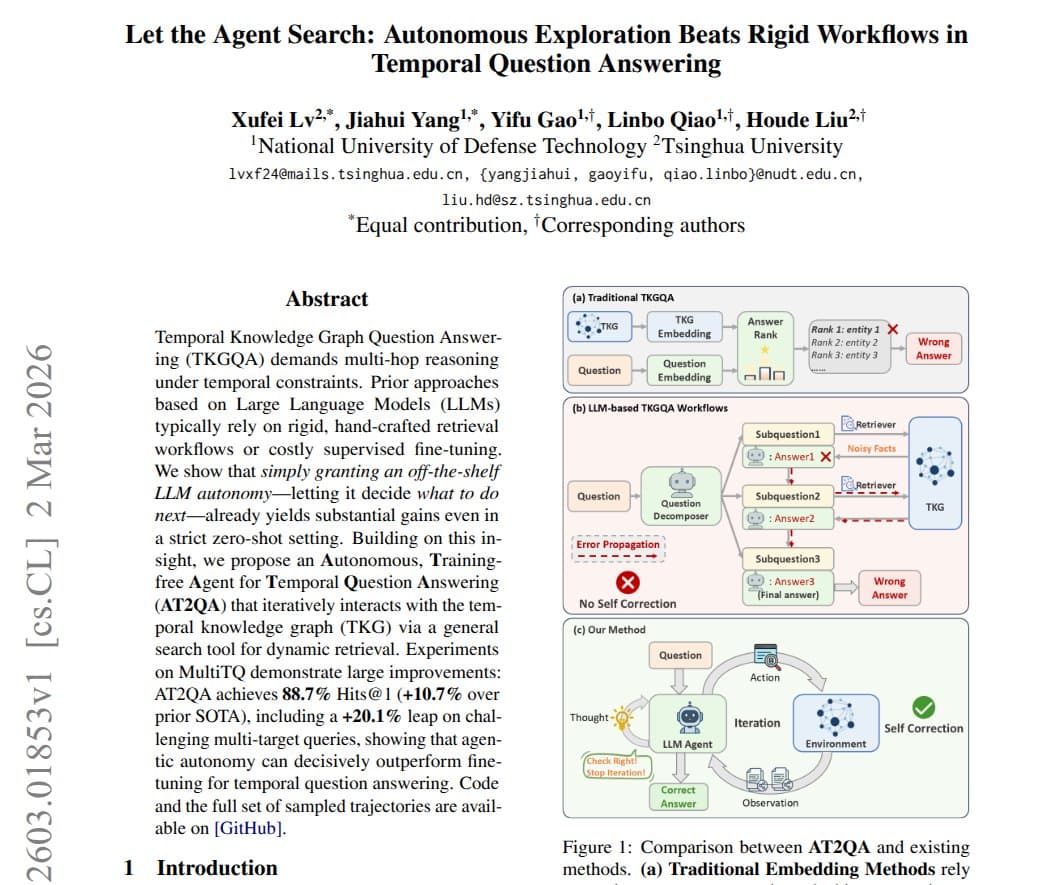
A groundbreaking study from Tsinghua University has revealed a paradigm shift in how large language models (LLMs) should handle temporal information. The research, detailed in the paper "Let the Agent Search: Autonomous Exploration Beats Rigid Workflows in Temporal Question Answering," demonstrates that giving standard LLMs the freedom to autonomously search temporal data significantly outperforms both rigid pipeline approaches and expensive fine-tuned models specifically trained for time-sensitive tasks.
The Problem with Current Temporal Approaches
Current systems for answering questions that depend on changing facts typically rely on pre-programmed search pipelines with fixed workflows. These rigid architectures follow predetermined steps to retrieve and process temporal information, but they suffer from a critical weakness: if the initial search guess is incorrect, the entire system breaks down. This brittleness has led developers to invest substantial resources in fine-tuning models specifically for temporal reasoning, attempting to teach them how to handle dates, events, and facts that change over time through expensive training processes.
According to the Tsinghua researchers, this represents a massive misallocation of resources. The paper suggests that "developers have wasted massive amounts of money fine-tuning models to understand facts that change over time" when a simpler, more effective approach exists.
The Autonomous Search Solution
The Tsinghua team proposed a radically different approach: instead of forcing LLMs through rigid workflows or spending millions on specialized training, they simply gave a standard LLM a basic search tool and allowed it complete autonomy over when and what to search. This "let the agent search" methodology enables the model to independently decide when information retrieval is necessary, what queries to formulate, and how to interpret the results.
The system operates through a self-correcting mechanism where the LLM can review retrieved facts and rewrite its own search queries if the initial evidence doesn't make sense. This creates a dynamic, adaptive process where the model essentially controls its own research process rather than following predetermined steps.
Performance Breakthrough
The researchers tested their autonomous search approach on a massive dataset of time-based questions, comparing it against the best existing fine-tuned systems. The results were striking: the standard LLM with search autonomy achieved 88.7% accuracy, beating the previous best fine-tuned system by a remarkable 10.7% margin.
This performance gap is particularly significant because it was achieved without any specialized training for temporal reasoning. The standard LLM, when given the freedom to control its own search process, demonstrated superior temporal understanding compared to models specifically engineered and trained for that purpose.
Implications for AI Development
This research challenges fundamental assumptions about how to equip LLMs with temporal reasoning capabilities. The findings suggest that:
Cost Efficiency: Organizations can achieve better temporal reasoning without expensive fine-tuning processes that require substantial computational resources and expertise.
Flexibility: Autonomous search systems are more adaptable to different types of temporal questions and can handle unexpected information needs without system redesign.
Scalability: This approach can be implemented with existing LLMs and search infrastructure, making it accessible to a wider range of developers and organizations.
Reasoning Preservation: By allowing LLMs to control their own search process, we preserve their inherent reasoning capabilities rather than constraining them within rigid workflows.
The paper indicates that LLMs already possess the reasoning capabilities necessary for temporal understanding—they simply need the freedom to exercise those capabilities through autonomous information gathering.
Future Directions and Applications
While the research focused specifically on temporal question answering, the implications extend far beyond this domain. The principle of granting LLMs autonomy over their information retrieval processes could revolutionize how we approach:
- Fact-checking systems that need to verify information against changing databases
- Financial analysis tools that must process time-sensitive market data
- Scientific research assistants that need to navigate evolving knowledge bases
- Customer service applications that require up-to-date product or policy information
The Tsinghua approach represents a shift toward more agentic AI systems that can independently manage their knowledge acquisition rather than relying on pre-structured information pipelines. This could lead to more robust, adaptable AI applications across numerous domains where information changes over time.
Source: Tsinghua University paper "Let the Agent Search: Autonomous Exploration Beats Rigid Workflows in Temporal Question Answering" (arXiv:2603.01853)