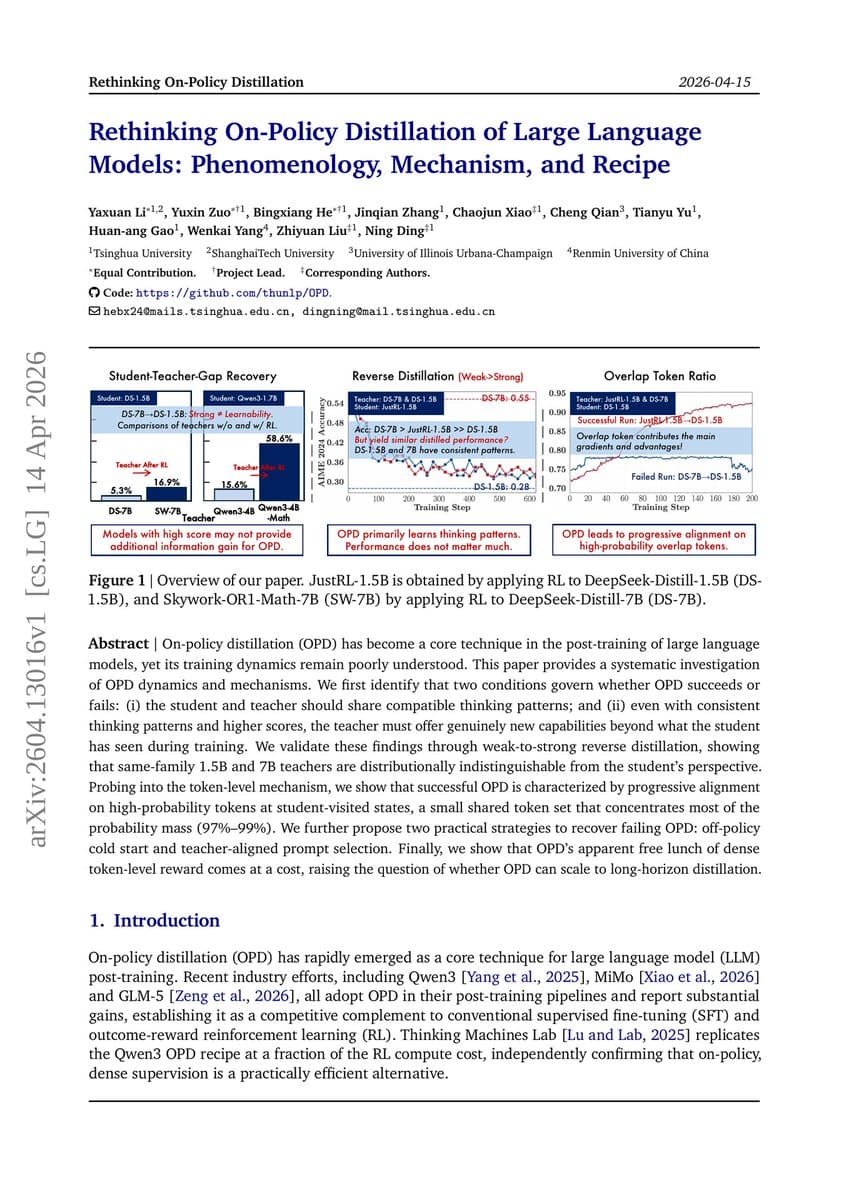
A research team from Tsinghua University has published work identifying the precise conditions under which on-policy distillation (OPD)—a technique for transferring capabilities from a larger teacher model to a smaller student model by having the student learn from the teacher's own outputs—fails to converge or produces poor performance. More importantly, they propose two concrete methods to diagnose and recover failing distillation runs, a common and costly problem in model compression.
The core finding is that successful OPD requires two conditions that are often not met:
- Compatible Thinking Patterns: The student model must be architecturally and functionally capable of mimicking the teacher's reasoning process on the target task. A mismatch in "thinking" leads to incoherent learning signals.
- Novel Teacher Capabilities: The teacher must possess knowledge or skills that the student does not already have. Distilling already-known information is inefficient and can lead to regression or instability.
When these conditions are violated, standard OPD training diverges, plateaus at poor performance, or produces a student that is worse than one trained from scratch.
Key Takeaways

- Researchers from Tsinghua University have pinpointed two necessary conditions for successful on-policy distillation: compatible thinking patterns and novel teacher capabilities.
- They propose two recovery methods to salvage failing distillation runs.
The Proposed Recovery Framework
To address these failure modes, the researchers propose a two-stage recovery framework.
1. Off-Policy Cold Start
Instead of beginning distillation with the student learning directly from the teacher's on-policy outputs (which may be incomprehensible to the poorly-initialized student), this method uses a high-quality, off-policy dataset to warm up the student. This dataset could be curated human demonstrations, high-scoring outputs from a different model, or filtered data from the teacher itself. The goal is to first bring the student's "thinking patterns" into rough alignment with the task demands, satisfying the first condition before engaging in full on-policy learning.
2. Teacher-Aligned Prompt Selection
To ensure the teacher is providing novel capabilities (the second condition), this method involves dynamically selecting prompts or training examples where the teacher demonstrably outperforms the current student. By focusing the distillation loss on these high-value gaps, the training signal is maximized, and the student avoids wasting capacity re-learning what it already knows. This requires a lightweight evaluation mechanism to compare teacher and student outputs during training.
Why This Matters for Practitioners

On-policy distillation is a cornerstone technique for creating smaller, faster, and cheaper models that retain the prowess of large foundation models. Failures are expensive, wasting thousands of GPU hours. This work moves the practice from alchemy to a more diagnostic engineering discipline.
- Diagnostic Tool: The two conditions provide a checklist for engineers when a distillation run underperforms. Is it a capability mismatch (Condition 1) or a lack of novel signal (Condition 2)?
- Salvaging Investment: The recovery methods offer a path to rescue a failing run rather than aborting it, potentially saving significant computational resources.
- Efficiency: Teacher-aligned prompt selection makes training more sample-efficient by focusing on the most informative data points.
gentic.news Analysis
This research tackles a pervasive but under-discussed pain point in industrial LLM development: the unreliable nature of knowledge distillation. While entities like Google (with its DistillBERT, and more recently, its Gemini Nano models) and Meta (with its Llama family and compression efforts) have advanced the state-of-the-art in creating smaller models, the training process remains fraught with instability. This Tsinghua work provides a formalized, causal explanation for failures that were previously attributed to hyperparameters or random seed variance.
The focus on "thinking pattern compatibility" subtly reinforces a trend we are seeing across the field: a shift from mere output mimicry to process mimicry. This aligns with growing interest in chain-of-thought distillation and process supervision, where the student learns the teacher's reasoning steps, not just its final answers. The Tsinghua team's work can be seen as a foundational step in making this type of distillation more robust.
Furthermore, this research has immediate implications for the booming market of fine-tuning and distillation-as-a-service offered by platforms like Together AI, Replicate, and Modal. These services promise to turn a large model into a specialized, efficient one. This paper arms their engineers with a better methodology to increase success rates and consistency, a key competitive advantage. If the recovery methods are as effective as claimed, we should see them integrated into popular training frameworks like Axolotl or LLaMA-Factory in the near term.
Frequently Asked Questions
What is on-policy distillation?
On-policy distillation is a training method where a smaller "student" model learns to imitate a larger "teacher" model by trying to match the teacher's outputs for a given input. The teacher generates these outputs specifically during the training process (on-policy), as opposed to using a static dataset of pre-generated answers (off-policy).
Why does on-policy distillation fail so often?
According to this research, failure primarily occurs when two conditions aren't met. First, if the student model's architecture is too simple or different to replicate the teacher's complex reasoning path (incompatible thinking). Second, if the teacher isn't providing new knowledge the student needs, causing the student to learn a noisy or redundant signal.
What is an "off-policy cold start"?
It's a recovery technique where you initially train the student model on a high-quality, static dataset (off-policy) instead of the teacher's live outputs. This stabilizes the student and aligns its basic capabilities with the task before switching to the more challenging on-policy distillation phase.
How does teacher-aligned prompt selection work?
During training, the system continuously evaluates whether the teacher's response to a given prompt is significantly better than the student's current response. It then prioritizes using those specific teacher-student pairs where a large gap exists for the distillation loss, ensuring the student focuses on learning what it doesn't already know.