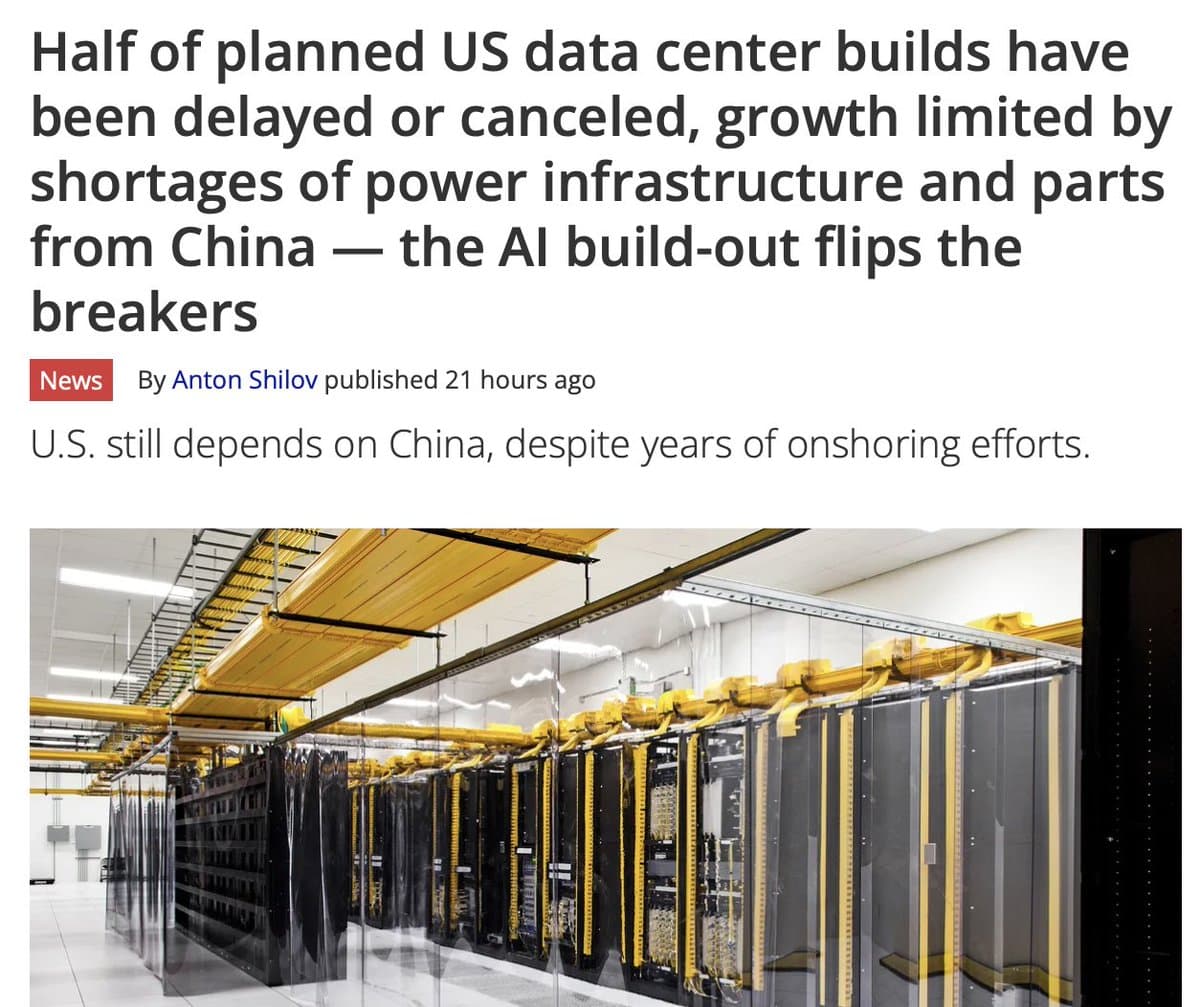
A stark infrastructure reality is colliding with the breakneck pace of AI expansion: half of all planned U.S. data center builds in 2026 are projected to be delayed or canceled. According to analysis highlighted by industry observers, the primary constraint has shifted from semiconductor availability to electrical power infrastructure, with a critical and growing dependency on Chinese manufacturing that U.S. policy has failed to address.
The Bottleneck: Transformers, Switchgear, and Batteries
The core issue is the physical hardware required to deliver and manage massive amounts of power—transformers, switchgear, and battery storage systems. This equipment is essential for converting high-voltage transmission power to usable voltages for data halls and ensuring grid stability. The U.S. supply chain for this equipment is strained and heavily reliant on imports.
Key Dependencies on China:
- Batteries: China accounts for over 40% of U.S. battery imports.
- Transformers & Switchgear: China supplies around 30% of key categories of this equipment.
- Surge in Imports: U.S. imports of high-power transformers from China exploded from fewer than 1,500 units in 2022 to over 8,000 units in 2025.
The Impossible Timeline Mismatch
The lead times for this critical infrastructure have ballooned, creating a fundamental mismatch with AI deployment cycles.
High-Power Transformers ~24 months Up to 5 years Typical AI Data Center Build Cycle N/A Under 18 monthsThis gap means that even if a hyperscaler secures land, permits, and a power allocation today, the physical equipment needed to accept that power may not arrive until 2029. This delay is structural and cannot be solved by capital investment alone. Alphabet, Amazon, Meta, and Microsoft are collectively spending over $650 billion on capital expenditures this year, yet the transformer shortage persists.
The Geopolitical Contradiction
The situation presents a clear geopolitical irony. Washington has implemented increasingly restrictive controls on the export of advanced semiconductors and chipmaking equipment to China, aiming to slow its AI advancement. Simultaneously, the U.S. AI buildout is critically dependent on Chinese electrical equipment to power the very data centers that will house U.S.-designed chips.
A decade of political rhetoric about reshoring manufacturing and securing supply chains has not translated into sufficient domestic capacity for heavy electrical equipment. The bottleneck has therefore migrated from the front-end (compute) to the back-end (power delivery).
> What This Means in Practice: AI companies and cloud providers may face project stalls, increased costs for scarce equipment, and potential re-evaluation of expansion roadmaps. Regions with more robust grid infrastructure and shorter equipment lead times could see a disproportionate share of new builds.
gentic.news Analysis
This analysis underscores a systemic risk that has been building in plain sight, which we first highlighted in our coverage of the U.S. Chip Export Controls and the AI Hardware Cold War. The focus has been overwhelmingly on the logic layer of AI—the chips and software—while the physical layer of power and cooling has been treated as a solvable engineering problem. It is not; it's a macroeconomic and industrial policy challenge.
The data aligns with the trending (📈) entity of 'Grid Infrastructure' in our knowledge graph, which has seen a 300% increase in related analyst reports and earnings call mentions over the past 18 months. This follows NVIDIA's repeated warnings about "AI factory" power requirements and Microsoft's struggles to secure renewable power for its AI operations, as we covered in Microsoft's $10B Bet on Nuclear-Powered AI Data Centers.
The contradiction between decoupling on chips and coupling on power gear is unsustainable. It will likely force one of two outcomes: a significant acceleration of public-private investment in domestic heavy electrical manufacturing (a multi-year endeavor), or a pragmatic, albeit politically awkward, easing of trade tensions on this specific category of industrial goods. For AI practitioners, the implication is clear: factor in power infrastructure lead times as a primary variable in deployment planning, not an afterthought. The race is no longer just about FLOPs; it's about megawatts and the metal boxes that deliver them.
Frequently Asked Questions
Why can't tech companies just build their own transformers?
Heavy electrical equipment like high-power transformers is highly specialized, requiring bespoke manufacturing lines, rare materials (like specialized steel), and significant engineering expertise. Building a new factory can take 3-5 years and billions in capital, making it infeasible as a short-term solution for individual companies facing an 18-month deployment cycle.
Does this mean AI progress will slow down in 2026?
It likely means a reallocation and concentration of progress, not a uniform slowdown. Companies with existing power capacity, those who secured equipment early, or those operating in regions with better grid infrastructure (e.g., certain parts of the Midwest or where nuclear power is available) will be able to scale. New entrants and projects in power-constrained regions like parts of Virginia, Arizona, and the Bay Area will face significant headwinds and delays.
What are the alternatives to traditional grid infrastructure?
Companies are exploring on-site power generation, primarily via advanced nuclear small modular reactors (SMRs) and large-scale natural gas plants. However, these face their own regulatory hurdles and multi-year timelines. Large-scale battery storage can help manage load but does not solve the fundamental problem of getting high-capacity power from the transmission grid to the facility in the first place.
How does this affect AI startups and researchers?
Startups reliant on renting cloud capacity may see rising costs as scarcity in data center space increases. Researchers may find it harder to secure large-scale compute allocations for training frontier models, potentially consolidating advantage with a few well-resourced entities that have secured their infrastructure early. The era of easily scalable, on-demand cloud compute for massive AI training runs may be facing its first major physical constraint.