What Happened
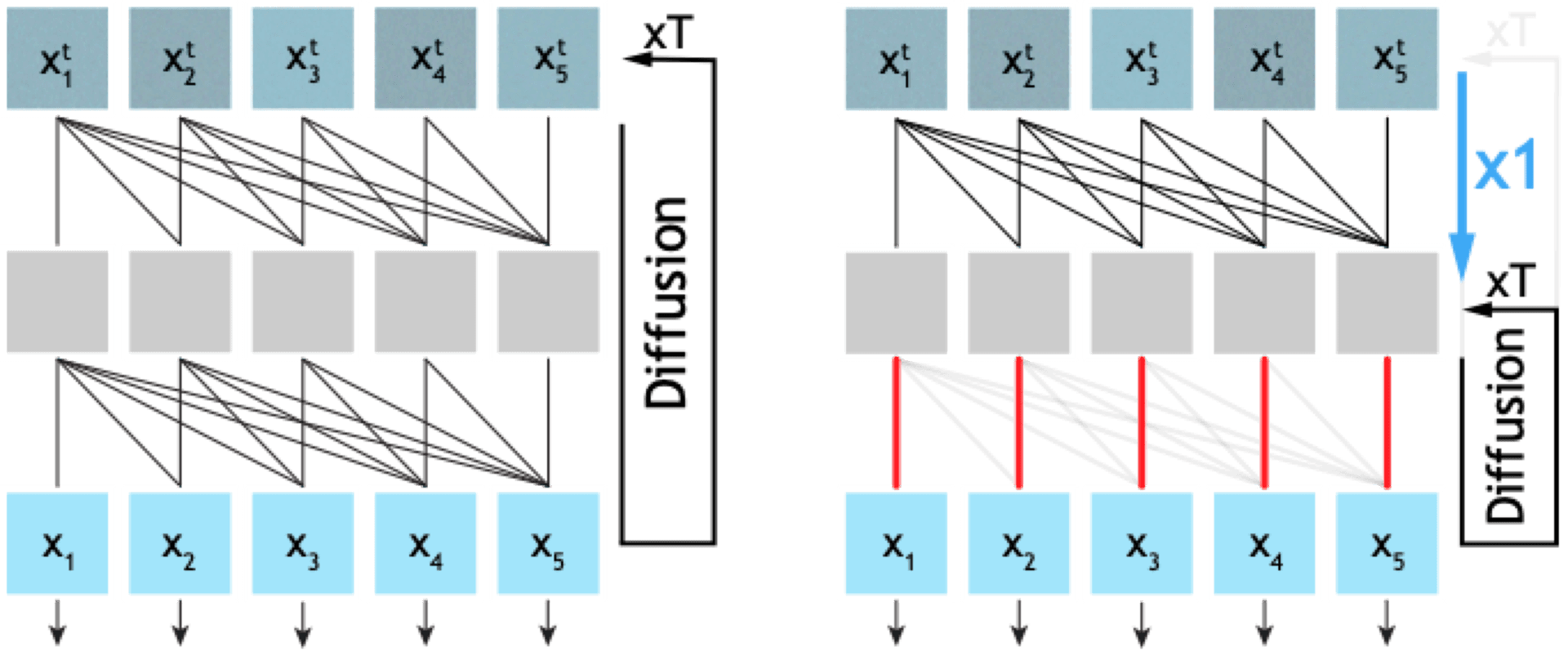
A new research finding challenges fundamental assumptions about how video reasoning models process temporal information. Contrary to the prevailing assumption that these models reason across video frames in a sequential, temporal manner, the research reveals they instead employ a Chain-of-Steps mechanism that unfolds along the diffusion denoising process.
The Chain-of-Steps Mechanism
The key insight is that reasoning doesn't occur across the spatial-temporal dimensions of the video frames themselves, but rather along the denoising steps of the diffusion process. This represents a fundamentally different computational pathway than previously assumed.
According to the findings, this mechanism exhibits two emergent properties:
Working Memory: The model develops a form of memory that persists across denoising steps, allowing it to maintain and manipulate information throughout the generation process.
Self-Correction Capabilities: The model demonstrates the ability to identify and correct errors during the denoising process, suggesting a more sophisticated reasoning process than simple frame-to-frame propagation.
Context
Most video generation and reasoning models have been designed with the assumption that temporal reasoning requires analyzing relationships between consecutive frames. This has influenced architectural choices, training methodologies, and evaluation benchmarks across the field.
The discovery of a Chain-of-Steps mechanism suggests that current models may be leveraging different computational pathways than researchers intended, which could explain some of the limitations and unexpected behaviors observed in video reasoning tasks.
Source Reference
The findings were shared via HuggingPapers on X, referencing research that appears to analyze the internal mechanisms of video reasoning models. The original paper (linked in the tweet) would contain the detailed methodology and experimental evidence supporting these conclusions.