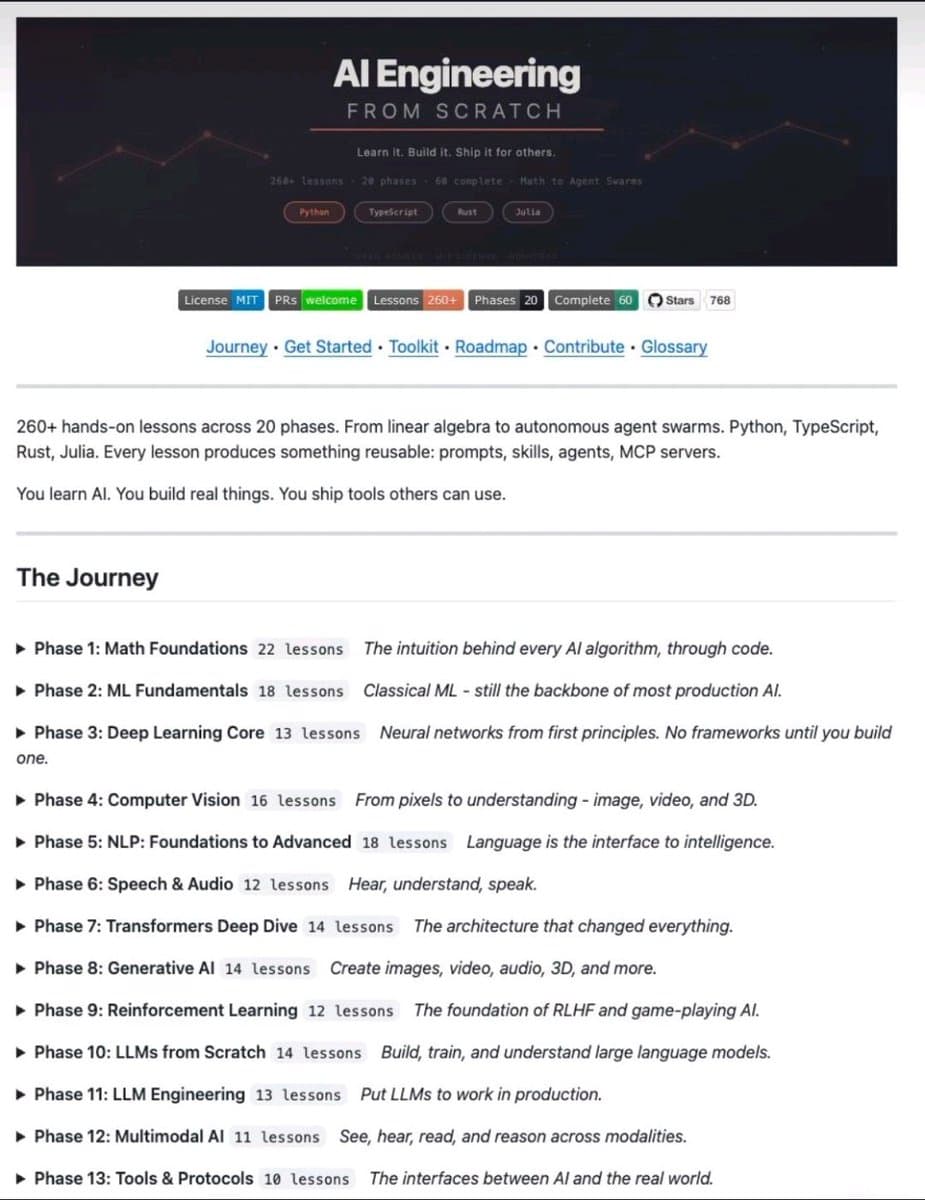
VMLOps, a prominent community and resource hub for machine learning operations, has launched a comprehensive, free AI engineering course designed to bridge the gap between theoretical learning and practical, deployable output. Unlike many tutorials that conclude with abstract understanding, this curriculum is structured so that each of its 230+ hands-on lessons results in a tangible artifact—a prompt, skill, agent, or MCP server—that others can actually use.
The course, accessible via GitHub, is organized into 20 progressive phases. It begins with foundational mathematics (linear algebra) and advances through modern AI architectures (transformers, LLMs) to cutting-edge applications (agents, autonomous swarms). Notably, it incorporates implementation across four programming languages—Python, TypeScript, Rust, and Julia—within a single repository, reflecting the polyglot reality of modern AI engineering stacks.
What's New: From Learning to Building
The core differentiator of this course is its project-based, output-oriented philosophy. The stated goal is for students to finish with a portfolio of functional tools, not just a certificate of completion.
- Every Lesson Ships Something Real: Each instructional unit is tied to creating a usable component. This could be a well-engineered prompt, a reusable skill, a functional AI agent, or a Model Context Protocol (MCP) server.
- Deep-Dive Implementation: The course mandates building core technologies from scratch. Students don't just learn about transformer architecture; they build one. They don't just study multi-agent systems; they construct an autonomous swarm.
- Multi-Language Approach: By integrating Python (the ML staple), TypeScript (for web/application integration), Rust (for performance-critical components), and Julia (for high-performance computing), the course prepares engineers for the heterogeneous toolchains found in production environments.
Course Structure & Technical Details
The 20-phase journey is designed as a continuous learning path:
- Foundation: Starts with linear algebra and core programming concepts across the four languages.
- Core AI/ML: Progresses to building neural networks, transformers, and large language models from the ground up.
- Applied AI: Focuses on creating agents, multi-agent systems (swarms), and tools for interoperability like MCP servers.
- Integration & Deployment: The final phases presumably guide the assembly and deployment of these components into a cohesive portfolio.
The entire curriculum is hosted in a public GitHub repository, making it freely accessible, modifiable, and community-driven. The use of MCP—an open protocol for tools to expose context to LLMs, pioneered by Anthropic—indicates a focus on practical, industry-relevant tooling that works with modern AI platforms.
How It Compares to Other AI Courses
Most MOOCs and bootcamps (e.g., Coursera specializations, DeepLearning.AI courses) excel at teaching theory and guided implementation but often stop short of mandating the creation of original, shareable tools. They typically end with a capstone project for the student's portfolio. In contrast, this VMLOps course is entirely portfolio construction; each lesson is a building block. It is more akin to a structured, open-source alternative to project-based platforms like Buildspace, but specifically and deeply focused on the full AI engineering stack, from math to deployment.
Its closest analogs might be intensive, project-based programs like "Full Stack Deep Learning" or some project tracks on LabLab.ai, but the VMLOps course's scope (230+ lessons), language diversity, and explicit focus on outputting a toolset for others appear unique, especially at its free price point.
What to Watch: Practical Impact and Community Adoption
The success of this initiative will hinge on two factors: completion rates and the quality of the resulting tool ecosystem. A 230-lesson course is a massive commitment. However, its modular, output-driven design may improve engagement by providing constant positive reinforcement—a working tool after each module.
If a critical mass of engineers completes the course, it could seed a substantial open-source repository of AI tools, skills, and agents. This aligns with a growing trend towards an "AI toolchain commons," similar to how Hugging Face hosts model weights. The requirement to build MCP servers is particularly strategic, as it directly contributes to the interoperable tooling ecosystem around LLMs.
gentic.news Analysis
This launch by VMLOps is a significant move in the AI education landscape, reflecting a maturation beyond conceptual learning to production engineering. It directly addresses a major industry pain point: the gap between AI researchers/enthusiasts and engineers who can ship robust, integrated systems. The inclusion of Rust and Julia alongside Python and TypeScript is a telling detail—it’s a curriculum built by practitioners for practitioners, acknowledging that high-performance inference and numerical computing are now part of the AI engineer's mandate.
The focus on Model Context Protocol (MCP) servers is especially astute. As we covered in our analysis of Anthropic's MCP launch last year, MCP is becoming a key standard for tool integration with LLMs. By training a cohort of developers to build MCP servers, VMLOps is effectively cultivating talent for the emerging tool-and-agent ecosystem, not just model tuning. This aligns with the broader industry shift we're tracking from standalone LLMs towards orchestrated agentic workflows, a trend evidenced by the rise of platforms like CrewAI and the continued evolution of LangChain.
Furthermore, this initiative leverages VMLOps's established credibility within the MLOps community to tackle education. It follows a pattern of top-tier technical communities (like MLOps.community) expanding their remit from knowledge-sharing to structured upskilling. If successful, it could create a powerful feedback loop: the course trains engineers, who then contribute tools back to the community, which in turn raises the bar for what's expected of an AI engineer. This could exert subtle pressure on commercial bootcamps and university programs to increase their practical, tooling-focused content.
Frequently Asked Questions
Is the VMLOps AI course really free?
Yes. The entire 230+ lesson curriculum, including all code and learning materials, is hosted on a public GitHub repository and is completely free to access, use, and modify.
What is the time commitment for this AI engineering course?
With over 230 hands-on lessons spanning 20 phases, the course is extremely comprehensive. A reasonable estimate for completion would be several hundred hours, making it equivalent to a full-time intensive bootcamp or a multi-month part-time commitment. It is designed as a deep, end-to-end learning path.
What programming languages do I need to know for this course?
The course incorporates Python, TypeScript, Rust, and Julia. You will be building components across all four languages. Strong fundamentals in at least one of these (likely Python) are recommended, and the course is structured to help you learn the others through implementation.
What is an MCP server, and why is it part of the course?
A Model Context Protocol (MCP) server is a tool that exposes data or functionality (like database queries or API calls) to a Large Language Model in a standardized way. It's an open protocol, notably adopted by Anthropic for Claude. Building MCP servers is a highly practical skill for creating production AI applications that can reliably use tools and access context beyond their initial prompt.