What Happened
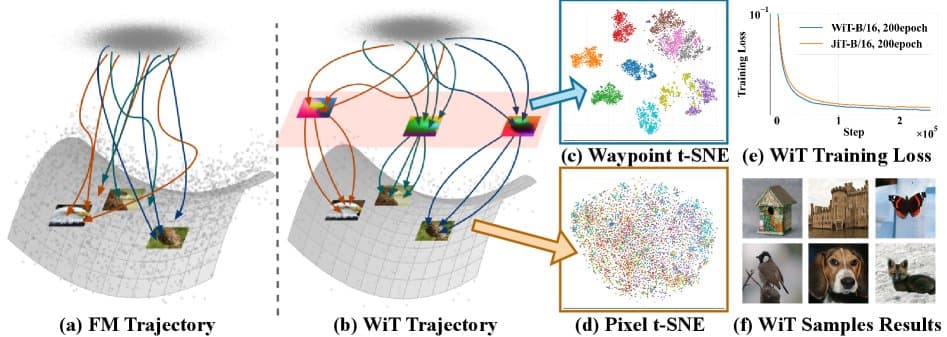
A research team has introduced WiT (Waypoint Diffusion Transformers), a novel architecture for image generation that addresses a fundamental challenge in flow matching models. The core innovation is the use of semantic waypoints—intermediate representations projected from pretrained vision models—to guide the diffusion process and resolve trajectory conflicts that occur in pixel-space flow matching.
According to results shared via HuggingPapers, WiT achieves Fréchet Inception Distance (FID) of 2.09 on ImageNet at 256×256 resolution. Notably, it reaches this performance in 265 training epochs, matching the results of the JiT-L/16 model trained for 600 epochs—representing a 56% reduction in training time for equivalent quality.
Context
Flow matching has emerged as an alternative to traditional diffusion models for generative tasks, offering theoretical advantages in stable training and efficient sampling. However, in pixel space, these models can suffer from trajectory conflicts—where multiple possible paths from noise to data intersect or interfere—leading to training instability and suboptimal sample quality.
Previous approaches like JiT (Joint Image-Text) models have shown strong performance but require extensive training. The WiT approach leverages pretrained vision models (likely CLIP or similar vision-language models) to provide semantic guidance without requiring full retraining of the vision backbone.
Technical Approach
While the source tweet provides limited architectural details, the key mechanism appears to be:
Waypoint Projection: During the diffusion process, the model projects intermediate states through a frozen pretrained vision encoder to obtain semantic representations.
Trajectory Routing: These semantic waypoints guide the flow matching process, helping resolve conflicts by providing high-level directional signals that complement low-level pixel transformations.
Transformer Integration: The waypoint information is integrated into a diffusion transformer architecture, allowing the model to attend to both pixel-level and semantic-level information throughout the generation process.
This approach effectively decouples the geometric transformation (handled by flow matching in pixel space) from the semantic guidance (provided by the pretrained vision model), reducing the learning burden on the generative component.
Performance Implications
The reported FID of 2.09 on ImageNet 256×256 places WiT among state-of-the-art generative models. For comparison:
- DiT-XL/2: ~3.0 FID on ImageNet 256×256
- ADM: ~3.9 FID on ImageNet 256×256
- LDM: ~3.6 FID on ImageNet 256×256
More significantly, the training efficiency gain—achieving in 265 epochs what required 600 epochs for JiT-L/16—suggests that semantic waypoints substantially accelerate convergence while maintaining final quality.
What's Missing from the Source
The tweet provides only high-level results without:
- Detailed architecture specifications
- Ablation studies on waypoint selection
- Sampling speed comparisons
- Broader benchmark results (e.g., class-conditional FID, precision/recall)
- Code or paper availability
Readers should await the full paper for comprehensive evaluation and implementation details.