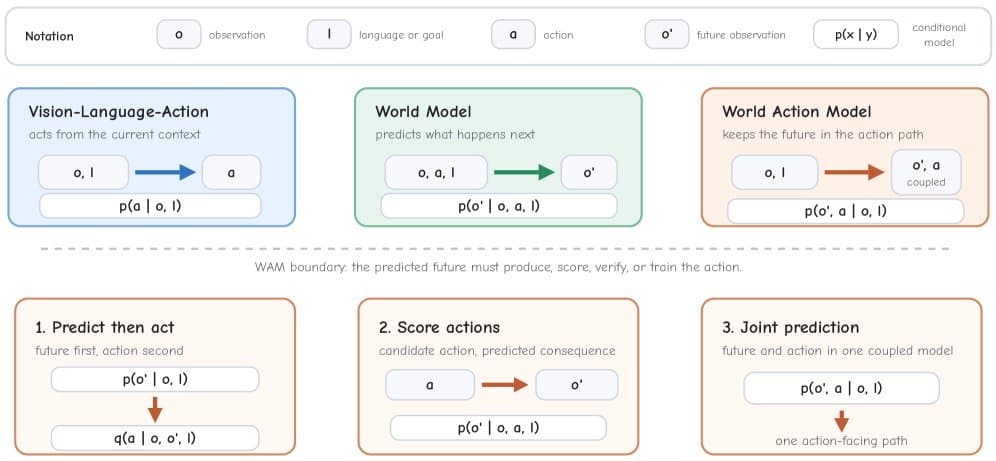
A new survey from Hugging Papers reviews 100+ world action models. It unifies world models, video generation, and vision-language-action (VLA) policies under one taxonomy.
Key facts
- Survey covers 100+ world action model methods.
- Unifies world models, video generation, and VLA policies.
- Tagline: "Dream less, act more."
- No benchmark results or compute data disclosed.
A new survey from Hugging Papers reviews 100+ world action models. It unifies world models, video generation, and vision-language-action (VLA) policies under one taxonomy.
The survey, posted on X by @HuggingPapers, carries the tagline "Dream less, act more." This reflects a shift from purely predictive world models toward those that directly inform action in embodied AI and robotics.
What the survey covers
The taxonomy spans three traditionally separate fields: world models (which simulate future states), video generation (which produces visual predictions), and VLA policies (which map perception to action). By unifying them, the survey aims to identify cross-cutting architectural patterns and training paradigms.
The survey does not disclose specific benchmark results, compute requirements, or code. It is a structured literature review, not an experimental paper.
Why it matters
World models have a long history in reinforcement learning (e.g., Ha and Schmidhuber 2018's World Models), but recent advances in video diffusion and large language models have blurred the lines between prediction and action. This survey provides a map for researchers navigating that convergence.
The timing is notable: as robotics and embodied AI labs push toward foundation models that both predict and act, a shared vocabulary becomes critical. The survey offers exactly that.
Limitations
The survey's scope is broad but shallow. It covers 100+ methods but does not provide head-to-head comparisons, ablation studies, or reproducibility analysis. Practitioners will need to dig into individual papers for implementation details.
No training cost or inference latency data is included, and the survey does not rank methods by performance on standard benchmarks like Habitat or MetaWorld.
What to watch
Watch for follow-up experimental benchmarks that test the taxonomy's predictive power against standard embodied AI tasks (e.g., Habitat, MetaWorld). A reproducibility study or leaderboard update would validate the survey's practical utility.