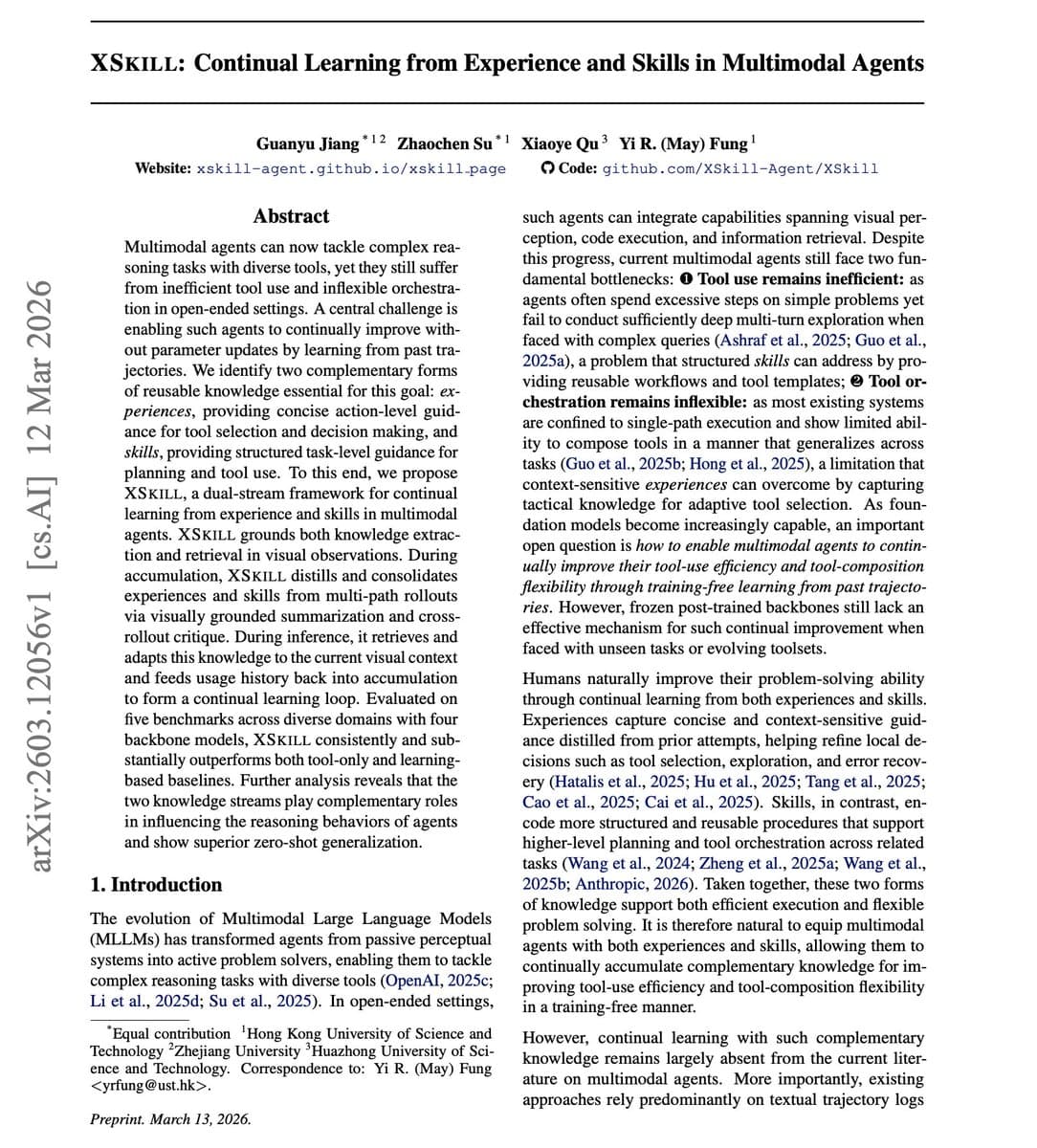
A new research breakthrough is demonstrating how AI agents can become more capable over time by learning from their own experiences and developing reusable skills. The XSkill framework, introduced in a recent paper, represents a significant advancement in continual learning for AI systems, allowing them to accumulate knowledge without requiring parameter updates.
The Dual-Stream Learning Approach
XSkill operates through a dual-stream architecture that distills two distinct types of knowledge from an agent's past trajectories. The first stream focuses on experiences—specific instances of successful tool selection and usage at the action level. The second stream extracts skills—higher-level patterns and workflows that can be applied across different tasks for planning and execution.
What makes this approach particularly innovative is how both types of knowledge are grounded in visual observations. This means agents learn from what they actually see during task execution, creating a more robust connection between perception and action.
Knowledge Accumulation Through Cross-Rollout Critique
During the learning phase, XSkill employs a sophisticated comparison mechanism called cross-rollout critique. Agents analyze both successful and failed attempts at tasks, extracting high-quality knowledge by contrasting what worked with what didn't. This process allows them to identify not just successful patterns but also understand why certain approaches fail.
As AI researcher Omar Sar noted in his analysis of the framework, "Skills are so good when you combine them properly with MCP & CLIs. I have found that Skills can significantly improve tool usage of my coding agents." This observation highlights the practical value of skill-based learning for real-world applications.
Performance Improvements Across Benchmarks
The research team evaluated XSkill across five different benchmarks using four backbone models, with consistently impressive results. On the Gemini-3-Flash model, the average success rate increased from 33.6% to 40.3%—a substantial improvement in task completion.
Perhaps even more significant was the reduction in tool usage errors, which dropped from 29.9% to 16.3% when skills were incorporated. This suggests that the skill-based learning approach helps agents make fewer mistakes when selecting and applying tools to solve problems.
The Self-Improvement Challenge
While XSkill represents a major step forward, the research community acknowledges that fully autonomous self-improvement remains challenging. As Sar observed, "Self-improving skills don't work that well (yet)." This honest assessment points to both the current limitations and future potential of continual learning systems.
The paper emphasizes the importance of regular documentation of improvements, patterns, and pitfalls. This human-in-the-loop approach to skill refinement appears to be more effective than purely autonomous skill development at this stage of AI evolution.
Implications for AI Development
The XSkill framework has several important implications for the future of AI:
Reduced Retraining Costs: By enabling agents to learn continuously without parameter updates, organizations could significantly reduce the computational resources needed to keep AI systems current.
More Adaptable Systems: Agents that can accumulate knowledge from their own experiences may become better at handling novel situations and adapting to changing environments.
Improved Tool Integration: The demonstrated reduction in tool usage errors suggests that skill-based learning could make AI systems more reliable when working with external tools and APIs.
Transfer Learning Potential: Skills learned in one domain might be transferable to related domains, accelerating development across multiple applications.
The Road Ahead for Continual Learning
XSkill represents one of several recent approaches to continual learning for AI agents. As Sar noted, "I have now seen two papers this week with similar ideas," indicating growing research interest in this area.
The framework's success suggests that combining experience-based learning with skill-based abstraction may be a particularly fruitful direction for future research. As these techniques mature, we may see AI systems that become genuinely more capable through use, much like human experts who refine their skills through practice and reflection.
For developers interested in implementing these concepts, Sar recommends checking out educational resources on building effective AI agents, noting that proper skill documentation and combination with existing tools (like MCP and CLIs) can yield significant improvements in agent performance.
Source: Research paper on XSkill framework via Omar Sar's analysis on X (formerly Twitter)