Chinese AI company Zhipu AI has announced the release of GLM-5.1, an updated version of its large language model. The announcement, made via a social media post, states the new model shows a "significant increase in evals compared to GLM-5.0."
What Happened
On April 9, 2026, Zhipu AI announced the release of GLM-5.1. The announcement was brief, highlighting a "significant increase in evals" as the primary improvement over the previous GLM-5.0 model, which was released in late 2025. No specific benchmark scores, architectural details, or dataset information were provided in the initial announcement.
Context
GLM (General Language Model) is a series of open-source LLMs developed by Zhipu AI, a Beijing-based company founded in 2019 and spun out of Tsinghua University's Knowledge Engineering Group (KEG). The GLM series has been a significant contributor to the open-source AI landscape, often positioning itself as a competitive alternative to models like Meta's Llama series.
The GLM-5.0 release in Q4 2025 was notable for its strong performance on coding and mathematical reasoning benchmarks, featuring a mixture-of-experts (MoE) architecture. This release follows a pattern of rapid iteration from Zhipu AI, which has consistently released updated model versions every few months.
What We're Waiting For
As of this announcement, Zhipu AI has not released:
- Detailed benchmark results (e.g., MMLU, GSM8K, HumanEval, MBPP)
- Technical paper or architecture specifications
- Model weights or access information
- Direct comparisons to other state-of-the-art models (e.g., GPT-5, Claude 4, Llama 4)
Typically, Zhipu AI follows such announcements with a more detailed technical report and open-source release within days or weeks. The AI community will be watching for whether GLM-5.1 represents an architectural advancement or primarily a refinement through improved training techniques and data.
gentic.news Analysis
This release continues the intense competition in the open-source LLM space, particularly from Chinese AI labs. Zhipu AI's rapid iteration from GLM-5.0 to GLM-5.1 in approximately four months demonstrates the accelerating pace of model development. This follows our previous coverage of China's "Model-as-a-Service" ecosystem, where companies like Zhipu, 01.AI, and Baidu are releasing increasingly capable models to capture developer mindshare.
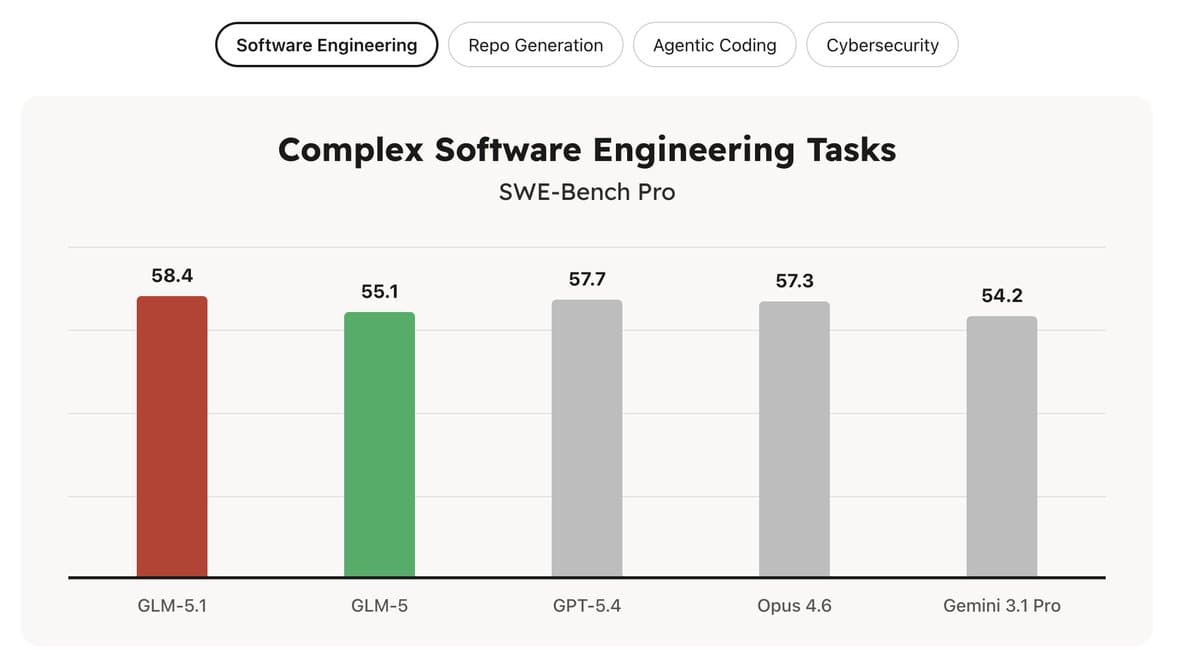
The claim of "significant increase in evals" is notable but requires verification through published benchmarks. If substantiated, it could indicate that Zhipu has made meaningful progress in training efficiency or data quality, potentially closing the gap with leading Western models. However, without specific numbers, it's impossible to assess the actual magnitude of improvement.
This development also reflects the broader trend of AI development becoming increasingly global and competitive. As we noted in our analysis of the "Great Model Race," Chinese labs are investing heavily in both scale and efficiency, with GLM-5.1 likely representing another step in this direction. The real test will come when independent researchers can evaluate the model against standardized benchmarks.
Frequently Asked Questions
What is GLM-5.1?
GLM-5.1 is the latest version of the General Language Model developed by Zhipu AI. It's an open-source large language model that reportedly shows significant evaluation improvements over its predecessor, GLM-5.0.
How does GLM-5.1 compare to other models?
Without published benchmark results, direct comparisons are impossible. Based on previous GLM models, it likely competes in the same tier as models like Meta's Llama 3.1, Google's Gemma 2, and other capable open-source models. Its predecessor, GLM-5.0, showed strong performance on coding and mathematical tasks.
When will GLM-5.1 be available?
Zhipu AI typically releases model weights and technical details shortly after announcements. Based on their previous release patterns, we expect more information within days to weeks of the April 9, 2026 announcement.
Is GLM-5.1 better than GPT-5 or Claude 4?
Almost certainly not for general capabilities. While Chinese models have made impressive strides, the leading proprietary models from OpenAI, Anthropic, and Google still maintain a significant lead in overall capability and reasoning. However, for specific use cases or regions where open-source models are preferred, GLM-5.1 may offer a compelling alternative.