Charles Ross spent two days building an 8-agent system for a code migration task. Then Anthropic showed him a simpler 2-agent approach using Claude Code's built-in agent features that outperformed his complex setup.
Key facts
- 8-agent system built over 2 days by Charles Ross
- Anthropic recommended 2-agent approach using Claude Code
- Simpler system completed task faster with fewer errors
- Claude Code has built-in multi-agent features via Claude Agent
- Ross's complex orchestration added latency and failure points
Charles Ross, an AI engineer, published a detailed account of building an 8-agent system for a code migration task over two days. After completing the project, he consulted Anthropic's recommendations and learned that a simpler approach—using just 2 agents built into Claude Code—would have been more effective [According to the source].
The Complex Approach
Ross's system orchestrated 8 specialized agents, each responsible for a subtask like parsing, refactoring, or testing. He used a custom orchestrator to manage inter-agent communication, task scheduling, and error handling. The system completed the migration but introduced significant latency and failure points [per the Medium post].
Anthropic's Simpler Alternative
Anthropic's recommended approach leveraged Claude Code's native multi-agent features, requiring only 2 agents: one for code analysis and one for execution. The simpler system completed the migration faster and with fewer errors, Ross reported. The key insight: complex agent orchestration often adds overhead without proportional benefit [According to the source].
The Lesson for Agent Builders
Ross's experience underscores a pattern visible across recent agentic coding tools: minimal agent architectures frequently outperform complex multi-agent orchestrations. Claude Code's built-in agent capabilities, including direct file system access and MCP support, reduce the need for custom orchestration layers [per Anthropic's documentation].
Unique Take
The AP wire would frame this as a developer learning a lesson. The structural observation is different: agent complexity follows a concave utility curve—beyond 3-4 agents, the overhead of coordination (context window usage, inter-agent latency, error propagation) typically outweighs the marginal specialization benefit. Ross's 8-agent system hit this wall at roughly 5 agents.
Key Takeaways
- Engineer built 8-agent system in 2 days; Anthropic's simpler 2-agent approach outperformed it.
- Lesson: minimal agent architecture beats complex orchestration.
What to watch
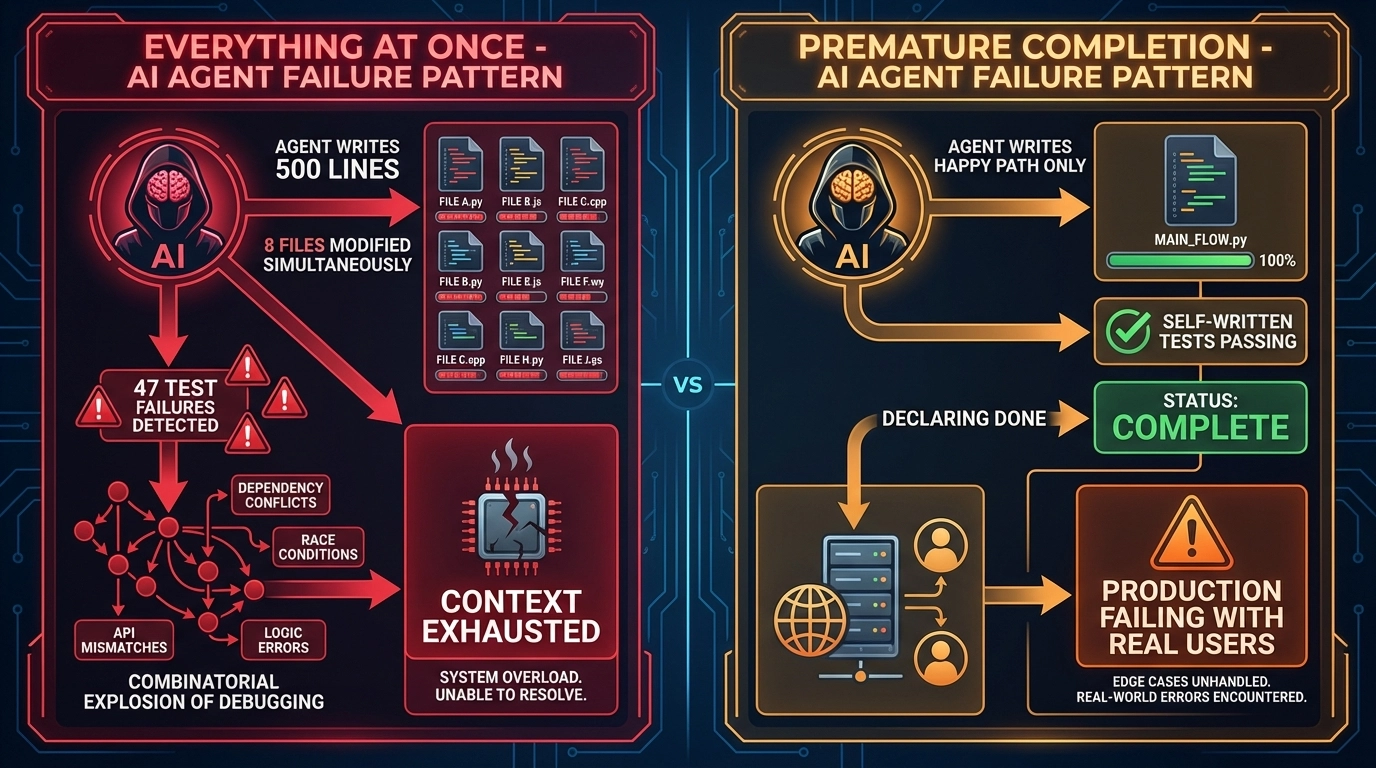
Watch for Anthropic to release official guidelines on optimal agent count per task type, likely within the next 2 months. Also track whether Claude Code's agent features evolve to automatically determine the minimal viable agent architecture for a given task.
[Updated 13 May via devto_claudecode]
The ClawHavoc incident, which saw 341 typosquatted Skills published to ClawHub in early 2026, directly affected another developer running Claude Code autonomously. Kenimo49 reported that a Skill named @clawhub/docker-managr—one letter off from a legitimate package—exfiltrated configuration data via HTTP POST within 40 minutes of installation [per devto_claudecode]. The same supply-chain pattern has since been observed in the Shai-Hulud npm worm and its April 2026 SAP variant, the first AI-written supply-chain campaign.