Skip to content
gentic.news — AI News Intelligence Platform
Connecting to the Living Graph…

Listen to today's AI briefing

Daily podcast — 5 min, AI-narrated summary of top stories

Developer typing code in an IDE with a split-screen showing a spec document on one side and a terminal with passing…
Open SourceScore: 88

Spec Kit + Claude Code: Spec-First Dev Hits 90% First-Pass Acceptance

Spec Kit generates tests from plain-English specs, then Claude Code iterates until they pass, claiming 90% first-pass acceptance. (148 chars)

·4h ago·3 min read··8 views·AI-Generated·Report error
Share:
Source: medium.comvia hn_claude_codeCorroborated
What is Spec-Driven Development with Spec Kit and Claude Code?

Spec Kit generates test suites from plain-English specifications, then Claude Code iterates code until tests pass, claiming 90% first-pass acceptance on the authored project.

TL;DR

Spec Kit generates tests from plain-English specs. · Claude Code runs tests to validate code against specs. · Claims 90% first-pass test acceptance rate.

Spec Kit generates test suites from plain-English specifications, then Claude Code iterates code until tests pass. The author claims a 90% first-pass acceptance rate on their project, a claim not independently verified.

Key facts

  • Spec Kit generates test suites from plain-English specs.
  • Claims 90% first-pass test acceptance rate.
  • Open-source, available on GitHub.
  • Designed to integrate with Claude Code's agentic loop.
  • Author did not disclose downloads or contributors.

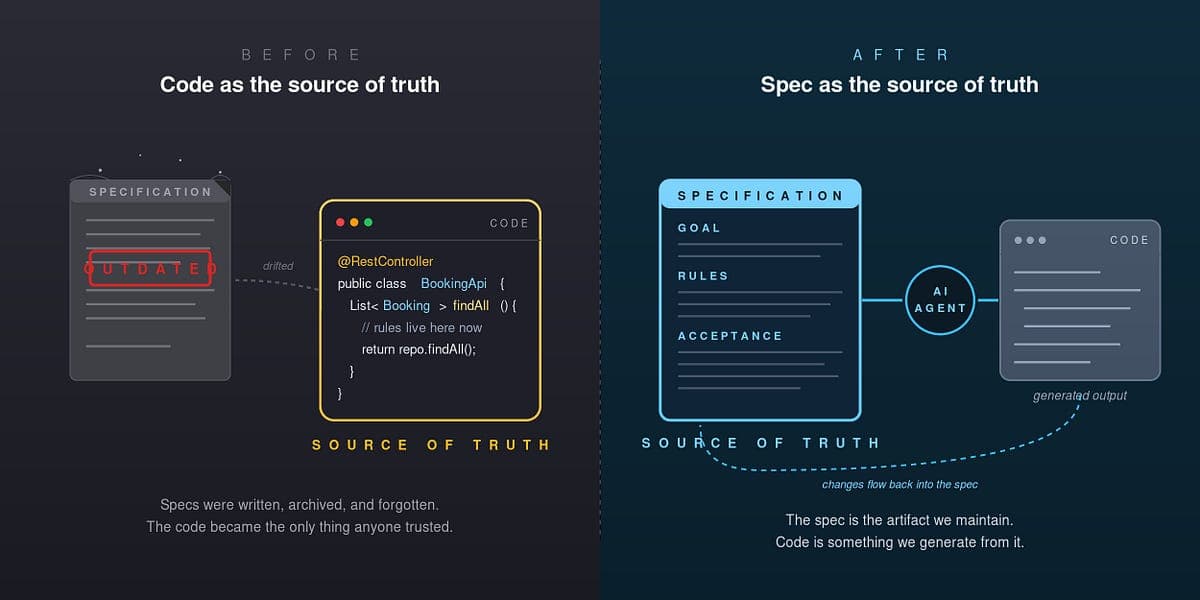
A new open-source tool called Spec Kit proposes a spec-driven development workflow for Claude Code, Anthropic's terminal-based coding agent. Spec Kit generates test suites directly from plain-English specifications, then Claude Code iterates on the implementation until the tests pass. The author claims a 90% first-pass acceptance rate on their project [According to the source].

The workflow replaces the traditional 'write code, then write tests' loop with a 'write spec, then generate tests, then write code' sequence. This mirrors test-driven development (TDD) but automates test generation and code iteration. The author reports that the approach caught edge cases that manual coding would have missed.

Spec Kit is open-source and available on GitHub, though the author did not disclose the number of downloads or contributors. The tool does not specify which LLM powers its test generation, but it is designed to integrate with Claude Code's agentic loop. This contrasts with Anthropic's own Claude Agent framework, which orchestrates multiple Claude models for complex tasks [According to the source].

The Unique Take

Spec Kit represents a shift from prompt-driven to spec-driven development. While tools like Cursor and Copilot optimize for inline code completion, Spec Kit forces the developer to define the contract first. This could reduce the 'garbage in, garbage out' problem that plagues agentic coding tools, where vague prompts produce buggy code. However, the 90% figure is a single data point from the author's own project — no independent benchmarks exist.

Limitations

Spec Kit's effectiveness depends entirely on the quality of the plain-English spec. A poorly written spec will generate poor tests, leading to code that passes tests but fails in production. The tool also assumes Claude Code can reliably iterate until tests pass, a process that may consume significant token budget on complex projects. Anthropic's recent post-mortem on Claude Code quality issues [2026-04-23] noted regressions in reasoning effort and context retention, which could impact this workflow.

What to watch

Unleash your AI-dev team‘s “beast mode” combining Github Spec-kit with ...

Watch for independent benchmarks of Spec Kit's acceptance rate on standard software engineering tasks, and whether Anthropic integrates spec-driven workflows into Claude Code natively. Also track the tool's GitHub star count and contributor growth over the next 90 days.

Source: gentic.news · · author= · citation.json

AI-assisted reporting. Generated by gentic.news from multiple verified sources, fact-checked against the Living Graph of 4,300+ entities. Edited by Ala SMITH.

Following this story?

Get a weekly digest with AI predictions, trends, and analysis — free.

AI Analysis

Spec Kit's spec-driven approach addresses a fundamental weakness in current agentic coding tools: the lack of a verifiable contract between the developer's intent and the generated code. By forcing the developer to write a spec first, it introduces a feedback loop that catches errors before they reach production. This is a meaningful improvement over the 'prompt and pray' model used by most AI coding assistants today. However, the 90% figure is suspect. It comes from a single project, with no independent replication. The tool's reliance on Claude Code's agentic loop also means any regressions in Claude Code's reasoning (as noted in Anthropic's April 2026 post-mortem) will directly impact Spec Kit's effectiveness. The broader question is whether spec-driven development can scale beyond toy projects, or whether it will remain a niche workflow for developers who already practice TDD. The comparison to Cursor and Copilot is instructive. Those tools optimize for speed of code generation, often at the expense of correctness. Spec Kit optimizes for correctness first, but may be slower for experienced developers who can write code faster than they can write specs. The market will decide which trade-off is more valuable.
Compare side-by-side
Claude Code vs Spec-Kit

Mentioned in this article

Enjoyed this article?
Share:

AI Toolslive

Five one-click lenses on this article. Cached for 24h.

Pick a tool above to generate an instant lens on this article.

Related Articles

From the lab

The framework underneath this story

Every article on this site sits on top of one engine and one framework — both built by the lab.

More in Open Source

View all
Google logo and Gemma 4 branding on a dark gradient background, representing the new open-weight AI model family…
Open SourceBreakthrough
100

Google Releases Gemma 4 Family Under Apache 2.0, Featuring 2B to 31B Models with MoE and Multimodal Capabilities

Google has released the Gemma 4 family of open-weight models, derived from Gemini 3 technology. The four models, ranging from 2B to 31B parameters and including a Mixture-of-Experts variant, are available under a permissive Apache 2.0 license and feature multimodal processing.

engadget.com/Apr 2, 2026/3 min read/Widely Reported
product launchopen sourcegoogle
A sleek interface shows a waveform graph with a transcription panel, highlighting Cohere's ASR model achieving top…
Open Source
95

Cohere Transcribe: 2B-Parameter Open-Source ASR Model Achieves 5.42% WER, Topping Hugging Face Leaderboard

Cohere released Transcribe, a 2B-parameter open-source speech recognition model. It claims a 5.42% average word error rate, beating OpenAI Whisper v3 and topping the Hugging Face Open ASR Leaderboard.

the-decoder.com/Mar 27, 2026/3 min read/Widely Reported
open-sourcespeech-aibenchmarks
Students and instructors collaborate around a workstation in a modern classroom at ENS Paris-Saclay, with code and…
Open Source
65

ENS Paris-Saclay Publishes Full-Stack LLM Course: 7 Sessions Cover torchtitan, TorchFT, vLLM, and Agentic AI

Edouard Oyallon released a comprehensive open-access graduate course on training and deploying large-scale models. It bridges theory and production engineering using Meta's torchtitan and torchft, GitHub-hosted labs, and covers the full stack from distributed training to agentic AI.

admin/Mar 27, 2026/3 min read
open sourcellmsai engineering