What Happened
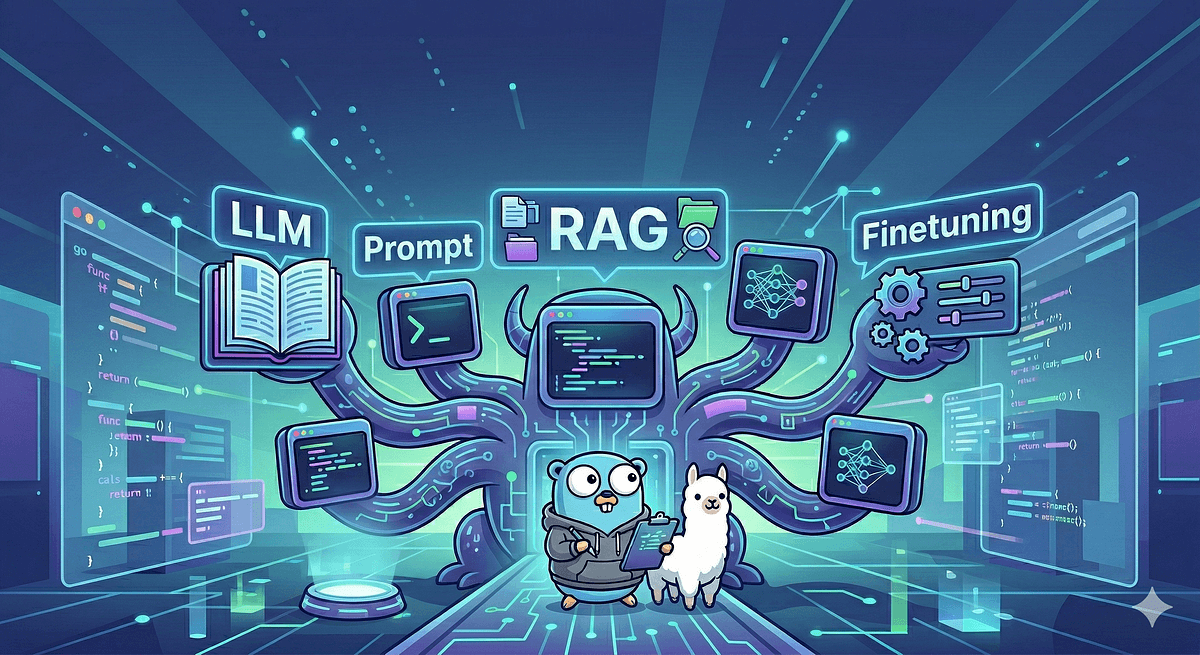
A software engineer specializing in Go has published a personal account of his journey to understand and build a Retrieval-Augmented Generation (RAG) system. The core narrative is one of demystification: moving from a perception of AI as an impenetrable "monster" to a tangible set of technologies that can be implemented through study and hands-on work. While the full article is behind a Medium paywall, the snippet indicates the author grappled with common questions about the difficulty of creating AI applications and ultimately embarked on a project to build his own RAG system.
This story is emblematic of a broader trend: skilled developers from traditional software engineering backgrounds are now applying their expertise to AI. The choice of Go is notable, as it contrasts with the Python-dominated landscape of machine learning, suggesting a focus on performance, concurrency, and production system integration from the outset.
Technical Details: The RAG Journey
Retrieval-Augmented Generation (RAG) is a technique that enhances large language models (LLMs) by allowing them to query and incorporate information from external knowledge sources—like vector databases—during the generation process. This addresses the LLM's inherent limitations of static, dated knowledge and tendency to hallucinate.
A typical developer's journey into RAG involves several key steps:
- Understanding the Core Components: Learning about embedding models (to convert text into numerical vectors), vector databases (to store and search those vectors efficiently), and the orchestration layer that stitches retrieval with generation.
- Choosing a Stack: Selecting specific models (e.g., OpenAI's GPT, Anthropic's Claude, or open-source alternatives), embedding APIs (like OpenAI's text-embedding-ada-002 or open-source models), and a vector store (such as Pinecone, Weaviate, or pgvector).
- Implementation: Building the data ingestion pipeline (chunking documents, generating embeddings), the retrieval logic (often using cosine similarity), and the prompt engineering to instruct the LLM to use the retrieved context.
- Evaluation and Iteration: Testing the system's accuracy, addressing edge cases like irrelevant retrievals, and optimizing for latency and cost.
The developer's journey highlights that while the concepts are advanced, the barrier to entry for a working prototype is lower than ever due to mature APIs and libraries.
Retail & Luxury Implications
The direct relevance of this specific developer's story to retail is low; it is a general technical narrative. However, the technology he is exploring—RAG—has profound and immediate implications for the luxury and retail sector.
For technical leaders in this space, the demystification of RAG is critical. The ability to build internal systems that leverage proprietary data is a key competitive advantage. Concrete applications include:
- Hyper-Personalized Customer Service: A RAG system can power a customer service agent that has instant, grounded access to all product manuals, inventory data, CRM notes, and return policies, enabling accurate and brand-consistent responses.
- Internal Knowledge Hubs: New stylists or sales associates can query a RAG-powered system to learn about brand heritage, fabric care instructions for a specific collection, or historical marketing campaigns, dramatically reducing training time.
- Enhanced Product Discovery: By connecting a RAG system to a product catalog with rich attribute data and past customer inquiries, a search function can move beyond keywords to understand nuanced requests like "a dress for a summer wedding in Tuscany" or "a bag that matches this shoe from the 2024 collection."
The journey from intimidation to implementation, as described by the developer, is precisely the mindset shift needed within retail IT departments to move from buying generic AI solutions to building proprietary, data-moated capabilities.