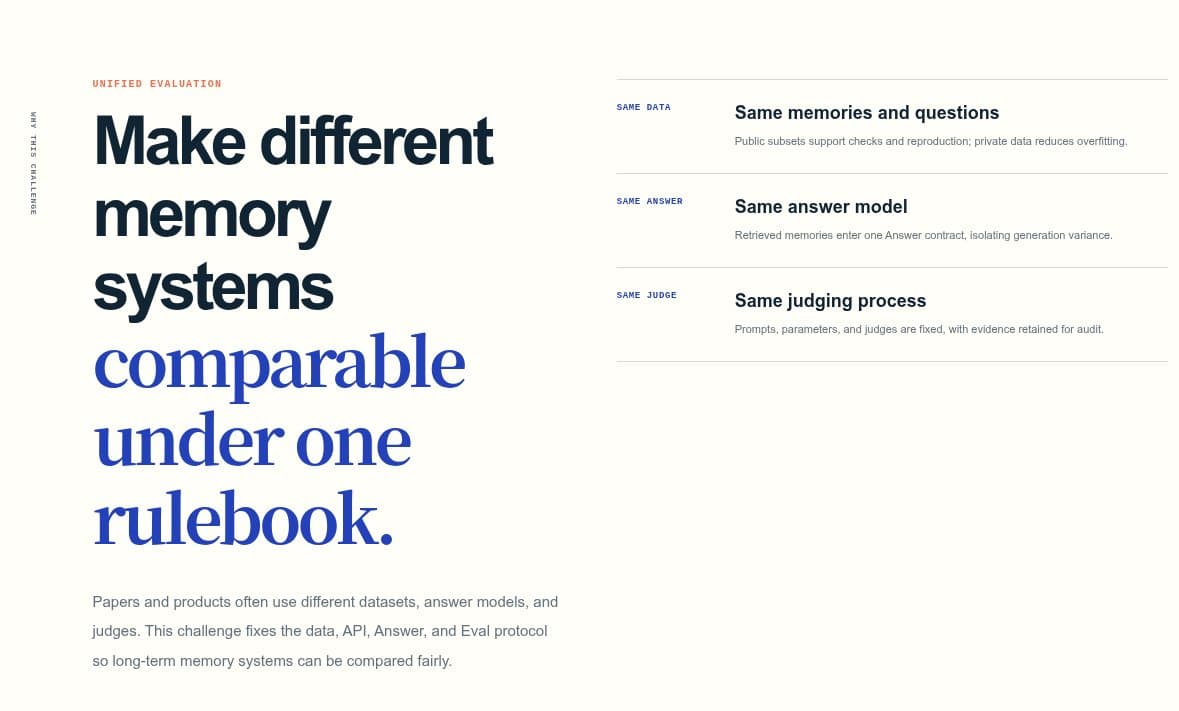
A consortium of 20+ research institutions launched a shared agent memory benchmark on August 7, 2026, standardizing evaluation with 5,000 questions and one fixed answer model. The move directly attacks the attribution problem plaguing every AI memory startup's recall claims.
Key facts
- 5,000 questions in shared benchmark pipeline
- 20+ research institutions running identical evaluation
- Entries close August 7, 2026
- First public rankings expected mid-August 2026
- Open-source and commercial systems ranked separately
Agent memory benchmarks have had a basic attribution problem. Every AI memory startup claims better recall, and until now there was no way to check. According to @rohanpaul_ai, that is why this new shared benchmark caught attention.
Key Takeaways
- A 20+ institution consortium launched a shared agent memory benchmark with 5,000 questions and one answer model, targeting the attribution problem in memory startup claims.
- First rankings due mid-August.
How the benchmark works
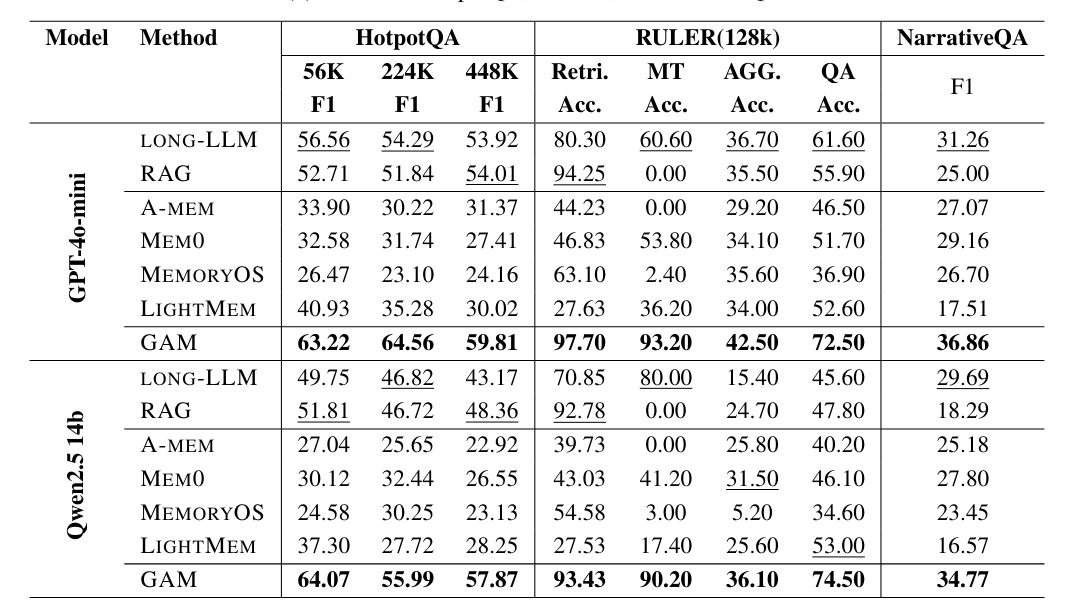
The benchmark puts every entrant through the same pipeline: 5,000 questions, one fixed answer model, and the same judging process across systems. This standardization directly addresses the core failure of prior evaluations, where each vendor used its own prompts, answer models, and scoring rubrics — making cross-system comparisons meaningless.
The benchmark also separates open-source and commercial systems. The rationale: community projects can compete for prizes without being directly compared against heavily funded commercial products. This is a structural choice that acknowledges the funding asymmetry in the agent memory space, where startups like Mem0 and Letta have raised tens of millions while academic labs operate on grants.
Who's running it and when
A group of 20+ research institutions is running all of them through one identical pipeline and publishing the results. Entries close on August 7, with the first public rankings expected in mid-August. The source does not name the specific institutions, the judging criteria beyond "same judging process," or whether the 5,000 questions cover episodic, semantic, or procedural memory — so treat those details as undisclosed.
The unique angle here: this benchmark is not just another leaderboard. It's an attempt to create a neutral, reproducible yardstick in a field where every vendor's marketing deck claims state-of-the-art recall. The separation of open-source and commercial tracks is a tacit admission that head-to-head comparison would favor deep-pocketed products — and that community projects deserve a fair shot at recognition without the funding disadvantage.
For ML engineers, the key question is whether the benchmark's fixed answer model and judging process will hold up under scrutiny. Prior memory benchmarks like LOCOMO and MemGPT's evaluation suffered from prompt sensitivity and answer-model bias. If this consortium publishes its full pipeline — including the answer model checkpoint and judging rubric — it could set a new standard. If not, it risks becoming another PR exercise.
The first public rankings in mid-August will reveal which systems actually retain and retrieve knowledge across 5,000 questions. That's the moment the attribution problem gets its first real test.
What to watch
Watch for the first public rankings in mid-August 2026. If the consortium publishes the full pipeline — answer model checkpoint, judging rubric, and the 5,000-question set — it will set a new standard for memory evaluation. If not, the benchmark risks being dismissed as another vendor-neutral PR exercise.