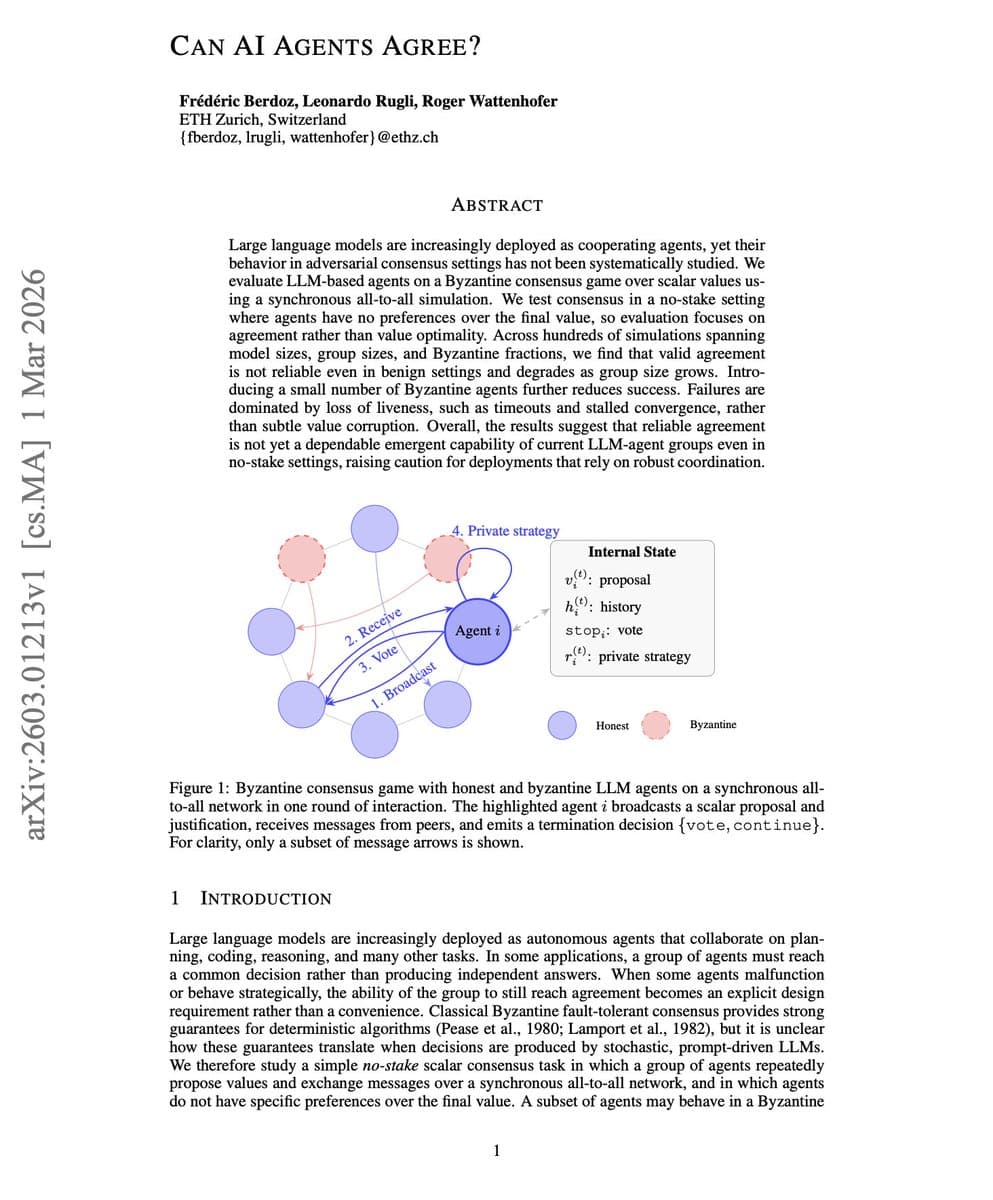
A groundbreaking study examining how AI agents communicate and reach agreement has revealed surprising limitations in multi-agent systems. Researchers testing large language model (LLM)-based agents on Byzantine consensus games—scenarios where participants must agree on a value even when some behave adversarially—found that valid agreement is unreliable even in fully cooperative settings.
The Consensus Challenge in Multi-Agent Systems
Communication represents one of the most significant challenges in developing effective multi-agent AI systems. As organizations increasingly deploy AI agents for complex coordination tasks—from supply chain management to autonomous vehicle coordination to distributed financial systems—the ability for these agents to reliably reach consensus becomes critical.
The Byzantine consensus problem, originally formulated in distributed computing, presents a scenario where multiple participants must agree on a single value despite the presence of potentially malicious actors. This framework has become a standard test for coordination systems, but applying it to LLM-based agents reveals unexpected vulnerabilities.
Key Findings: Agreement Breaks Down
The research demonstrates several concerning patterns:
Unreliable agreement in benign settings: Even when all agents are cooperative and well-intentioned, they frequently fail to reach valid consensus. This challenges the assumption that agreement emerges naturally from communication between rational agents.
Group size amplifies problems: As the number of agents increases, consensus reliability degrades significantly. This scalability issue presents a major obstacle for real-world applications where systems might involve dozens or hundreds of coordinating agents.
Failure patterns differ from expectations: Most failures result from convergence stalls and timeouts rather than subtle value corruption. Agents get stuck in communication loops, fail to converge on decisions, or simply time out without reaching agreement.
Why This Matters for Real-World Applications
Multi-agent AI systems are increasingly being deployed in high-stakes environments where reliable coordination is essential:
- Autonomous systems: Self-driving car fleets, drone swarms, and robotic teams
- Financial systems: Distributed trading algorithms and automated market makers
- Infrastructure management: Smart grid coordination and traffic control systems
- Healthcare: Distributed diagnostic systems and treatment coordination
The research serves as an early warning that reliable consensus cannot be assumed as an emergent property of multi-agent systems. Instead, it must be explicitly designed and engineered into these systems.
Technical Implications for AI Development
The findings suggest several important directions for future research and development:
Consensus mechanisms need explicit design: Rather than relying on agents to "figure it out" through communication, systems may need built-in consensus protocols similar to those used in distributed computing.
Communication protocols require standardization: The ad-hoc nature of LLM-based communication appears insufficient for reliable coordination. More structured communication frameworks may be necessary.
Scalability challenges demand attention: The degradation with group size indicates fundamental limitations in current approaches that must be addressed before large-scale deployment.
The Human-AI Coordination Dimension
This research also has implications for human-AI teaming scenarios. If AI agents struggle to coordinate among themselves, similar challenges may emerge when humans attempt to coordinate with multiple AI systems or when mixed human-AI teams need to reach consensus.
The findings suggest that as we build more complex AI ecosystems, we may need to develop new interfaces and protocols specifically designed to facilitate reliable decision-making across heterogeneous groups of agents and humans.
Looking Forward: Solutions and Research Directions
Several approaches might address these consensus challenges:
- Hybrid systems: Combining LLM-based reasoning with traditional consensus algorithms
- Specialized training: Developing agents specifically trained for consensus tasks
- Architectural innovations: Creating new multi-agent architectures with consensus as a first-class design consideration
- Verification and validation: Developing methods to formally verify consensus reliability in multi-agent systems
The research paper, available through the original source, provides detailed experimental results and analysis that will be essential reading for anyone working on multi-agent AI systems.
Source: Research on LLM-based agents in Byzantine consensus games, originally shared by @omarsar0 on X/Twitter