Key Takeaways
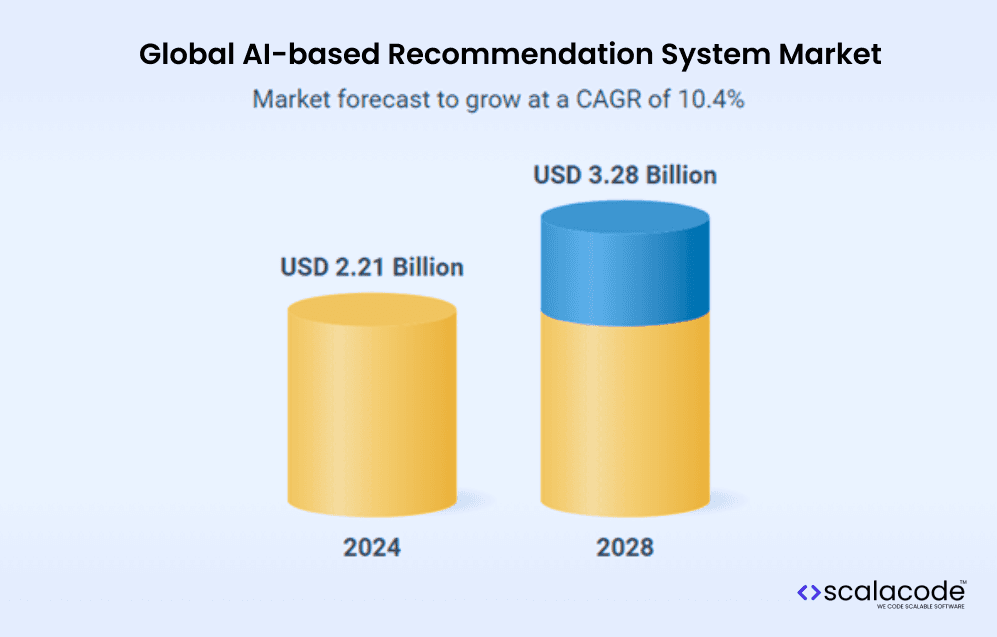
- A market analysis projects the AI-based recommendation system sector will grow significantly, reaching a valuation of USD 34.4 billion by 2033.
- This underscores the technology's transition from a nice-to-have feature to a core, high-value component of digital business strategy.
The Market Forecast
A recent market report, highlighted by Bayelsa Watch, projects substantial growth for AI-based recommendation systems. The global market for this technology is forecast to reach USD 34.4 billion by the year 2033. While the provided source excerpt is limited, the headline figure points to a significant, long-term expansion in the adoption and commercial value of these systems.
Recommendation engines, powered by machine learning and increasingly by large language models (LLMs), analyze user behavior, preferences, and contextual data to suggest relevant products, content, or services. They are fundamental to personalization in digital experiences.
Why This Matters for Retail & Luxury
For luxury and retail leaders, this isn't just a market statistic; it's a validation of strategic investment. Recommendation systems are the engine of personalized commerce. In a sector where customer relationship and perceived value are paramount, a sophisticated recommendation system is no longer a utility—it's a critical brand touchpoint.
- From Transaction to Curation: For luxury houses, the goal shifts from simply selling an item to curating a client's wardrobe or lifestyle. AI recommendations can suggest complementary items, limited editions, or pre-collection pieces based on a client's purchase history and browsing behavior, mimicking the intuition of a top-tier personal shopper.
- Combating Attribution Complexity: In omnichannel retail, understanding the customer journey is notoriously difficult. Advanced recommendation systems that unify online and offline data (e.g., linking in-store purchases to online browsing) provide a clearer view of customer intent, enabling more accurate forecasting and inventory allocation.
- Defining the "Segment of One": The mass-market approach of broad customer segments is anathema to luxury. Modern AI systems enable hyper-personalization at an individual level, ensuring communications and product suggestions feel uniquely tailored, thereby increasing engagement and loyalty.
Business Impact
The projected market size of $34.4 billion signals that companies are moving beyond basic collaborative filtering. Investment is flowing into next-generation systems that incorporate:
- Computer Vision: Enabling "search by image" and recommendations based on visual similarity (e.g., "find items with a similar silhouette or fabric").
- Natural Language Processing (NLP) & LLMs: Powering conversational commerce, interpreting nuanced customer feedback, and generating rich, personalized product descriptions.
- Real-Time Learning: Systems that adapt recommendations not just daily, but within a single browsing session based on clickstream data.
For a luxury group, the business impact is measured in Average Order Value (AOV), Customer Lifetime Value (LTV), and sell-through rates. A highly effective recommendation system can directly lift these metrics by reducing decision fatigue and surfacing high-affinity products.
Implementation Approach
Implementing a state-of-the-art system requires a layered strategy:
- Data Foundation: Success is predicated on a unified customer data platform (CDP). Siloed data in separate brand or regional systems is the primary obstacle. The first technical step is integrating first-party data from POS, CRM, e-commerce, and clienteling apps.
- Model Selection: The choice between classic models (matrix factorization), two-tower architectures for embeddings, and newer LLM-based agents depends on use case, data volume, and latency requirements. A hybrid approach is often best.
- Infrastructure: Real-time recommendations demand a robust MLOps pipeline for model training, deployment, and A/B testing, often leveraging cloud-based vector databases for low-latency similarity search.
- Integration: The final model must be seamlessly integrated into the digital storefront, mobile app, email marketing platform, and, increasingly, in-store clienteling tablets.
Governance & Risk Assessment
For luxury brands, the risks are particularly acute:
- Privacy & Data Sovereignty: Handling high-net-worth client data requires exceeding GDPR/CCPA standards. Anonymization and on-premise processing options must be considered.
- Brand Dilution: An algorithm that recommends mismatched or low-perceived-value items can damage brand equity. Recommendations must be governed by brand guidelines and aesthetic rules.
- Bias & Fairness: Systems trained on historical data can perpetuate biases (e.g., favoring certain demographics). Continuous auditing for fairness is non-negotiable.
- Explainability: For high-value purchases, clients and sales associates may want to understand why an item was recommended (e.g., "Because you purchased X" or "This complements the color of Y"). Black-box models pose a challenge here.
The technology is mature, but its application in the nuanced world of luxury requires careful, brand-conscious governance.