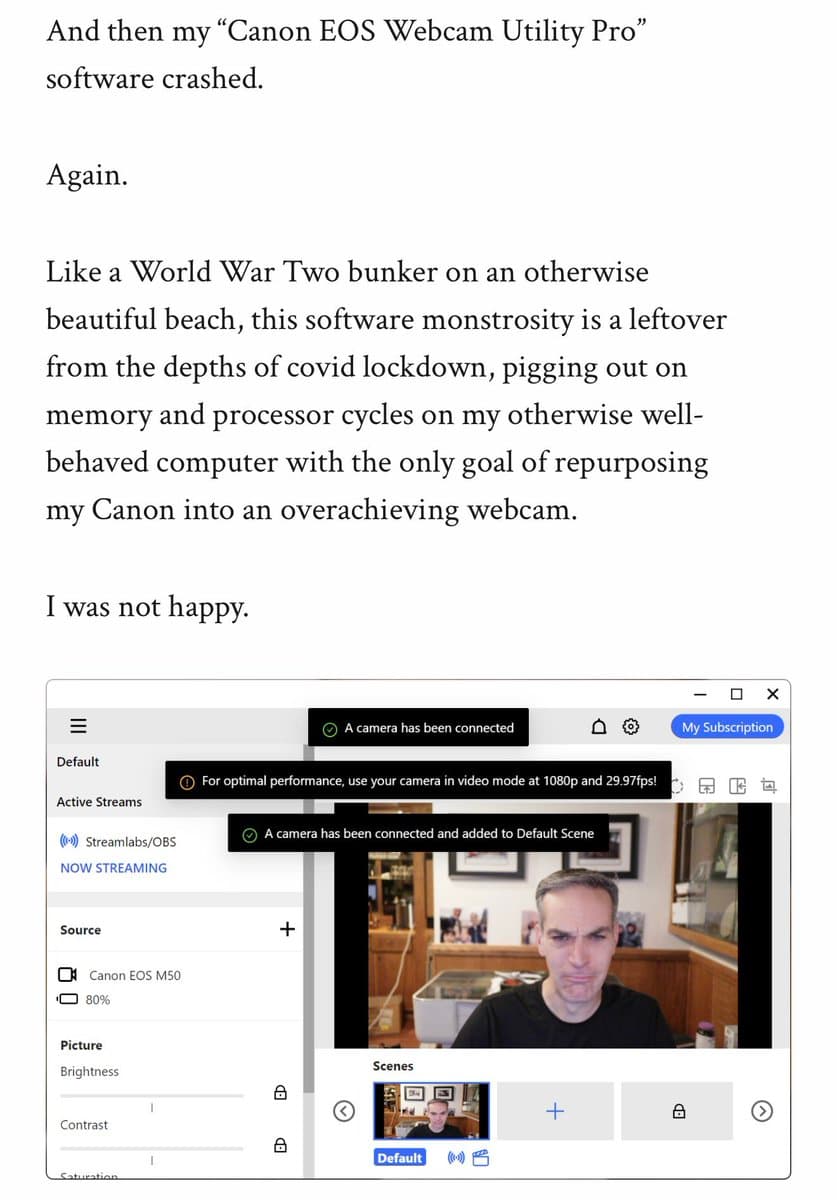
A developer has demonstrated the practical, real-world utility of AI coding assistants by using one to completely rewrite and fix the official webcam software for a Canon camera. The story, shared by Dan Shapiro and highlighted by researcher Ethan Mollick, shows an AI agent successfully tackling a long-standing, frustrating technical problem that the original vendor had not resolved.
What Happened
Dan Shapiro owned a Canon EOS R5 camera that he wanted to use as a webcam. The official software provided by Canon, Canon EOS Webcam Utility, was notoriously unreliable and would frequently crash. After enduring this for an extended period, Shapiro decided to task an AI coding agent with fixing the problem.
He provided the agent with the goal: create a stable webcam application for the Canon camera. Overnight, the AI agent worked autonomously. By morning, it had delivered a new, fully functional webcam application written in Rust. According to Shapiro, this Rust-based application has worked flawlessly ever since, completely replacing the buggy official software.
Context
This incident is a tangible example of AI moving beyond simple code completion or snippet generation into the realm of end-to-end software development and reverse engineering. The task required the AI to:
- Understand the hardware interface and protocol for the Canon camera.
- Reverse-engineer or find alternatives to the functionality of the official, closed-source driver.
- Design and implement a new software architecture in a different language (Rust).
- Produce a stable, usable application.
The use of Rust is notable, as it is a modern systems programming language prized for its memory safety and performance, suggesting the AI made a deliberate language choice suited to the task of a low-level device driver application.
gentic.news Analysis
This anecdote is a powerful data point in the ongoing evaluation of AI coding agents. It aligns with the trend we identified in our coverage of DeepSeek-Coder-V2 and Claude 3.5 Sonnet's performance on SWE-Bench, where models are demonstrating increasing proficiency at not just writing code, but understanding complex systems and delivering complete, working solutions. The key takeaway here isn't just that code was written, but that the AI performed problem diagnosis and system replacement—a higher-order task than typical coding assistance.
This story also intersects with the broader industry trend of AI-enabled reverse engineering and legacy system modernization, a topic we explored following Google's Project IDX announcements. Large companies like Canon often lack the resources to update niche utility software, creating a gap that AI tools are now beginning to fill for end-users. However, it's crucial to maintain perspective: this is a single success story. The reliability of AI agents in consistently delivering production-ready, secure software across diverse, undocumented hardware interfaces remains an open question. It demonstrates potential, not yet proven scalability.
Frequently Asked Questions
What AI coding agent was used in this story?
The original story shared by Dan Shapiro does not specify which AI coding agent he used. Popular agents capable of such tasks include Claude Code, GPT-Engineer, Aider, Cursor, or advanced uses of Claude 3.5 Sonnet or GPT-4 with code execution capabilities. The outcome highlights the capabilities of the current generation of AI coding tools in general.
Is it legal to reverse-engineer and replace Canon's software?
This touches on complex legal areas including reverse engineering and interoperability. Laws vary by jurisdiction, but many, like the U.S. Digital Millennium Copyright Act (DMCA), include exemptions for reverse engineering to achieve interoperability with independently created software. The legality often hinges on whether the AI agent created a clean-room implementation without directly copying protected code. Users should be aware of their local laws and the Canon software's End User License Agreement (EULA).
Why is rewriting the software in Rust significant?
Rust is a systems programming language designed for performance and, critically, memory safety. A common cause of crashes in C/C++ applications (like many device drivers) is memory corruption errors. Rust's compiler enforces strict rules that prevent entire classes of these errors. An AI agent choosing Rust suggests an architectural decision focused on creating a stable, crash-resistant foundation, which directly addressed the core problem with the original software.
Can I use AI to fix other broken device drivers or software?
Potentially, yes. This story provides a blueprint: define the clear functional goal (e.g., "create a stable driver for device X"), provide the AI with any available documentation or error logs, and let it iterate. Success is not guaranteed and depends heavily on the complexity of the hardware interface, the quality of the AI agent, and the user's ability to guide the process and test the output. It is currently an advanced, experimental use case.