The Innovation — What the source reports
In 2026, artificial intelligence is no longer a fringe experiment for online retailers—it's a core operational and strategic tool. According to a report from Digital Commerce 360, three major AI trends are reshaping ecommerce: agentic commerce, hyper-personalization, and back-end automation. These shifts are being driven by maturing AI models from companies like OpenAI, Shopify, and Walmart, and are delivering measurable business outcomes.
Agentic commerce refers to AI systems that can autonomously perform complex tasks—such as handling customer service inquiries, managing orders, and even negotiating returns—without human intervention. Shopify, for example, has integrated agentic AI into its platform, allowing merchants to automate customer interactions and streamline fulfillment. Walmart is using similar technology to power its online grocery ordering and curbside pickup systems.
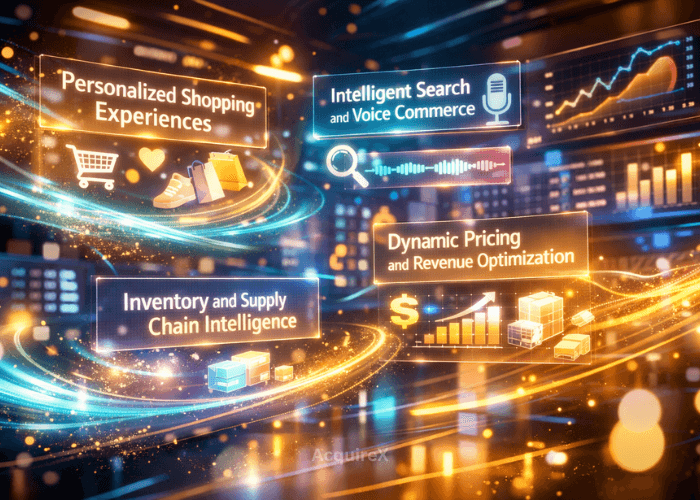
Hyper-personalization goes beyond basic product recommendations. Retailers are now using real-time data—including browsing history, purchase patterns, and even in-store behavior—to tailor every aspect of the shopping experience. This includes dynamic pricing, personalized email campaigns, and customized landing pages. OpenAI's GPT-5.3 and GPT-4o models are being used to generate natural language product descriptions and personalized offers at scale.
Back-end automation is perhaps the most impactful for profitability. AI is being deployed to optimize inventory management, detect fraud, and streamline logistics. Intel's new AI data center chips, announced in late 2026, are enabling faster, more cost-efficient processing of these workloads. Early adopters report cost reductions of up to 30% and conversion rate increases of 15-20%.
Why This Matters for Retail & Luxury
For luxury brands like Kering, Richemont, and Burberry, these trends are particularly relevant. Agentic commerce can handle high-touch customer service—such as scheduling appointments with personal shoppers or managing waitlists for limited-edition products—without diluting the brand experience. Hyper-personalization allows luxury retailers to offer bespoke recommendations that feel curated, not generic. Back-end automation helps manage complex supply chains for high-value, low-volume goods.
However, luxury brands must be cautious. Over-automation can erode the exclusivity and human touch that define luxury. The key is to use AI to enhance, not replace, the personal relationship between brand and customer.
Business Impact
The financial impact is significant. According to Digital Commerce 360, retailers using agentic commerce have seen customer service costs drop by 25-30%, while hyper-personalization has lifted average order values by 10-15%. Automation of back-end operations has reduced inventory carrying costs by up to 20%.
These numbers are supported by broader industry trends. Stifel recently upgraded Shopify to a Buy rating, citing agentic commerce as a key growth driver. OpenAI's partnership with Microsoft and its Stargate data center project in Texas (targeting 5 GW capacity) signal that the infrastructure for these AI capabilities is scaling rapidly.
Implementation Approach
For retailers looking to adopt these AI trends, the implementation path varies by use case:
- Agentic commerce: Requires integration with existing customer service platforms (e.g., Zendesk, Salesforce) and a robust AI model (e.g., OpenAI's GPT-5.3 or Anthropic's Claude). Start with simple tasks like order status inquiries, then scale to returns and refunds.
- Hyper-personalization: Needs a unified customer data platform (CDP) that ingests real-time data from web, mobile, and in-store sources. Use embedding models to create customer profiles and recommend products. Shopify's AI tools offer a low-code entry point.
- Back-end automation: Typically involves upgrading IT infrastructure to handle AI workloads. Intel's new AI chips (competing with Nvidia and AMD) are designed for these tasks. Cloud providers like AWS and Azure offer managed services for fraud detection and inventory optimization.
Governance & Risk Assessment
Privacy: Hyper-personalization relies on customer data, which raises GDPR and CCPA compliance concerns. Retailers must obtain explicit consent and anonymize data where possible.
Bias: AI models can perpetuate biases in product recommendations or pricing. Regular audits are essential.
Maturity: Agentic commerce is still emerging. While early results are promising, retailers should expect hiccups and invest in fallback human support.
Security: Automated systems handling orders and payments are attractive targets for cyberattacks. Intel's chip-level security features and OpenAI's GPT-Red (which found 84% of attacks in testing) offer some protection, but vigilance is required.
Retail & Luxury Implications
The implications for luxury are nuanced. Agentic commerce must be carefully designed to maintain brand voice—a chatbot that sounds too robotic can damage a luxury brand's perception. Hyper-personalization in luxury should focus on subtlety: suggesting a matching accessory rather than bombarding with discounts. Back-end automation is a clear win, as it frees up human staff to focus on high-value interactions.
Luxury brands should also watch the competitive landscape. Shopify's AI tools are democratizing agentic commerce for small and mid-market brands, potentially threatening the exclusivity that luxury houses rely on. Meanwhile, Walmart's use of AI for grocery pickup shows that automation can work even in high-volume, low-margin environments—a lesson for luxury's supply chain.
gentic.news Analysis
This Digital Commerce 360 report is a useful snapshot of where ecommerce AI stands in mid-2026, but it lacks granularity on specific technologies and timelines. The 30% cost reduction figure is consistent with other industry reports, but it's important to note that these results come from early adopters who likely had strong data infrastructure and AI expertise going in. For most retailers, the path to these outcomes will be slower and more incremental.
From an AI practitioner's perspective, the most interesting development is the shift from narrow AI (e.g., chatbots that answer FAQs) to agentic AI that can execute multi-step tasks. This requires not just better models, but also robust integration with enterprise systems—ERP, CRM, and supply chain software. The fact that Shopify and Walmart are leading here suggests that platform-native AI will be a key competitive differentiator.
For luxury brands, the risk is not in adopting AI too slowly, but in adopting it poorly. A poorly implemented agentic commerce system can damage brand equity faster than a human error. The governance section above is not optional; it's essential.
Looking ahead, the convergence of agentic commerce with hyper-personalization could create truly autonomous shopping experiences—where AI predicts a customer's needs, sources the product, and completes the purchase without the customer lifting a finger. That's the long-term vision, but for 2026, the focus should be on getting the basics right: cost savings, conversion lifts, and customer satisfaction.
Source: digitalcommerce360.com