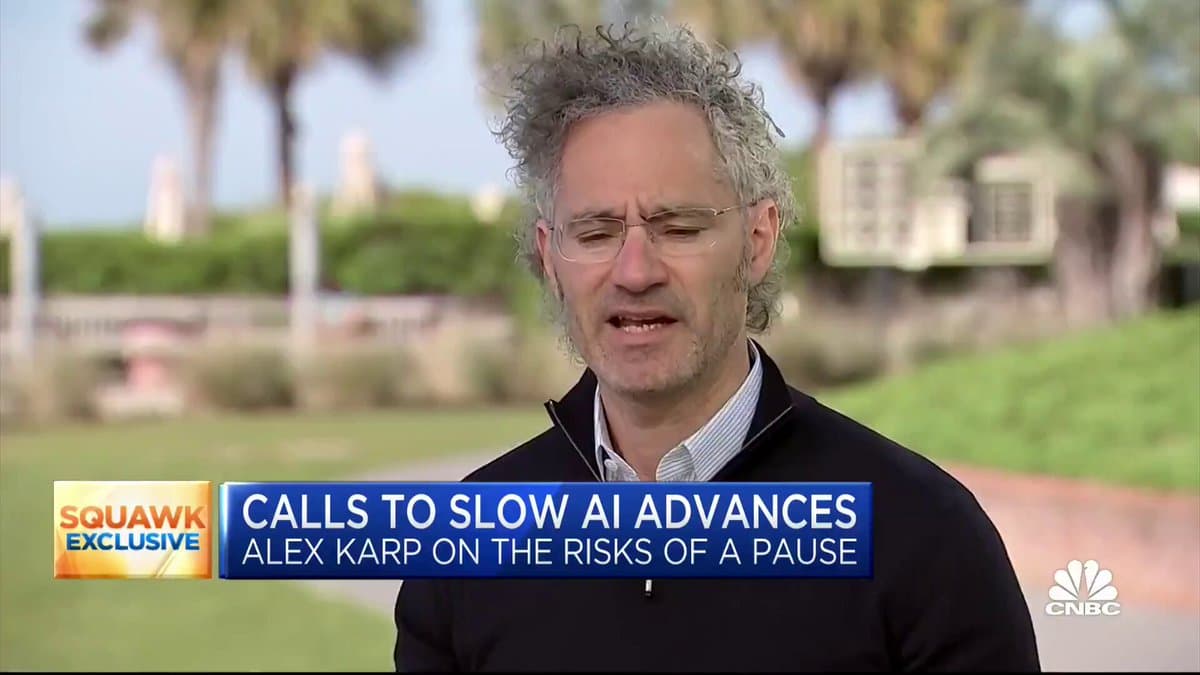
In a striking assessment of the current technological landscape, Palantir CEO Alex Karp has presented a dual argument that positions artificial intelligence not merely as another sector of innovation, but as the fundamental pillar sustaining U.S. economic growth and global strategic advantage. According to analysis shared by commentator @kimmonismus, Karp contends that the U.S. economy is growing almost exclusively through data center capital expansion driven by AI, and that without this expansion, the country would have already entered an economic recession.
This perspective emerges amid ongoing debates about AI safety, regulation, and calls from some quarters for development moratoriums. Karp's warning adds a layer of economic and geopolitical urgency to these discussions, suggesting that the stakes extend far beyond laboratory ethics into the core of national economic health and international power dynamics.
The Economic Lifeline Argument
Karp's first claim presents a sobering economic diagnosis. He posits that traditional drivers of U.S. economic growth are insufficient or faltering, and that the massive capital investment flowing into AI infrastructure—specifically the construction and operation of data centers—is currently the primary engine preventing contraction.
This aligns with observable trends. Major technology companies have announced hundreds of billions in data center investments over recent years. Microsoft, Google, Amazon, and Meta are engaged in an infrastructure arms race to support increasingly large and complex AI models. These projects involve not just server racks, but real estate, energy infrastructure, cooling systems, and semiconductor supply chains, creating a multiplier effect across the economy.
The argument implies that sectors like manufacturing, consumer spending, or traditional services are not providing enough growth momentum on their own. If accurate, this makes AI expansion less a choice and more a necessity for maintaining GDP growth, employment in related industries, and technological sector vitality. It frames AI not as a speculative bubble, but as a critical piece of national economic infrastructure that has already been woven into the country's growth narrative.
The Geopolitical Stakes: The China Factor
The second pillar of Karp's argument introduces a classic, yet intensified, dimension of great-power competition. He warns that China is hot on the heels of the U.S. in AI capability. A moratorium or significant slowdown in American development would, in this view, mean the end of its AI lead.
The consequences of losing this lead, Karp suggests, are enormous, spanning both research and military domains. In the research arena, leadership attracts top global talent, sets de facto standards, and creates the ecosystem for successive waves of innovation. The nation that leads in foundational AI research tends to dominate in its commercial and scientific applications.
The military implications are even more stark. AI is widely seen as a force multiplier and a potential source of strategic advantage in intelligence, cyber warfare, autonomous systems, and decision-support. A loss of leadership could alter the balance of power in critical regions and undermine decades of U.S. technological superiority in defense.
China's state-led, whole-of-nation approach to AI—with massive state funding, clear strategic goals outlined in plans like the "Next Generation Artificial Intelligence Development Plan," and fewer public debates about ethics moratoriums—creates a competitive dynamic where the U.S. cannot afford to pause without ceding ground.
The Impossibility of a Pause
Synthesizing these points, Karp concludes that under current circumstances, there is no way for the U.S. to implement a moratorium without causing itself significant harm. This is a direct rebuttal to calls from some AI ethicists and researchers for pauses in the development of the most powerful systems, such as the much-cited open letter advocating a six-month halt on giant AI experiments.
From Karp's perspective, such a halt is economically untenable and strategically perilous. The economic harm would be immediate, potentially triggering the recession currently being staved off by AI investment. The strategic harm would be longer-term but potentially irreversible, as China and other competitors would continue their own programs unabated, possibly achieving decisive breakthroughs.
This creates a profound policy dilemma: how to manage the very real risks of advanced AI—from disinformation and job displacement to potential long-term existential concerns—while maintaining the economic and strategic momentum that now appears indispensable.
Context and the Messenger
It is worth noting that Alex Karp leads Palantir, a company whose business model is deeply intertwined with data analysis, AI, and government contracts, particularly in defense and intelligence. His views naturally reflect the interests of his company and the sector. However, the substance of his arguments about economic dependency and geopolitical competition is echoed by a broader range of economists, national security experts, and policymakers in Washington.
The Biden administration's executive order on AI, while establishing safety standards, also explicitly aims to "maintain America's leadership" in the field. Legislative efforts, like the proposed federal funding for AI research via the CREATE AI Act, similarly frame AI advancement as a national priority. Karp's comments thus crystallize a growing consensus within the U.S. establishment, even if his formulation is particularly blunt.
The Road Ahead
The implications of accepting Karp's premise are significant. If AI expansion is the primary bulwark against recession, then policy must prioritize maintaining its investment trajectory. This could influence interest rate decisions, tax incentives for capital expenditure, energy policy to power data centers, and immigration policy to attract AI talent.
If maintaining a lead over China is an imperative, then national AI strategy becomes inseparable from national security strategy. This could lead to increased public investment in AI research, tighter controls on technology exports, and deeper partnerships between the Pentagon, intelligence agencies, and Silicon Valley.
It also suggests that the governance of AI will be shaped overwhelmingly by the logic of competition rather than the logic of caution. Safety measures and ethical guidelines will need to be designed in ways that do not meaningfully slow the pace of advancement relative to rivals.
In essence, Karp's argument is that the U.S. has entered an AI race with its economy and its strategic position on the line. From this vantage point, the question is no longer whether to push forward aggressively, but how to do so while managing the profound risks that accompany the technology. The era of AI as a purely scientific or commercial endeavor is over; it is now, irrevocably, a matter of national economic and strategic necessity.
Source: Analysis based on arguments attributed to Alex Karp as presented by @kimmonismus on X/Twitter.