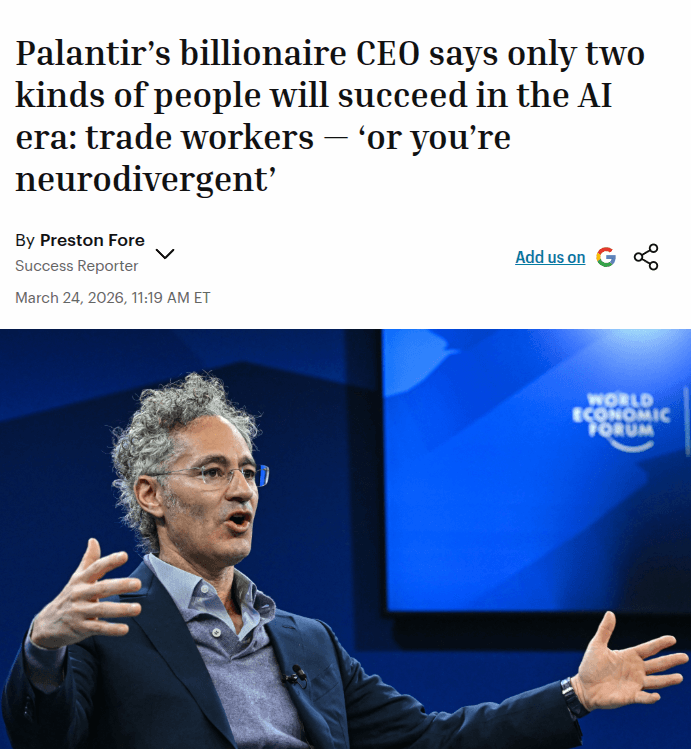
In a recent interview, Palantir Technologies CEO Alex Karp outlined a counterintuitive vision for who will thrive in the AI-driven future. According to Karp, the two groups poised to be most rewarded are not necessarily elite software engineers, but people with hands-on trade skills and people who think in unusually original ways.
Karp, whose data analytics company works extensively with defense, intelligence, and industrial sectors, suggested that neurodivergent individuals may be particularly well-suited for the AI era. He noted they often "notice patterns others miss, question standard assumptions, and build ideas from odd angles"—capabilities he views as increasingly critical as AI automates more routine cognitive tasks.
What Karp Argued
The core of Karp's argument, as reported, is a bifurcation of valuable human labor in an AI-saturated world.
1. The Value of Hands-On, Vocational Skills
Karp highlights trades—think electricians, welders, advanced manufacturing technicians, and field engineers—as a resilient category. These roles involve physical dexterity, real-world problem-solving in unstructured environments, and the integration of digital tools (including AI assistants) with tangible outcomes. As AI proliferates in knowledge work, the demand and compensation for skilled trades that are difficult to fully automate may rise.
2. The Premium on Unconventional, Original Thinking
The second group comprises individuals who can generate novel frameworks, ask foundational questions, and connect disparate concepts. Karp explicitly links this to neurodivergence (e.g., some forms of autism, ADHD, dyslexia), where cognitive differences can lead to exceptional pattern recognition, system-level thinking, and creativity. In an era where AI can execute on well-defined instructions, the ability to define new problems and imagine entirely new solutions becomes a scarce and valuable commodity.
Context: Palantir's AI Focus and Karp's Philosophy
This commentary is not abstract for Karp. Palantir has aggressively pivoted to AI, launching its Artificial Intelligence Platform (AIP) and conducting immersive "boot camps" with clients to deploy AI in operational settings, from logistics to battlefield decision-making. Karp's view is likely informed by seeing which human roles remain indispensable when organizations are equipped with powerful AI tools.
His perspective directly challenges a common anxiety that AI will primarily displace blue-collar or manual work. Instead, he implies a significant disruption to middle-tier analytical and administrative roles, while elevating both high-context physical work and elite, non-conformist cognition.
gentic.news Analysis
Karp's thesis aligns with several emerging threads in the AI landscape we've been tracking, yet frames them through a distinctively Palantir lens. First, it echoes the growing discourse around "human-in-the-loop" systems in critical infrastructure, where AI assists but cannot replace the judgment of a skilled operator—whether that's a technician maintaining a power grid or a surgeon in an operating room. This isn't just about automation resistance; it's about synergy where human expertise guides and validates AI output.
Second, the emphasis on neurodivergent thinking connects to a tangible trend in AI research and development. We've covered how companies like Google DeepMind and OpenAI seek researchers with deep, often unconventional, mathematical and conceptual intuition. The problems at the frontier—like reasoning, long-horizon planning, and true understanding—may not yield to incremental engineering alone. This follows our analysis of the "scaling laws" debate, where some argue that pure scale is hitting diminishing returns and novel algorithmic insights are needed. Individuals who can provide those insights are, as Karp suggests, becoming more valuable.
However, Karp's view from Palantir's fortress—serving governments and large enterprises—may underweight other thriving paths in the AI era. He doesn't deeply address the entrepreneurial layer: individuals and small teams using accessible AI tools to build products and companies, a trend powered by the very software platforms Palantir competes with. The success of the AI era may also belong to agile synthesizers who can leverage AI across the stack, not just deep specialists or original thinkers in isolation.
Ultimately, Karp provides a valuable, experience-based corrective. The future isn't solely about everyone learning to prompt an LLM. It may be about deepening mastery in domains where AI is a powerful tool but not the master, and cultivating the uniquely human cognitive diversity that AI cannot replicate.
Frequently Asked Questions
What did Alex Karp say about AI and jobs?
Palantir CEO Alex Karp stated that AI will most reward two groups: people with hands-on trade skills (like electricians or technicians) and people who think in unusually original, often neurodivergent, ways. He argues that as AI automates routine cognitive tasks, these human capabilities will become more valuable.
Why does Alex Karp think neurodivergent people may excel in the AI era?
Karp suggests that neurodivergent individuals often notice patterns others miss, question standard assumptions, and build ideas from unique angles. These traits—strong pattern recognition, system-level thinking, and unconventional problem-framing—are areas where human cognition can complement and guide AI, which excels at execution within defined parameters.
Is Palantir itself investing in AI based on this philosophy?
Yes. Palantir has fully embraced AI, launching its Artificial Intelligence Platform (AIP) and conducting intensive AI boot camps for clients. The company's focus is on deploying AI in high-stakes, operational environments (defense, intelligence, heavy industry), where human expertise in the field and unconventional analytical thinking are critical to successfully implementing and trusting AI systems.
How does this view contrast with common fears about AI and employment?
Common narratives often fear AI will displace manual or routine jobs first. Karp's view implies a different disruption pattern: AI may significantly impact mid-level analytical, administrative, and even some software roles, while increasing the value of both high-skill manual trades (hard to automate fully) and elite, non-conformist cognitive work (hard to automate at all).