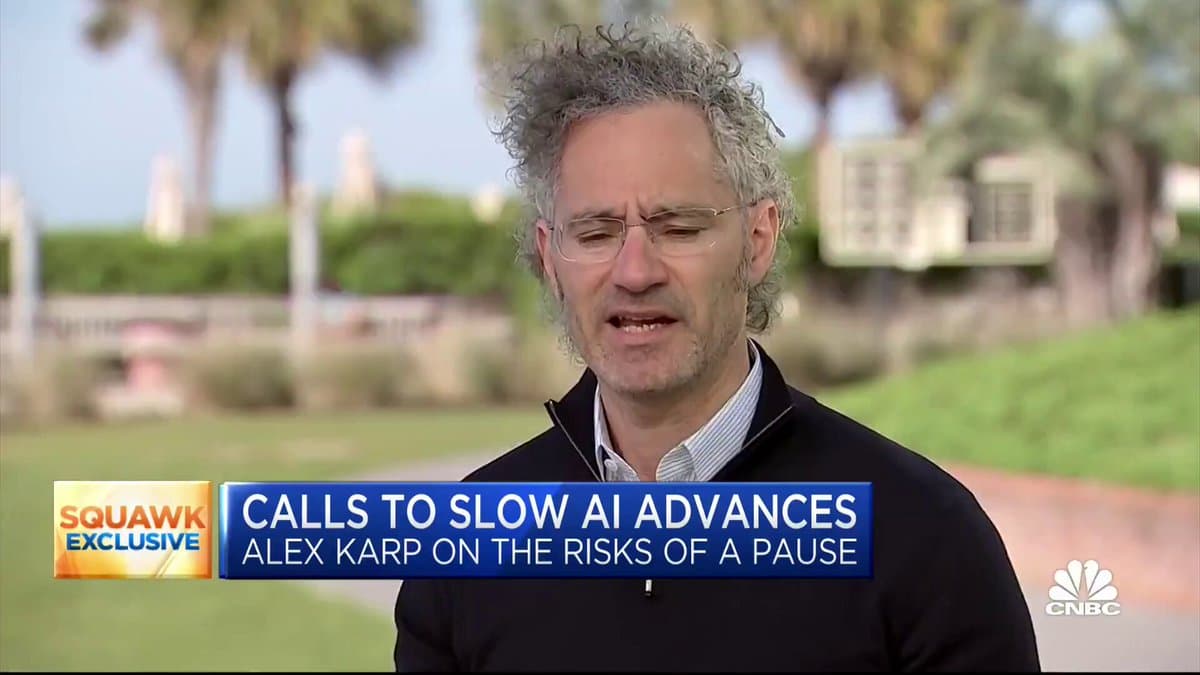
In a striking admission that cuts to the heart of the global AI race, Palantir Technologies CEO Alex Karp has articulated a tension facing leaders in the field. According to a post by AI commentator Rohan Paul, Karp stated: "If we didn't have adversaries, I would be very in favor of pausing this technology completely, but we do." This brief remark, shared on social media platform X, encapsulates a profound dilemma shaping national strategies and corporate ethics in artificial intelligence.
The Context of the Statement
Alex Karp, co-founder and CEO of the controversial data analytics and defense contractor Palantir, is no stranger to the intersection of advanced technology, national security, and geopolitical competition. His company's software is used by U.S. intelligence agencies, military branches, and allied governments for data integration and analysis. Therefore, his perspective is inherently informed by a worldview where technological supremacy is directly tied to strategic advantage.
The statement appears to be a direct response to the ongoing debate about AI safety and governance. For years, researchers, ethicists, and even some industry leaders have called for pauses, moratoriums, or stringent regulations on the development of advanced AI, particularly artificial general intelligence (AGI). These calls often cite existential risks, alignment problems, and potential societal disruption. Karp’s hypothetical support for a pause aligns him, in principle, with some of these concerns.
However, the crucial second clause—"but we do"—serves as the pivot. It acknowledges a world of state and non-state adversaries where technological stagnation is perceived as a form of unilateral disarmament. This reflects a core tenet of great power competition, where the development of dual-use technologies like AI is seen as a zero-sum game. If one nation pauses, others may accelerate, creating a dangerous power imbalance.
The Economic Engine of AI
The source material adds a critical economic dimension to Karp's geopolitical point. It notes: "And the fact remains that US economic growth currently largely relies on AI related infra investments." This is not merely an observation but a powerful argument against any broad-based pause.
Over the past two years, a significant portion of U.S. capital expenditure and market growth has been driven by investments in AI infrastructure. This includes:
- Semiconductor fabrication plants for advanced chips.
- Data center construction and expansion to handle massive AI workloads.
- Cloud computing infrastructure built by giants like Amazon Web Services, Microsoft Azure, and Google Cloud.
- Venture capital flowing into AI startups and foundational model developers.
This investment cycle is creating jobs, driving innovation in adjacent sectors, and is widely seen as the next major platform shift in computing. To pause core AI development would risk stalling this economic engine, potentially leading to a loss of competitiveness not just in technology, but across manufacturing, finance, healthcare, and logistics.
Analysis: The Realpolitik of AI Development
Karp’s statement is a masterclass in technological realpolitik. It separates the idealistic goal of cautious, controlled development from the messy reality of international competition. His position suggests that the primary constraint on AI development is no longer just technical feasibility or capital availability, but the actions of perceived adversaries—likely referring to nations like China, which has stated its ambition to become the world leader in AI by 2030.
This creates a security dilemma in the digital realm. One nation's defensive investment in AI for cybersecurity or intelligence analysis is seen as an offensive threat by another, spurring a cycle of acceleration. A voluntary pause by Western companies or governments, in this view, would simply cede the field, allowing other actors to set the technological standards, control the supply chains, and potentially weaponize the technology's advantages.
The Implications for Policy and Ethics
Karp’s admission has significant implications for how AI governance might evolve:
National Security Will Trump Global Moratoriums: Broad, international pauses akin to those proposed for genetic engineering or chemical weapons are less likely for AI. Governance will instead focus on export controls (like those on advanced chips), security guidelines for model weights, and domestic use regulations, rather than on stopping development outright.
The Public-Private Partnership Model Strengthens: Companies like Palantir, OpenAI (with its capped-profit structure and close ties to Microsoft), and Anthropic (founded with a focus on safety) are becoming strategic national assets. Their development roadmaps are increasingly intertwined with government priorities for economic and national security.
The Burden Shifts to Safe Acceleration: If a pause is off the table, the ethical imperative becomes how to develop AI safely and responsibly at speed. This places enormous pressure on alignment research, red-teaming, and the development of robust governance frameworks that can keep pace with capability advances.
A New Argument for Investment: Karp provides a clear, dual-purpose rationale for continued massive investment in AI: it is both an economic necessity for growth and a geopolitical imperative for security. This argument is likely to resonate powerfully in Washington D.C. and other world capitals.
Conclusion: Navigating an Unpausable Future
Alex Karp’s candid remark reveals a consensus forming among a certain class of tech leader and policymaker: the AI genie is out of the bottle, and the focus must be on managing its trajectory in a competitive world, not on wishing it back in.
The dream of a coordinated global "time-out" to carefully plan our AI future seems increasingly quixotic against the backdrop of economic dependency and strategic rivalry. The challenge now is to build the guardrails, treaties, and ethical norms for a technology that is developing in the context of a race. The goal is no longer to stop the car, but to ensure it has the best possible brakes, steering, and rules of the road while everyone else is also pressing the accelerator.
Source: Statement by Palantir CEO Alex Karp, as shared by @rohanpaul_ai on X, May 28, 2025.