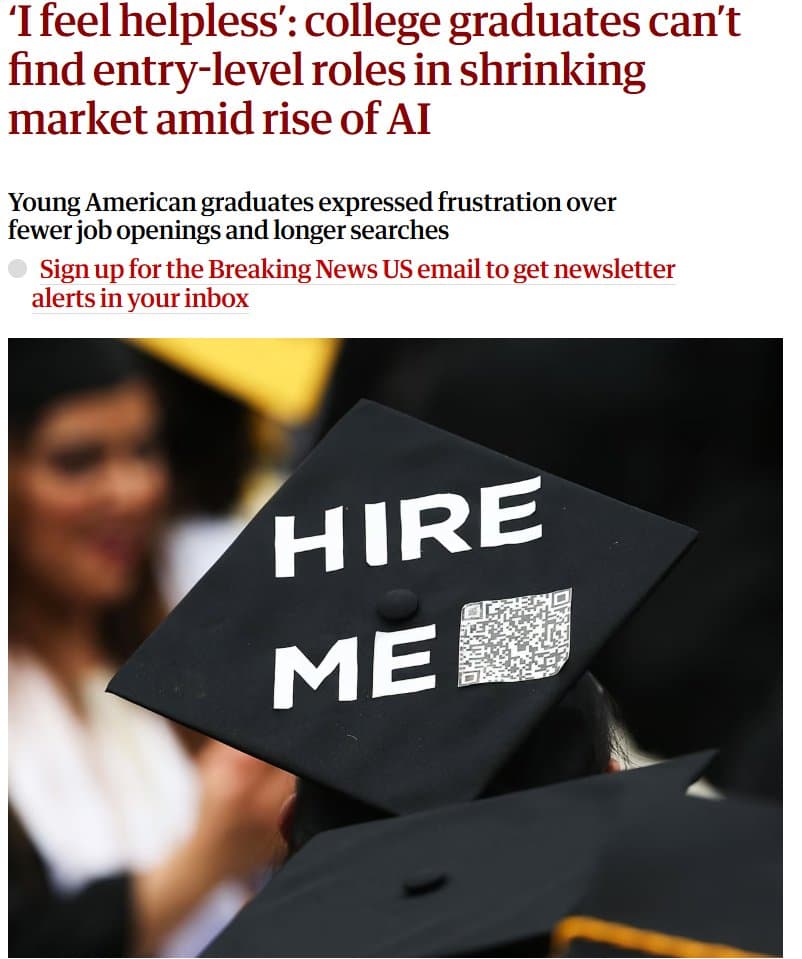
A new report highlights a grim reality for recent graduates: a shrinking entry-level job market where underemployment has hit 42.5%, the highest rate since 2020. While economic factors play a role, a significant and growing point of friction is the widespread adoption of AI-driven hiring systems. These automated gatekeepers are forcing candidates to spend excessive time optimizing their resumes for algorithmic parsing before a human recruiter ever sees their application, adding a frustrating and opaque layer to an already difficult process.
Key Takeaways
- Young graduates face a 42.5% underemployment rate, the highest since 2020, with AI hiring systems creating a frustrating layer of resume optimization before human review.
- This occurs as broader AI adoption in business is still in its early stages.
The AI Hiring Bottleneck
Candidates report sending dozens of applications into a void, frequently experiencing "ghosting" (no response) and facing job postings with unrealistic experience demands for entry-level roles. The integration of Applicant Tracking Systems (ATS) and AI-powered resume screeners has fundamentally changed the initial phase of job hunting. The primary task is no longer crafting a compelling narrative for a human manager but engineering a document that will score highly on specific keyword matching, formatting rules, and semantic analysis performed by software.
This creates a dual burden: candidates must be qualified for the role and technically proficient in reverse-engineering often-unknown AI screening criteria. The result is a market where the ability to "game the ATS" can be as valuable as the skills listed on the resume itself, disproportionately affecting new graduates who lack the resources or knowledge to navigate these systems effectively.
A Market Still in Early Stages
The report underscores a critical tension: while AI hiring tools are creating significant pain points for job seekers, the broader adoption of AI in business operations is described as having "barely even started." This suggests that the current challenges are not the endpoint but rather the early symptoms of a larger transformation. The hiring function, often an early candidate for automation due to its volume and pattern-matching nature, is serving as a frontline experiment for AI integration, with job seekers as the test subjects.
As these systems evolve from simple keyword matchers to more sophisticated LLM-driven analyzers capable of scoring writing samples or simulated tasks, the gatekeeping function of AI in hiring will likely become more profound, not less.
The Human Cost of Automated Screening
The 42.5% underemployment figure represents a massive underutilization of talent and education. When qualified graduates are filtered out by an algorithm for failing to include a specific phrase or using an incompatible file format, it represents a systemic inefficiency. The "frustrating layer" described is more than an inconvenience; it contributes to career delays, student debt burdens, and a erosion of trust in the job market's fairness. The process favors those with insider knowledge of how these systems work, potentially exacerbating existing inequalities.
gentic.news Analysis
This report aligns with a growing trend we've tracked in the enterprise AI sector: the rapid deployment of point-solution automation in HR and recruiting, often ahead of broader, more integrated AI transformation. Companies like HireVue (which uses AI analysis of video interviews) and Pymetrics (which uses neuroscience-based games and AI) have seen increased adoption, aiming to reduce bias and increase efficiency. However, as this data shows, the outcome for candidates can feel like an opaque, machine-driven gauntlet.
This development directly connects to our previous coverage on LLM evaluation benchmarks (like SWE-Bench or GPQA). The same core technology—large language models trained to assess text—is being deployed in a high-stakes, real-world setting: evaluating human potential. A key difference is that while AI research benchmarks are transparent with their rubrics, commercial hiring algorithms are almost always black boxes. This creates a significant asymmetry of information.
Furthermore, this trend contradicts the optimistic narrative pushed by some AI lab leaders, such as OpenAI's Sam Altman and Anthropic's Dario Amodei, who have emphasized AI's potential to augment human productivity and create new job categories. For today's graduates, the immediate experience is of AI acting as a barrier to employment, not a catalyst. The data suggests that the job-displacement and job-transformation effects of AI are hitting the entry-level market first and with notable force, potentially reshaping career trajectories before the promised augmentation benefits materialize.
Looking at the timeline, the post-2020 period mentioned in the report coincides with the explosion of accessible LLM APIs (following GPT-3.5 and GPT-4 releases). It is highly likely that the sophistication and deployment speed of these hiring tools accelerated dramatically in this period. The 42.5% underemployment rate is not just an economic indicator; it is a early metric for the societal integration curve of applied AI.
Frequently Asked Questions
What is an AI-driven hiring system?
AI-driven hiring systems, often part of an Applicant Tracking System (ATS), use algorithms to automatically screen, rank, and filter job applications. They can parse resumes for keywords, skills, education, and experience, sometimes using natural language processing to understand context. Their goal is to reduce the volume of applications a human recruiter must review by identifying the candidates that best match the job description.
How can I optimize my resume for an AI hiring system?
To pass an AI screen, use standard section headings (e.g., "Work Experience," "Education"), incorporate keywords from the job description naturally into your bullet points, use a simple, machine-readable format (like a Word document or PDF without complex graphics or columns), and avoid headers/footers that might confuse the parser. The key is to make your resume easily digestible for text-extraction software.
Do AI hiring systems reduce bias or increase it?
This is a major debate. Proponents argue AI can reduce human biases by focusing purely on skills and keywords. Critics, and numerous studies, show that AI systems often inherit and amplify biases present in their training data (e.g., penalizing resumes from women's colleges or certain ethnic names). Because the algorithms are proprietary, auditing them for fairness is extremely difficult.
Is the 42.5% underemployment rate solely because of AI?
No. Underemployment is caused by a complex mix of economic factors, including market saturation in certain degrees, economic slowdowns, and corporate caution. However, the report identifies AI hiring systems as a significant and frustrating contributing factor that adds a new, complex layer to the job search process, potentially preventing good matches between candidates and roles.