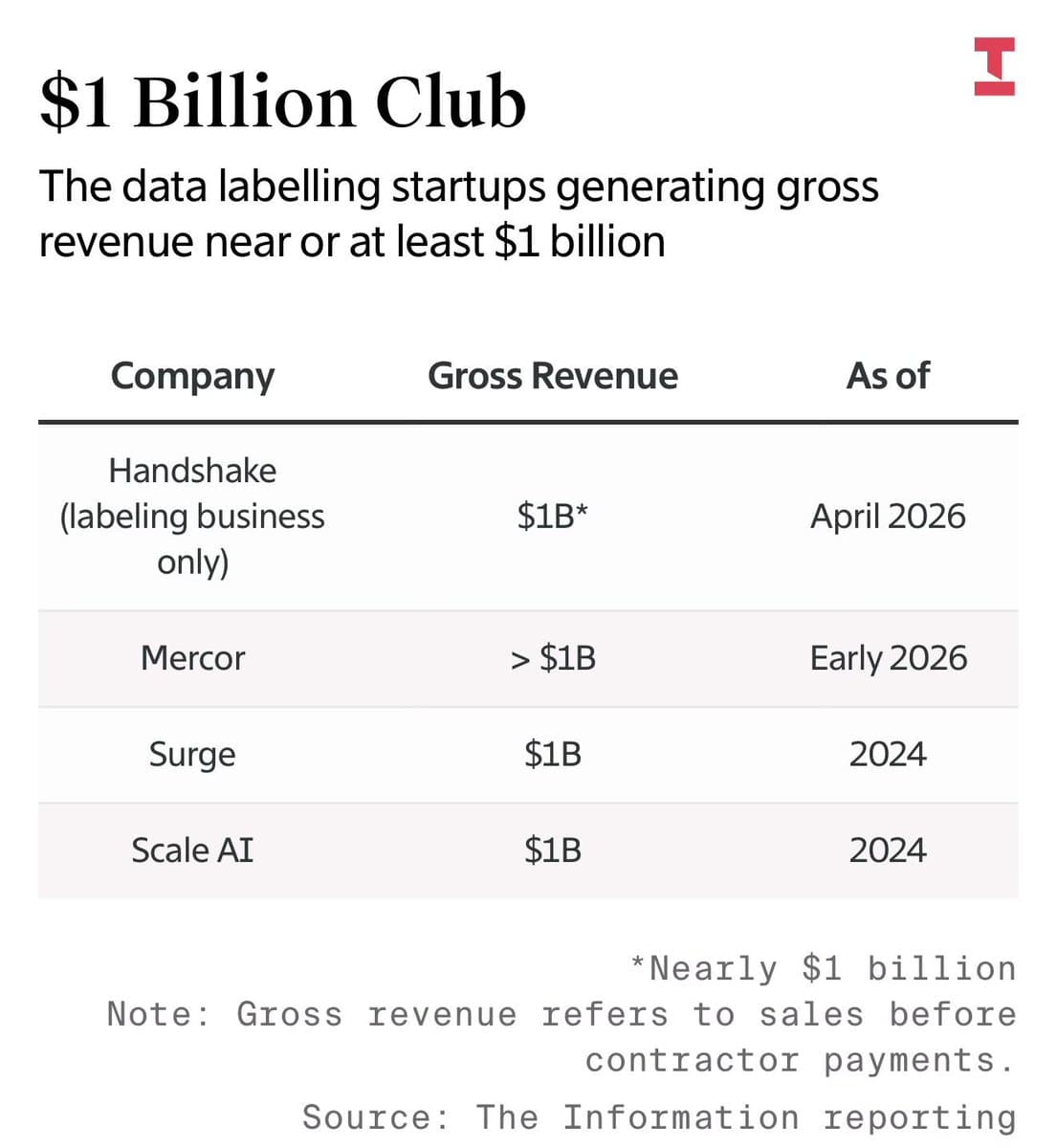
A prominent trend in AI development is emerging: the frontier model race is not automating away human expertise but is instead creating a massive, specialized labor market for it. The value of expert human feedback is increasing as models become more capable, shifting the industry's focus from pure software engineering to large-scale, human-in-the-loop operations.
What's Happening: The Rise of the Feedback Layer

The core observation is that advanced AI models, particularly large language models (LLMs) and multimodal systems, require immense amounts of high-quality, nuanced human input to improve. This need scales with model capability. The labor market is expanding to include:
- Domain Experts: Specialists in law, medicine, biology, or finance who can provide accurate, nuanced information and critique model outputs in their field.
- Evaluators & Annotators: Workers who systematically assess model responses for safety, accuracy, helpfulness, and alignment, creating the labeled data for reinforcement learning from human feedback (RLHF) and related techniques.
- Red-Teamers: Individuals who proactively stress-test models to uncover biases, vulnerabilities, or potential harmful outputs.
- High-Signal Data Generators: People capable of creating the complex, multi-step reasoning, creative writing, or expert dialogue that forms the next generation of training data.
This represents a structural shift. Building AI is becoming less like writing a monolithic application and more like managing a continuous, global-scale human feedback loop where quality and expertise are the primary bottlenecks.
The Technical Driver: The Insatiable Appetite for Quality Data
The trend is driven by a fundamental technical reality: the performance ceiling for models trained solely on passively scraped internet data has been largely reached. Further gains—especially in reasoning, reliability, and niche expertise—require actively curated, high-signal datasets. This is the "feedback layer" of AI development, and it is labor-intensive.
Major labs like OpenAI, Anthropic, and Google DeepMind now operate vast data operations. For instance, training a state-of-the-art model involves thousands of human hours for:
- Preference Modeling: Generating millions of comparisons where humans choose the better of two model outputs.
- Constitutional AI & Rule-Based Feedback: Having humans write and refine the principles (constitutions) that guide AI self-critique and improvement.
- Specialist SFT (Supervised Fine-Tuning): Creating expert-level conversations and Q&A pairs in specific verticals.
This work cannot be fully automated by current AI; it requires human judgment, cultural context, and expert knowledge. The model's capability becomes a function of the quality and scale of this human feedback.
Market Implications: A New Gig Economy for Expertise

This shift is spawning a new sector within the tech economy. Companies like Scale AI, Labelbox, and Surge AI have evolved from basic data labeling platforms into sophisticated marketplaces for expert-level annotation and evaluation. They are building networks of vetted specialists—from PhDs to practicing professionals—who contribute to model training.
The economics are also changing. While early data labeling was often low-wage, the demand for true domain expertise is creating higher-value roles. Annotating legal contracts or evaluating medical diagnostic suggestions commands a premium compared to classifying images.
gentic.news Analysis
This observation aligns with a clear pattern we've tracked across the industry. It contextualizes several recent developments we've covered. For instance, our reporting on Anthropic's expansion of its Constitutional AI methodology highlighted their increased reliance on large teams of human researchers and red-teamers to define and refine AI principles—a direct example of scaling human operations for model alignment.
Similarly, the fierce competition between OpenAI and xAI isn't just about compute and algorithms; it's also a race to secure exclusive access to unique, high-quality data streams and the human expertise needed to curate them. This trend contradicts a common public narrative that AI development is purely about replacing human labor. Instead, it reveals a symbiotic, if complex, relationship where advanced AI both demands and creates new forms of specialized human work.
Looking at the knowledge graph, entities like Scale AI (📈) show marked increased activity, with funding rounds and partnerships specifically aimed at capturing this expert-level data market. The trend suggests that the next competitive moat for AI labs may not be a secret architecture, but a proprietary, scaled network of human experts feeding their training pipelines.
Frequently Asked Questions
Why can't AI automate the creation of its own training data?
Current AI models are fundamentally limited by the data they were trained on. They excel at interpolating within their training distribution but struggle to generate genuinely novel, high-quality reasoning or expert knowledge beyond it. Creating that next tier of data requires human creativity, intuition, and real-world expertise that the models do not yet possess. It's a bootstrapping problem.
Is this just another form of "clickwork" or low-paid gig labor?
While some basic data annotation remains, the growing demand is for expertise. The market is bifurcating. There is still volume work (e.g., basic preference labeling), but the high-value, bottleneck work involves domain specialists—lawyers, scientists, engineers—whose input is critical for advancing model capabilities in specific areas. This commands significantly higher compensation.
How does this affect the business model of AI companies?
It significantly increases operational costs beyond just cloud compute. AI labs must now build and manage large, global human operations teams. This makes the development process more akin to running a "factory" with a quality control floor, impacting margins and scaling dynamics. It also creates strategic advantages for companies that can build loyal networks of expert contributors.
What skills are most valuable in this new labor market?
Deep domain knowledge in a specialized field (medicine, law, coding), combined with the ability to clearly articulate that knowledge and critique AI outputs, is paramount. Skills in prompt engineering, evaluation rubric design, and an understanding of basic ML concepts are also highly valuable, creating a hybrid role of "domain expert + AI trainer."