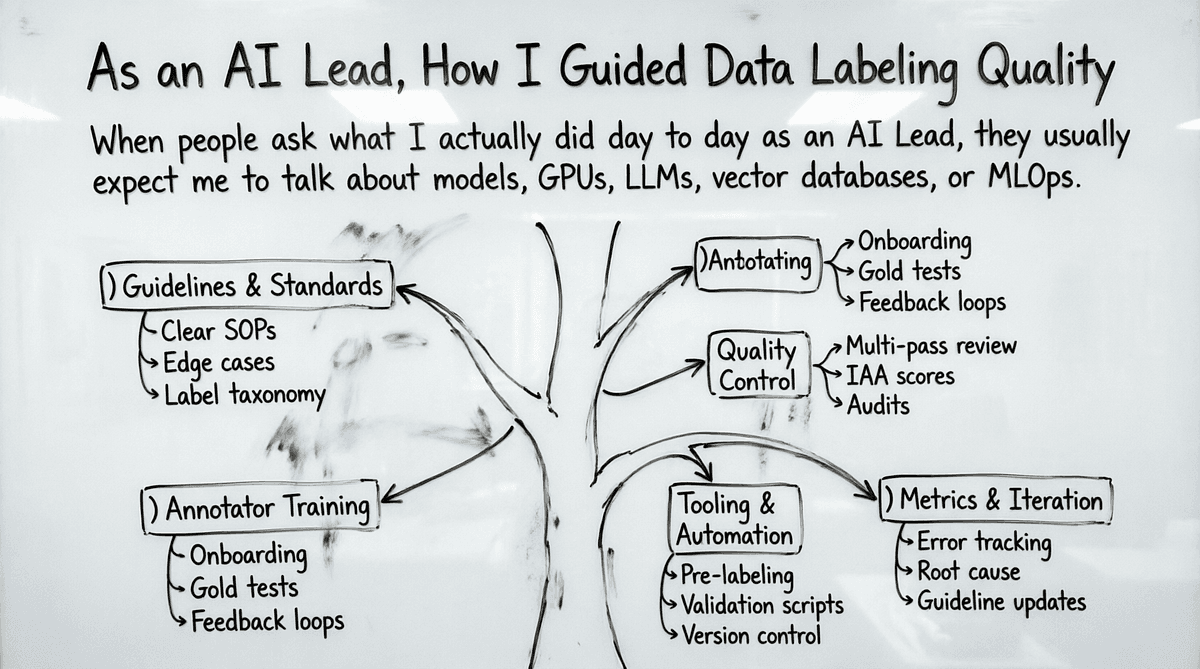
An AI Lead reports spending 80% of engineering time on data labeling, not model architecture. The admission, published on Medium by NextGenAI, exposes a persistent gap between MLOps theory and production reality.
Key facts
- 80% of engineering time spent on data labeling.
- Model architecture called 'easiest part of the pipeline'.
- Article published on NextGenAI Medium channel.
- LLM commoditization shifts moat to data pipelines.
- MLOps tooling gap persists in data preparation layer.
The piece, written by a practitioner identified only as an AI Lead, details a day-to-day reality that diverges sharply from the research-focused narrative dominant in large language model (LLM) discourse. [According to the source] Data labeling consumed roughly 80% of engineering time, with model selection and tuning relegated to a minority share.
The Data Bottleneck
The author contrasts their experience against the typical portrayal of AI work—training runs, GPU allocation, vector database tuning—noting that "the model architecture was often the easiest part of the pipeline." This echoes a structural observation: as LLMs commoditize via open-weight releases (Meta's Llama, Mistral), the competitive moat shifts to proprietary data pipelines. [Per the article] Most teams underestimate the infrastructure cost of maintaining high-quality labeled datasets.
MLOps Gap
The admission underlines a known but under-discussed friction in MLOps. While the field has produced sophisticated tooling for model deployment, monitoring, and retraining (MLflow, Kubeflow, Weights & Biases), the data preparation layer remains manual and brittle. The author's experience suggests that even at the AI Lead level, the bottleneck is not compute or architecture—it's labeled data.
Why This Matters

The unique take here is not that data is important—that is well-established. The take is that the time allocation asymmetry (80% labeling vs. 20% modeling) is a structural artifact of current MLOps immaturity, not a fundamental law of AI engineering. If the field is to scale beyond bespoke deployments, the labeling bottleneck must be automated or eliminated, perhaps through synthetic data generation or self-supervised techniques that reduce human annotation requirements.
What to watch
Watch for synthetic data generation startups (e.g., Gretel, Mostly AI) to publish production benchmarks comparing labeled data quality against human-annotated baselines. If synthetic data matches or exceeds human quality at scale, the 80% labeling tax may shrink.