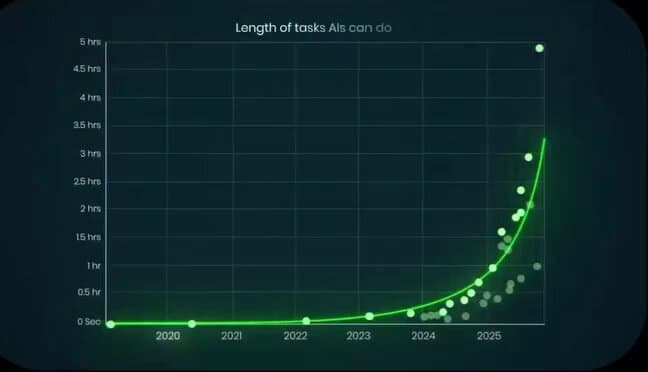
A striking visualization circulating in AI research circles reveals what many experts consider the most significant development in artificial intelligence: the exponential growth in AI's ability to handle increasingly complex and lengthy tasks. This isn't just about better algorithms or faster processing—it represents a fundamental shift in what artificial intelligence can accomplish, moving from simple, discrete commands to sophisticated, multi-step operations that mirror human cognitive processes.
The Visualization That Changed Perspectives
The visualization, shared by AI researcher @kimmonismus on social media platform X, demonstrates through clear graphical representation how AI task length capabilities have grown exponentially in recent years. While the exact metrics and timeframes aren't specified in the source material, the core message is unmistakable: what was once limited to brief interactions has expanded dramatically, enabling AI systems to process, understand, and execute increasingly complex sequences of instructions.
This development goes beyond mere technical improvement—it represents what the source describes as "why it's such a revolutionary technology." The ability to handle longer, more complex tasks fundamentally changes the relationship between humans and AI systems, transforming them from simple tools into collaborative partners capable of understanding context, maintaining coherence across extended interactions, and executing sophisticated workflows.
From Simple Commands to Complex Operations
Historically, AI systems excelled at narrow, well-defined tasks with clear boundaries. Early chatbots could answer simple questions, image recognition systems could identify objects in photos, and language models could generate short paragraphs. The limitation was always task length and complexity—these systems struggled with extended dialogues, multi-step problem solving, or maintaining context across lengthy interactions.
The exponential development visualized by @kimmonismus shows how this limitation has been systematically overcome. Modern AI systems can now engage in extended conversations, follow complex instructions spanning multiple paragraphs, analyze lengthy documents, and execute sophisticated sequences of operations without losing coherence or context. This represents a qualitative leap in artificial intelligence capabilities that has profound implications across every sector of society.
Technical Foundations of the Exponential Growth
Several key technological advancements have driven this exponential development in AI task length capabilities. Transformer architectures, particularly attention mechanisms, allow AI systems to process and relate information across much longer sequences than previous models. Improved training techniques, including reinforcement learning from human feedback (RLHF), have enabled systems to maintain coherence and relevance across extended interactions.
Memory architectures and context window expansions have been particularly crucial. Where early language models might have struggled with context beyond a few hundred tokens, modern systems can handle tens of thousands or even hundreds of thousands of tokens, allowing them to reference earlier parts of lengthy conversations or documents. This technical foundation enables the exponential growth visualized by @kimmonismus, creating systems that can engage with complex, multi-faceted problems rather than simple, isolated tasks.
Practical Implications Across Industries
The exponential development of AI task length capabilities has immediate practical implications across virtually every industry. In healthcare, AI systems can now analyze complete patient histories rather than isolated symptoms, leading to more accurate diagnoses and personalized treatment plans. In legal and financial sectors, AI can process lengthy contracts or financial reports, identifying patterns and risks that would be impractical for humans to detect manually.
Creative industries are experiencing perhaps the most visible transformation. Where AI once generated short snippets of text or simple images, modern systems can now produce complete articles, detailed illustrations with specific stylistic requirements, or even coordinate complex multimedia projects. This represents not just incremental improvement but a fundamental shift in how creative work can be approached and executed.
Education stands to benefit significantly as well. AI tutors can now engage in extended dialogues with students, adapting explanations based on the student's responses and maintaining context across multiple learning sessions. This creates personalized learning experiences that were previously impossible to scale, potentially revolutionizing how knowledge is transmitted and acquired.
The Human-AI Collaboration Revolution
Perhaps the most significant implication of this exponential development is how it transforms human-AI collaboration. When AI systems could only handle brief, simple tasks, they served primarily as tools—extensions of human capability that performed specific functions. With the ability to engage in extended, complex interactions, AI becomes a true collaborator, capable of understanding nuanced instructions, providing contextual feedback, and contributing to sophisticated problem-solving processes.
This shift has profound implications for workplace dynamics, creative processes, and even social interactions. As @kimmonismus notes in the source material, this capability is "why it's such a revolutionary technology"—it changes the fundamental nature of what AI is and how it integrates with human endeavors. We're moving from using AI to augment specific tasks to collaborating with AI on complex projects that require sustained attention, contextual understanding, and adaptive responses.
Ethical and Societal Considerations
With this exponential growth in capabilities comes increased responsibility. Longer task capabilities mean AI systems have greater influence over extended processes and decisions. This raises important questions about transparency, accountability, and control. How do we ensure that AI systems making complex, multi-step decisions remain aligned with human values and ethical principles?
The ability to handle lengthy tasks also increases the potential for misuse. AI systems capable of sophisticated, extended operations could be deployed for malicious purposes with greater effectiveness than simpler systems. This necessitates robust governance frameworks, ethical guidelines, and technical safeguards to ensure these powerful capabilities are used responsibly.
Additionally, the economic implications are substantial. As AI systems become capable of handling increasingly complex tasks, they may displace human workers in roles that previously seemed immune to automation. This requires thoughtful consideration of workforce transitions, education systems, and social safety nets to ensure that the benefits of this technological revolution are broadly shared.
Looking Forward: The Next Exponential Leap
The visualization shared by @kimmonismus captures a moment in an ongoing exponential curve. Current developments suggest this growth will continue, with AI systems becoming capable of handling even more complex, extended tasks. Researchers are already working on systems that can maintain context across days or weeks of interaction, coordinate multiple complex projects simultaneously, and adapt their approaches based on extended experience.
Future developments may see AI systems capable of managing complete business processes, conducting sophisticated scientific research with minimal human guidance, or creating complex artistic works that evolve over extended periods. Each step in this exponential development opens new possibilities while presenting new challenges that society must address thoughtfully.
Conclusion: A Fundamental Shift in Intelligence
The exponential development of AI task length capabilities visualized by @kimmonismus represents more than just technical progress—it signifies a fundamental shift in what artificial intelligence means and how it functions in our world. By moving from simple, discrete tasks to complex, extended operations, AI systems are becoming true collaborators rather than mere tools.
This revolution, as described in the source material, changes everything from how we work and create to how we learn and solve problems. As these capabilities continue to grow exponentially, our challenge will be to harness this potential while addressing the ethical, societal, and practical implications that accompany such transformative technology. The visualization serves as both a record of remarkable progress and a preview of even more revolutionary developments to come.
Source: Visualization shared by @kimmonismus on X/Twitter demonstrating exponential development of AI task length capabilities.