Artificial intelligence systems, particularly large language models, suffer from a fundamental limitation: they have short memories. Each interaction exists in isolation, forcing developers to constantly re-explain context, preferences, and past decisions. This "context amnesia" problem has become one of the biggest bottlenecks in creating truly useful AI assistants and agents.
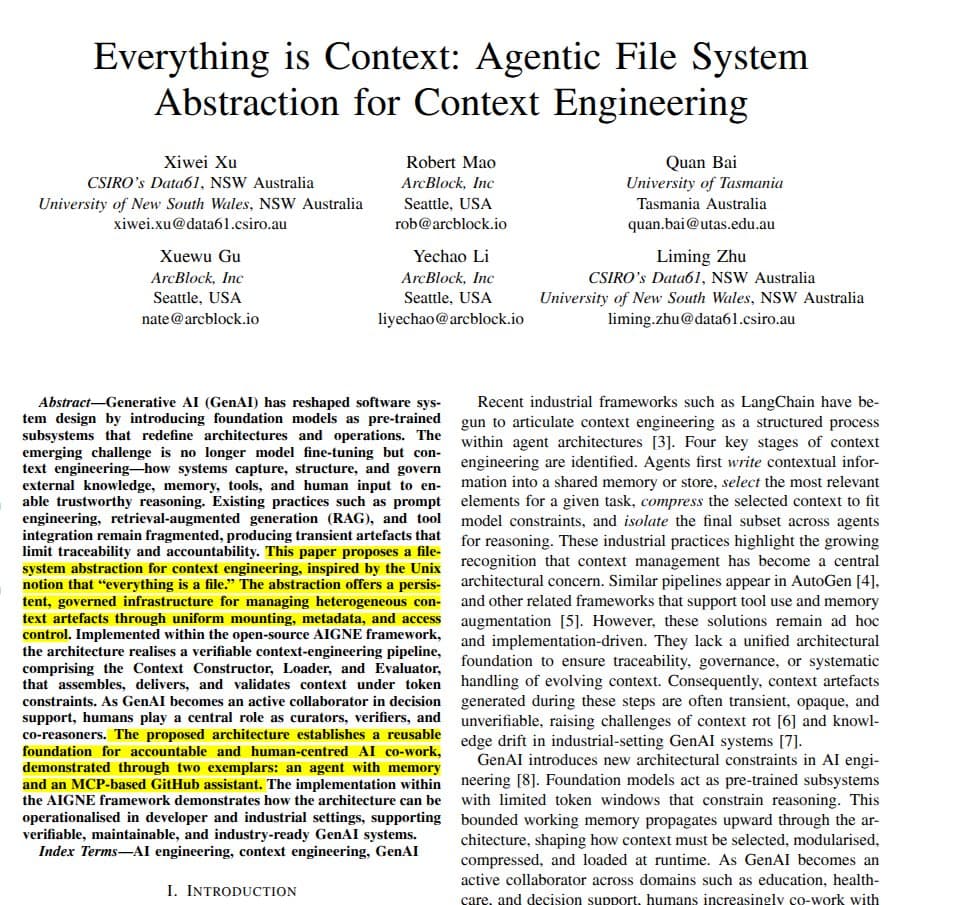
Now, researchers have proposed a radical solution outlined in the paper "Everything is Context: Agentic File System Abstraction for Context Engineering" (arXiv:2512.05470). Their approach? Treat everything an AI needs to know—memories, tools, external sources, and human notes—as files in a unified file system.
The Context Scattering Problem
Today's AI systems manage knowledge across multiple disconnected silos. As noted in the research, "a model's knowledge sits in separate prompts, databases, tools, and logs." This fragmentation creates several problems:
- Context window limitations: LLMs can only process a limited amount of text per interaction
- Information loss: Important details from previous conversations disappear
- Tool integration complexity: Each external service requires custom integration
- Audit trail gaps: Understanding how an AI arrived at a particular answer becomes difficult
The current approach forces developers to engage in "context engineering"—manually pulling together disparate information sources into coherent prompts for each interaction. This is both inefficient and error-prone.
The Agentic File System Solution
The proposed architecture introduces an agentic file system where every piece of information appears as a file in a shared space. This includes:
- Memories: Past conversations and learned information
- Tools: External services like GitHub, APIs, and databases
- Human feedback: Notes, corrections, and preferences from users
- External sources: Retrieved documents, web pages, and data
"Every access and transformation is logged with timestamps and provenance," the researchers explain, creating "a trail for how information, tools, and human feedback shaped an answer."
Three-Layer Context Architecture
The system organizes context into three distinct layers:
- Raw History: Complete record of all interactions
- Long-Term Memory: Important information distilled from history
- Short-Lived Scratchpads: Temporary working space for current tasks
This separation ensures that "the model's prompt holds only the slice needed right now" while maintaining access to the full historical record when necessary.
The AIGNE Framework Implementation
The architecture is implemented in the AIGNE framework (Agentic Intelligent General-purpose Network Environment), which demonstrates several practical applications:
- Persistent memory: Agents remember past conversations across sessions
- Unified tool access: Services like GitHub are accessed through the same file-style interface
- Context optimization: Automatic shrinking and updating of context based on current needs
The framework includes three key components:
- Constructor: Shrinks context to fit within model limitations
- Updater: Swaps context pieces based on relevance
- Evaluator: Checks answers and updates memory accordingly
Practical Implications for AI Development
This approach fundamentally changes how developers interact with AI systems. Instead of crafting elaborate prompts for each interaction, they can work with familiar file system concepts:
- Organize knowledge in directories: Create logical structures for different types of information
- Set permissions: Control what different agents can access
- Version control: Track changes to context over time
- Backup and restore: Save and load context states
The file system abstraction "turns scattered prompts into a reusable context layer," potentially accelerating AI application development and improving system reliability.
Challenges and Considerations
While promising, the approach raises several questions:
- Performance overhead: File system operations may introduce latency
- Security implications: Unified context storage creates new attack surfaces
- Privacy concerns: Persistent memory of all interactions requires careful handling
- Scalability: Managing potentially massive context repositories
The researchers acknowledge these challenges and suggest that the benefits of organized, auditable context outweigh the potential drawbacks for many applications.
The Future of Context-Aware AI
This research represents a significant step toward solving AI's memory problem. By treating context as a first-class citizen in AI architecture, developers can create systems that:
- Learn continuously from interactions
- Maintain consistent personalities and preferences
- Provide better explanations for their reasoning
- Integrate more seamlessly with existing tools and workflows
As AI systems become more integrated into daily life and work, solutions like the agentic file system may become essential infrastructure—the operating system for artificial intelligence.
Source: "Everything is Context: Agentic File System Abstraction for Context Engineering" (arXiv:2512.05470)