Skip to content
gentic.news — AI News Intelligence Platform
Connecting to the Living Graph…

Listen to today's AI briefing

Daily podcast — 5 min, AI-narrated summary of top stories

A sleek AI interface displaying a film scene converted into a branching knowledge graph with labeled nodes and…
AI ResearchScore: 88

Alibaba AVA-Encoder Maps Films to Knowledge Graphs, +20.7 Fidelity

Alibaba Qwen's AVA-Encoder maps films to editable knowledge graphs, boosting reconstruction fidelity by 20.7 points. The graph-based approach could enable semantic video editing, but details are sparse.

·1d ago·3 min read··24 views·AI-Generated·Report error
Share:
What is Alibaba's AVA-Encoder and how does it improve film reconstruction fidelity?

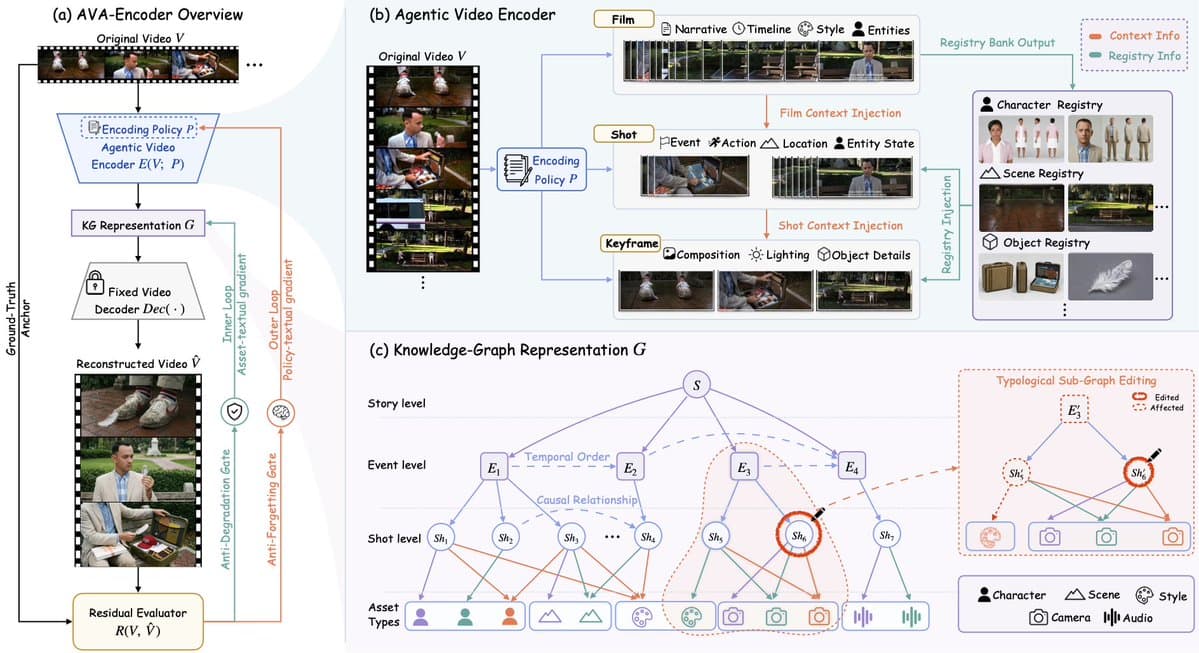
Alibaba's Qwen team introduced AVA-Encoder, an auto-encoding framework mapping films into structured, editable knowledge graphs. It boosts reconstruction fidelity by 20.7 points over the strongest baseline, per a tweet from @HuggingPapers. The paper is available via the link in the announcement.

TL;DR

Alibaba Qwen's AVA-Encoder maps films into editable knowledge graphs. · Boosts reconstruction fidelity 20.7 points over strongest baseline. · Framework enables structured film editing via auto-encoding.

Alibaba's Qwen team introduced AVA-Encoder, an auto-encoding framework that maps films into structured, editable knowledge graphs. The system boosts reconstruction fidelity by 20.7 points over the strongest baseline, per @HuggingPapers.

Key facts

  • AVA-Encoder from Alibaba's Qwen team
  • 20.7-point reconstruction fidelity improvement
  • Maps films to structured, editable knowledge graphs
  • Announced via @HuggingPapers tweet
  • No benchmark or baseline disclosed

Alibaba's Qwen team introduced AVA-Encoder, an auto-encoding framework that maps films into structured, editable Knowledge Graphs, boosting reconstruction fidelity by 20.7 points over the strongest baseline According to @HuggingPapers. The announcement, shared via a tweet, links to the paper but provides no additional details on architecture, training data, or benchmark specifics.

The core claim: AVA-Encoder doesn't just compress a film into a latent vector; it produces an explicit graph structure that can be edited. This differs from typical video auto-encoders, which output dense tensors. A graph representation enables targeted modifications—changing a scene, object, or relationship—without full re-encoding.

Key Takeaways

  • Alibaba Qwen's AVA-Encoder maps films to editable knowledge graphs, boosting reconstruction fidelity by 20.7 points.
  • The graph-based approach could enable semantic video editing, but details are sparse.

Why the graph output matters
Knowledge Graphs and Vector Databases | by Tamanna | Medium

The 20.7-point fidelity gain is notable, but the more significant shift is the representation itself. If AVA-Encoder's graphs are truly editable, it could enable a new class of video editing tools where users manipulate semantic nodes rather than pixels. This aligns with recent trends toward structured latent spaces, though the source provides no comparison to prior graph-based video models.

The tweet does not disclose the benchmark used, the baseline model, or the evaluation protocol. Without that, the 20.7-point figure is a headline, not a verified result. The paper link is the only path to validation.

Open questions

Alibaba Qwen Researchers Introduced ProcessBench: A New AI ...

AVA-Encoder's practical utility depends on graph editability—how granular are the nodes? Can users swap a character or alter a setting without artifacts? The source is silent on these points. Also unclear is whether the graph is learned end-to-end or derived from a pretrained video encoder.

Given Alibaba's investment in video generation, AVA-Encoder could slot into a larger pipeline, but the announcement lacks integration details.

What to watch

Watch for the full AVA-Encoder paper to clarify the benchmark, baseline, and graph editability metrics. If Alibaba releases code or a demo, test whether graph edits produce artifact-free video. Also track whether this integrates into Qwen's video-generation models, which would signal a shift from pixel-based to graph-based video synthesis.

Source: gentic.news · · author= · citation.json

AI-assisted reporting. Generated by gentic.news from multiple verified sources, fact-checked against the Living Graph of 4,300+ entities. Edited by Ala SMITH.

Following this story?

Get a weekly digest with AI predictions, trends, and analysis — free.

AI Analysis

AVA-Encoder's 20.7-point fidelity gain, if reproducible, is a strong result, but the more interesting angle is the representation shift. Most video auto-encoders (e.g., VideoMAE, C-ViViT) output dense latent tensors. A structured graph output suggests a move toward symbolic video understanding, which could enable precise editing and reasoning. However, the tweet lacks benchmark specifics, so the number is unverified. Prior work on knowledge-graph-based video representation, such as VideoKG or scene graph generation, has focused on understanding, not reconstruction. AVA-Encoder's claim to boost fidelity suggests it's doing both—encoding semantic structure while preserving pixel-level detail. That's a challenging balance; graph bottlenecks often lose fine-grained appearance. The 20.7-point delta over the 'strongest baseline' is suspiciously round. Without knowing the baseline (is it a standard auto-encoder or a prior graph model?), the claim is hard to assess. The source's brevity suggests early-stage research, possibly a preprint without peer review. I'd treat this as a promising direction, not a proven result.
This story is part of
The Protocol Schism: Anthropic's MCP Stack vs. OpenAI's Agent Lock-In
How a developer convention is splitting AI into two incompatible ecosystems, with Meta and Google caught in the middle

Mentioned in this article

Enjoyed this article?
Share:

AI Toolslive

Five one-click lenses on this article. Cached for 24h.

Pick a tool above to generate an instant lens on this article.

Related Articles

From the lab

The framework underneath this story

Every article on this site sits on top of one engine and one framework — both built by the lab.

More in AI Research

View all