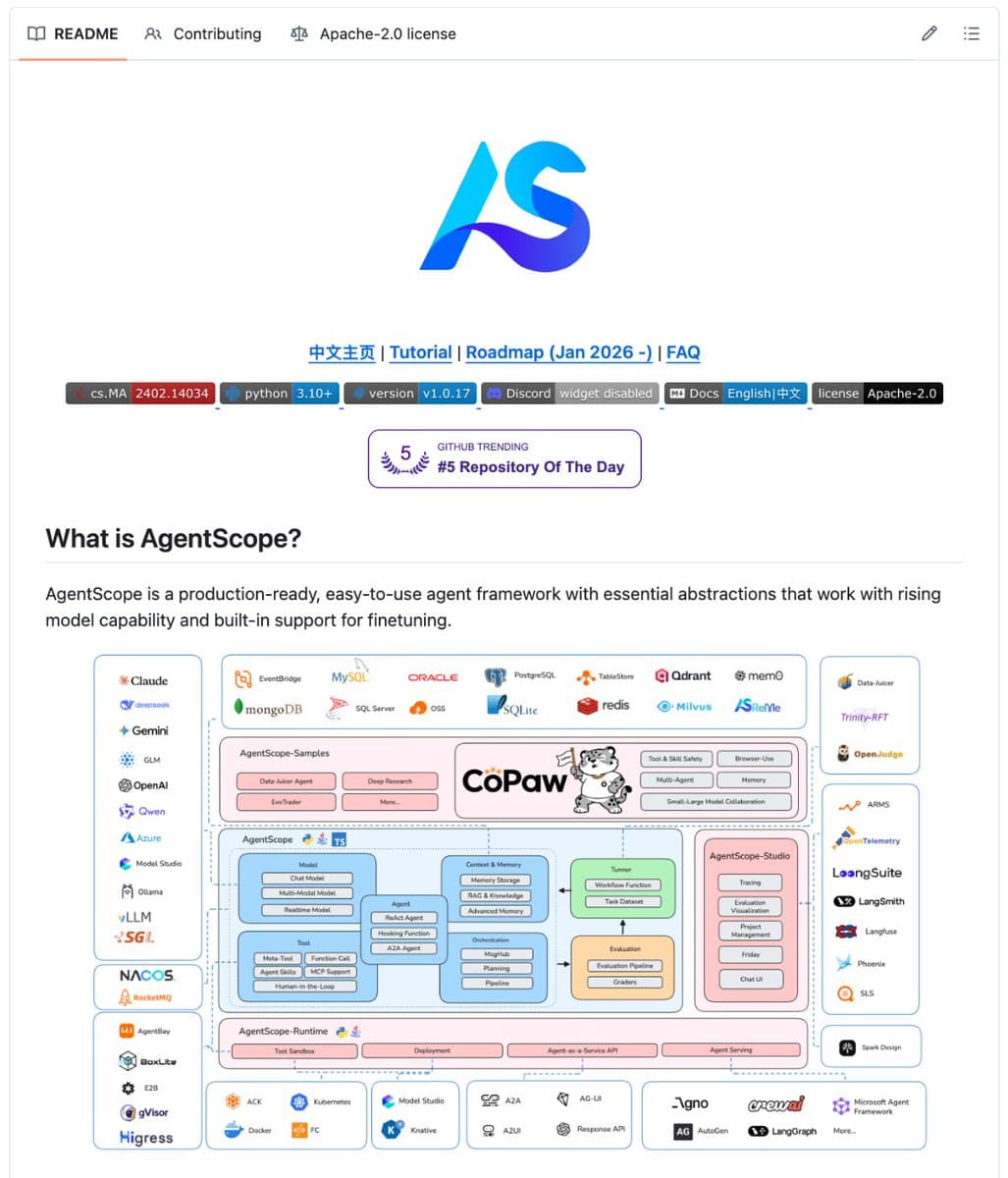
Alibaba's DAMO Academy, the research division behind the Qwen series of large language models, has released AgentScope, an open-source Python framework for building multi-agent AI systems. The framework takes an agent-oriented programming approach, providing a complete architecture for designing, coordinating, and deploying AI agents that can work together on complex tasks.
What's New
AgentScope distinguishes itself from existing agent frameworks by offering a visual agent builder that allows developers to design entire multi-agent systems before writing code. This visual interface maps out agent roles, their relationships, and the flow of information between them.
Key features include:
- Native Model Context Protocol (MCP) tool support for connecting external tools directly to agents
- Built-in memory systems that maintain context, decisions, and history across sessions
- Integrated RAG pipeline for connecting documents, databases, and knowledge bases
- Reasoning modules that enable planning, reflection, and self-correction capabilities
- Multi-agent coordination that enables agents to collaborate as a system rather than isolated API calls
The framework is released under the Apache 2.0 license, making it freely available for both commercial and research use.
Technical Architecture
AgentScope is designed from first principles around how agents need to think, remember, and work together. Unlike frameworks that provide basic building blocks, AgentScope provides a complete architecture where:
- Goal Definition: Developers define the overall task objective
- Role Mapping: The framework maps out required agent roles based on the goal
- Agent Configuration: Each agent receives specific tools, memory systems, and reasoning layers
- Coordination Layer: Agents communicate and collaborate through structured protocols
- Result Aggregation: Outputs flow back through the system to produce final deliverables
A typical workflow might involve a planner agent breaking down a complex task, a researcher agent gathering information, a coder agent implementing solutions, and a critic agent evaluating outputs—all coordinated through AgentScope's architecture.
How It Compares
Most existing agent frameworks (LangChain, LlamaIndex, AutoGen) provide components that developers must assemble into systems. AgentScope takes a different approach by providing the complete system architecture upfront. This reduces the integration work required to build functional multi-agent systems.
The visual design component is particularly notable, as it allows for rapid prototyping and visualization of agent workflows—a feature not commonly found in other Python agent frameworks.
What to Watch
As an open-source project from Alibaba's research division, AgentScope represents a significant contribution to the multi-agent ecosystem. The community has already begun integrating it into data pipelines, research workflows, and automation systems beyond the team's original scope.
Early adopters should monitor:
- Performance benchmarks for complex multi-agent tasks
- Integration capabilities with existing LLM providers and tool ecosystems
- Community adoption and extension development
- Documentation quality and learning curve for new users
gentic.news Analysis
This release follows Alibaba DAMO Academy's pattern of releasing significant open-source AI infrastructure. The same lab behind the Qwen series—which has seen rapid iteration with models like Qwen2.5 and specialized variants—is now applying its research capabilities to the agent framework space. This aligns with our previous coverage of China's increasing contributions to open-source AI tooling, where frameworks and infrastructure are becoming as strategically important as the models themselves.
The timing is notable given the current industry focus on moving from single-agent chatbots to coordinated multi-agent systems. AgentScope's architectural approach addresses a genuine pain point in current agent development: the significant integration work required to make multiple agents work together effectively. By providing a complete system rather than components, DAMO Academy is positioning AgentScope as a potential standard for enterprise-grade agent deployments.
This release also represents a competitive move against Western frameworks that currently dominate the agent development space. With Alibaba's backing and the Apache 2.0 license, AgentScope could gain significant traction in both Chinese and international developer communities, particularly among enterprises looking to deploy complex agent systems without building everything from scratch.
Frequently Asked Questions
What is AgentScope?
AgentScope is an open-source Python framework for building multi-agent AI systems, developed by Alibaba's DAMO Academy. It provides a complete architecture for designing, coordinating, and deploying AI agents that can work together on complex tasks, featuring visual design tools, built-in memory, RAG integration, and reasoning capabilities.
How does AgentScope differ from LangChain or AutoGen?
While LangChain and AutoGen provide components and building blocks for agent development, AgentScope offers a complete system architecture from the start. It includes a visual agent builder for designing systems before coding, native MCP tool support, and built-in coordination layers that enable agents to work together as an integrated system rather than isolated components.
Is AgentScope free to use commercially?
Yes, AgentScope is released under the Apache 2.0 license, which permits both commercial and non-commercial use, modification, and distribution. This makes it suitable for enterprise deployments as well as research projects.
What types of applications is AgentScope best suited for?
AgentScope is designed for complex multi-agent applications where coordination between specialized agents is required. This includes research workflows, data processing pipelines, automated content creation systems, and enterprise automation where tasks need to be broken down and handled by different specialized agents working in coordination.