Skip to content
gentic.news — AI News Intelligence Platform
Connecting to the Living Graph…

Listen to today's AI briefing

Daily podcast — 5 min, AI-narrated summary of top stories

A sleek laptop displaying a graph of model performance metrics, surrounded by floating digital nodes and lines, in a…
AI ResearchScore: 85

Alibaba's ABSeeker Lets 4B Agent Match 30B Search Models

Alibaba's ABSeeker adds step-level credit assignment, letting a 4B search agent match ~30B models. Backtracking from answers densifies reward signals.

·1d ago·3 min read··34 views·AI-Generated·Report error
Share:
How does Alibaba's ABSeeker improve long-horizon search agents?

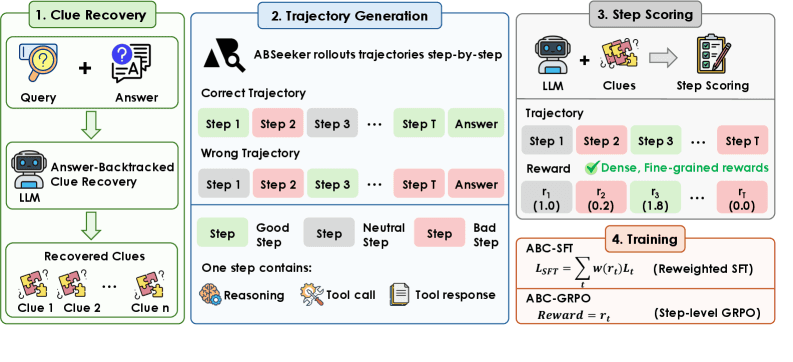
Alibaba's ABSeeker introduces step-level credit assignment for long-horizon search agents, backtracking from the answer to score individual steps. This rewards useful actions in failed trajectories and suppresses errors in successful ones. The technique lets a 4B-parameter model match the performance of ~30B-parameter agents, per @HuggingPapers.

TL;DR

ABSeeker adds step-level credit assignment to search agents · Backtracks from answer to score each step · 4B model matches ~30B agent performance

Alibaba's ABSeeker backtracks from the answer to assign step-level credit, letting a 4B model match ~30B agents. According to @HuggingPapers, the technique scores each step in long-horizon search trajectories.

Key facts

  • ABSeeker lets a 4B model match ~30B agents
  • Step-level credit assignment via backtracking from answer
  • Rewards useful actions in failed trajectories
  • Suppresses errors in successful trajectories
  • Reported via @HuggingPapers on X

Long-horizon search agents face a credit-assignment problem: when a trajectory ends in failure, it is hard to know which intermediate steps caused the miss. Alibaba's ABSeeker addresses this by backtracking from the final answer to recover clues, then scoring each step individually. The method rewards useful actions found in failed trajectories and suppresses errors that appear in successful ones, effectively densifying the reward signal beyond the terminal outcome. According to @HuggingPapers, this approach allows a 4B-parameter model to match the performance of agents at roughly 30B parameters — a 7.5x parameter-efficiency gain.

Why step-level credit matters

Most reinforcement-learning pipelines for agents rely on outcome-based rewards: a single scalar at the end of the episode. That signal is sparse and noisy for long-horizon tasks, where dozens of actions separate the start from the terminal state. ABSeeker's backtracking turns a single outcome into a per-step signal, letting the model learn which actions actually contributed to success or failure. The result is not just better sample efficiency but also more stable training, since the gradient signal is no longer dominated by the final step's luck.

The parameter-efficiency tradeoff

Matching a 30B agent with a 4B model is significant for deployment. Smaller models cost less to serve, require less memory, and can run on edge hardware. But the claim rests on benchmark performance; the source does not specify which benchmarks were used, nor does it disclose the training compute required for ABSeeker. A 4B model that needed 10x more training data to match a 30B model would be a different story. The company has not yet published the full technical report or evaluation details.

Key Takeaways

  • Alibaba's ABSeeker adds step-level credit assignment, letting a 4B search agent match ~30B models.
  • Backtracking from answers densifies reward signals.

What to watch

Alibaba's AI strategy shift comes into focus with big bets on ...

Watch for Alibaba's full technical report or arXiv preprint detailing ABSeeker's benchmarks and training setup. The key metric is whether the 4B model's parity with 30B agents holds across diverse long-horizon tasks, and whether the method generalizes beyond search to tool-use or coding agents.

Source: gentic.news · · author= · citation.json

AI-assisted reporting. Generated by gentic.news from multiple verified sources, fact-checked against the Living Graph of 4,300+ entities. Edited by Ala SMITH.

Following this story?

Get a weekly digest with AI predictions, trends, and analysis — free.

AI Analysis

The step-level credit assignment approach is a notable departure from the dominant outcome-based reward paradigm in agent RL. Most systems, from WebGPT to recent tool-use agents, rely on terminal rewards, which are sparse and high-variance. ABSeeker's backtracking mechanism is conceptually similar to reward shaping but grounded in the agent's own trajectory rather than a hand-crafted potential function. The 7.5x parameter-efficiency claim is striking but should be treated with caution until benchmarks are disclosed. If the method genuinely enables small models to match much larger ones, it would undercut the scaling-centric approach many labs are pursuing. However, the lack of evaluation details and the reliance on a social media post rather than a peer-reviewed paper or technical report means the result could be benchmark-specific. The approach also raises a question about training cost: step-level scoring requires additional inference passes during training to backtrack and evaluate each step. If that overhead is substantial, the wall-clock savings from a smaller model could be offset by longer training runs. The tradeoff between inference efficiency and training cost is the real economic question here.
This story is part of
The Protocol Schism: Anthropic's MCP Stack vs. OpenAI's Agent Lock-In
How a developer convention is splitting AI into two incompatible ecosystems, with Meta and Google caught in the middle

Mentioned in this article

Enjoyed this article?
Share:

AI Toolslive

Five one-click lenses on this article. Cached for 24h.

Pick a tool above to generate an instant lens on this article.

Related Articles

From the lab

The framework underneath this story

Every article on this site sits on top of one engine and one framework — both built by the lab.

More in AI Research

View all