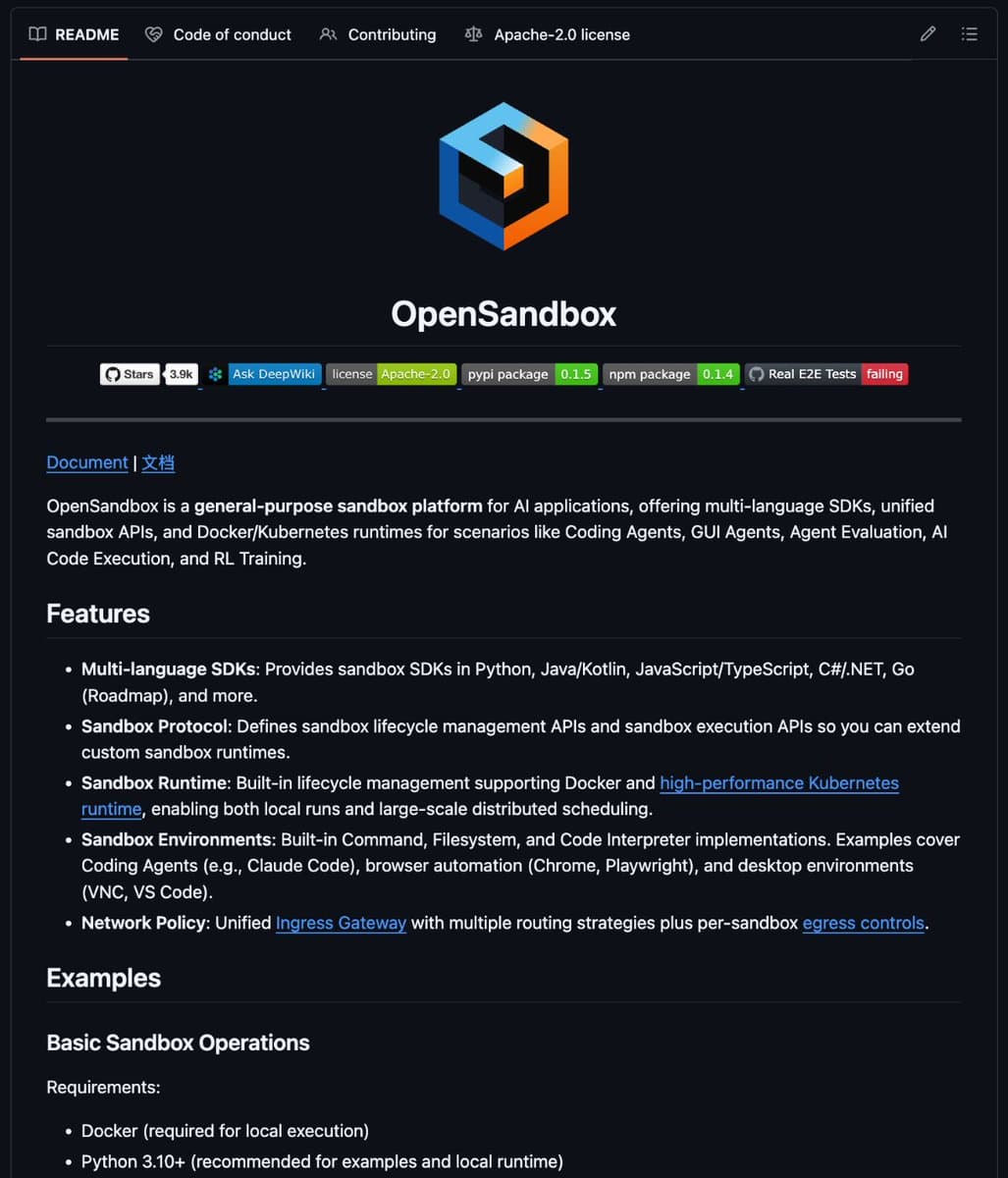
In a significant move that could reshape the AI agent development landscape, Alibaba has released OpenSandbox as a 100% open-source tool under the Apache 2.0 license. This powerful sandbox environment provides developers with the same infrastructure Alibaba uses internally to run AI workloads at massive scale, now available to anyone for free.
What OpenSandbox Actually Does
OpenSandbox creates isolated, secure environments where AI agents can execute code, browse the web, and train models through a unified API that works across multiple programming languages. The tool eliminates the need for developers to stitch together disparate tools and services, offering instead a cohesive platform that handles everything from local development to production-scale distributed runs.
The system supports various agent types including coding agents, GUI agents, and reinforcement learning training environments. It comes with SDKs for Python, TypeScript, Java/Kotlin, and C#, with Go support planned for the future. For deployment flexibility, it supports Docker for local development and Kubernetes for production-scale distributed operations.
Key Features and Capabilities
No Vendor Lock-In or Billing Surprises
Unlike many cloud-based AI services that operate on per-minute billing models, OpenSandbox is completely free and open-source. This removes financial barriers for developers and researchers who need to run extensive AI agent experiments without worrying about unexpected costs.
Comprehensive Integration Ecosystem
The tool boasts impressive integration capabilities with major AI platforms including:
Additionally, it supports browser automation through Chrome and Playwright, and provides full VNC desktop capabilities for GUI-based agents.
Enterprise-Grade Security
Built on Alibaba's internal infrastructure, OpenSandbox provides secure isolation between different agent environments. This is crucial for preventing malicious code execution and ensuring that AI agents don't inadvertently interfere with each other or the host system.
Getting Started in Minutes
The setup process is remarkably simple:
pip install opensandbox-server
opensandbox-server init-config
opensandbox-server
With just three commands, developers can have a fully functional sandbox environment ready for their AI agents to execute code, browse the web, or train models.
Industry Context and Significance
OpenSandbox arrives at a critical moment in AI agent development. As AI systems become more autonomous and capable of performing complex tasks, the need for safe, scalable testing environments has grown exponentially. Previously, developers had to either build their own sandbox solutions from scratch or rely on expensive, proprietary platforms with limited flexibility.
Alibaba's decision to open-source this technology follows a growing trend among major tech companies to release internal tools to the public. However, what makes OpenSandbox particularly noteworthy is its comprehensive feature set and production-ready architecture.
Potential Impact on AI Development
Accelerating Research and Innovation
By removing infrastructure barriers, OpenSandbox could significantly accelerate AI agent research. Academic institutions, startups, and independent developers now have access to tools previously available only to large corporations with substantial resources.
Standardizing Development Practices
The unified API approach could help standardize how AI agents interact with execution environments, making it easier to share and collaborate on agent development across different organizations and research groups.
Enabling New Use Cases
With secure web browsing and full desktop capabilities, OpenSandbox opens up possibilities for more sophisticated AI agents that can interact with web applications, automate complex workflows, and perform tasks that require graphical interfaces.
Challenges and Considerations
While OpenSandbox offers tremendous potential, developers should consider several factors:
Resource Requirements
Running sandboxed environments, especially with full desktop capabilities, can be resource-intensive. Developers will need to ensure they have adequate hardware or cloud resources for their specific use cases.
Security Responsibility
Although OpenSandbox provides isolation mechanisms, developers remain responsible for implementing proper security practices within their agent code and monitoring agent behavior.
Community Support
As with any open-source project, the long-term success of OpenSandbox will depend on community adoption and contribution. Alibaba's backing provides initial credibility, but sustained development will require active community participation.
Looking Forward
OpenSandbox represents more than just another open-source tool—it's a strategic move that could democratize access to enterprise-grade AI agent infrastructure. By providing these capabilities for free, Alibaba is positioning itself as a key enabler of the next generation of AI applications.
The tool's release comes as competition in the AI space intensifies globally, with companies seeking to establish ecosystems around their technologies. OpenSandbox could become a foundational layer for AI agent development, much like Docker became for containerization or Kubernetes for orchestration.
For developers and researchers working on AI agents, OpenSandbox offers an unprecedented opportunity to experiment with sophisticated agent behaviors without the traditional infrastructure hurdles. As the community begins to explore its capabilities, we can expect to see new types of AI agents and applications emerging that were previously impractical or too costly to develop.
Source: @hasantoxr on X