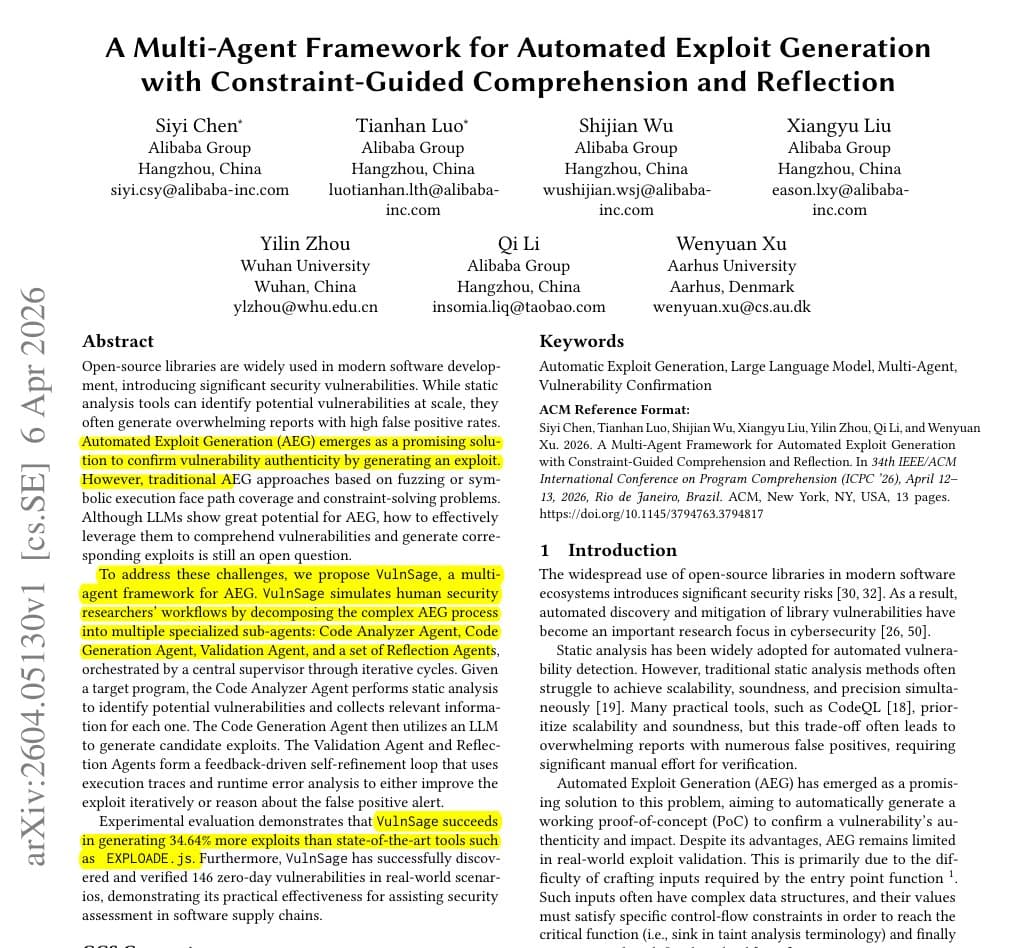
A research team from Alibaba has published a paper demonstrating a significant escalation in AI's offensive security capabilities. Their framework, VulnSage, uses a multi-agent workflow of large language models (LLMs) not just to find software vulnerabilities, but to automatically generate functional, working exploits that can confirm them. The system reportedly discovered 146 zero-day vulnerabilities in real-world JavaScript packages and generated 34.64% more successful exploits than prior state-of-the-art tools on the SecBench.js benchmark.
This work provides a concrete technical example of the escalating AI cybersecurity arms race, a trend recently highlighted by industry warnings. It moves beyond static analysis or fuzzing into the realm of automated weaponization, where AI doesn't just identify a flaw but actively proves it can be weaponized.
What the Researchers Built: A Multi-Agent Exploit Factory
The core innovation of VulnSage is its rejection of a single, monolithic LLM approach. The researchers found that a single model tasked with exploit generation "loses the thread, hallucinates details, and struggles to repair its own mistakes."
Instead, VulnSage decomposes the exploit generation problem into a structured workflow handled by specialized agents:
- Dataflow Extractor: Analyzes the vulnerable code to identify the critical dataflow path that must be manipulated.
- Constraint Comprehender: Translates the complex, low-level code path into a set of high-level, natural language constraints (e.g., "the input must be an object where property
xis a string longer than 100 characters that passes through functions A and B"). - Exploit Generator: Uses the natural-language constraints to write candidate exploit code.
- Validation & Reflection Agents: Execute the candidate exploit in a sandbox. Crucially, they analyze execution traces and errors, using this feedback to guide iterative refinement of the exploit or to conclude the vulnerability is a false positive.
Key Results: From Benchmarks to Real Zero-Days
The paper evaluates VulnSage on two fronts: benchmark performance and real-world discovery.
SecBench.js Successful Exploits Generated Not Disclosed (Count) Baseline Count +34.64% Real npm Packages Zero-Day Vulnerabilities Found 146 N/A N/AThe 34.6% improvement on SecBench.js is significant, but the discovery of 146 zero-days in live open-source packages is the headline figure. It demonstrates the framework's ability to handle the "messy, more realistic software where older methods often fail."
How It Works: Turning Code Comprehension into Exploits
The technical breakthrough is in the Constraint Comprehender agent. Traditional automated exploit generation (AEG) tools like fuzzers or symbolic executors (e.g., SymTS) fail when the exploit requires constructing complex program-specific objects, not just simple input values.
VulnSage's comprehending agent rewrites the vulnerable dataflow path in plain English. This allows the downstream LLM agents to reason about the semantic intent of the code—"which object to build and which method path keeps the malicious input alive." The system effectively uses LLMs for deep code understanding, then leverages that understanding to guide the systematic construction of a proof-of-concept exploit.
The multi-agent architecture creates a closed loop: generate, execute, observe, reflect, and regenerate. This mimics the iterative, trial-and-error process of a human security researcher, allowing the system to recover from dead-ends and incorrect assumptions.
Why It Matters: The Weaponization Threshold is Lowering
This research is not an incremental improvement in static analysis. It represents a phase shift: from vulnerability detection to automated vulnerability confirmation and weaponization. The "proof" is no longer a static report but a functional exploit.
For defenders and security teams, tools like VulnSage could theoretically be used for aggressive, proactive penetration testing and bug bounty hunting at scale. For offensive actors—both state-sponsored and criminal—it lowers the barrier to turning a raw vulnerability into a usable weapon, potentially accelerating the timeline from discovery to exploitation in the wild.
The paper directly addresses the limitations of previous AEG, which choked on real-world code complexity. By using LLMs to comprehend and reason about that complexity, VulnSage bypasses a major historical bottleneck.
gentic.news Analysis
This paper from Alibaba's research arm is a direct and potent validation of the warnings issued by leaders like Google's Sundar Pichai about the dual-use nature of advancing AI. It follows a clear trend we've been tracking: the migration of LLM capabilities from passive analysis to active, goal-directed synthesis in critical domains. Earlier this year, we covered how Cognition Labs' Devin agent pushed the boundaries of AI in software creation. VulnSage applies a similar multi-agent, iterative reasoning architecture to software breakage.
The technical approach—using a multi-agent framework to manage complexity and reflection—is becoming a dominant pattern for applying LLMs to hard, multi-step problems. This aligns with frameworks like OpenAI's o1 for reasoning and Google's Astra team's work on agentic systems. The key insight here is that the "hard part" of exploit generation is often semantic code comprehension, a task at which modern LLMs excel. VulnSage effectively weaponizes that comprehension capability.
For the security industry, the implication is immediate. Defensive AI tooling must evolve at a commensurate pace, focusing not just on detecting vulnerabilities but on predicting and mitigating exploit chains that systems like VulnSage can now generate automatically. The discovery of 146 zero-days in npm packages also highlights a massive and ongoing supply-chain security problem that automated tools are now poised to exploit faster than humans can patch.
Frequently Asked Questions
What is VulnSage?
VulnSage is a research framework from Alibaba that uses a team of specialized large language model (LLM) agents to automatically generate working software exploits from source code. It translates vulnerable code paths into natural language constraints, then iteratively writes and tests exploit code until it succeeds or determines a flaw is a false positive.
How does VulnSage differ from traditional vulnerability scanners?
Traditional scanners (SAST, DAST) and fuzzers identify potential vulnerabilities or crash conditions. VulnSage goes a step further by actively proving a vulnerability is exploitable. It generates the actual weaponized code (the exploit) that can be used to trigger the vulnerability, moving from detection to confirmation and weaponization.
What does "146 zero-days" mean in this context?
It means the VulnSage framework was run against real-world, open-source JavaScript packages (likely from the npm registry) and successfully generated exploits for 146 previously unknown and unreported vulnerabilities. These are "zero-days" because the software maintainers had zero days of awareness to fix them before the AI found them.
Could this technology be used by malicious hackers?
Yes, that is the primary dual-use concern. The paper is published openly on arXiv, meaning the methodology is available to anyone. While it could empower defensive security teams (red teams, bug bounty hunters), it equally lowers the technical barrier for offensive actors to develop exploits, automating a process that previously required deep, manual expertise.