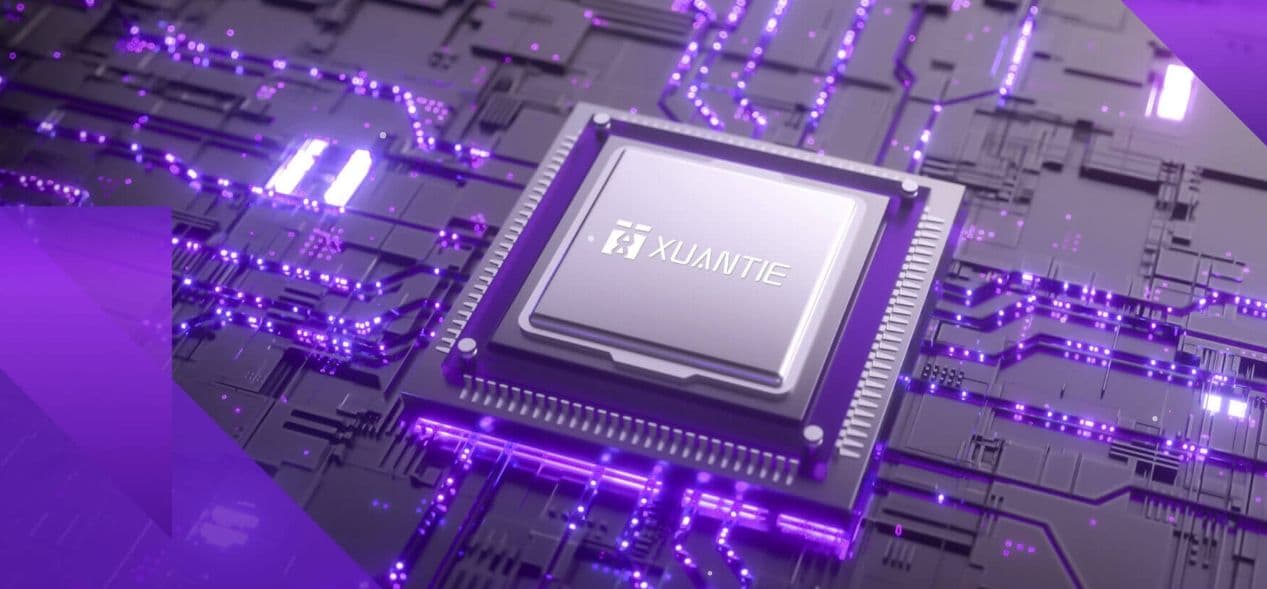
Alibaba's DAMO Academy has unveiled the XuanTie C950, a RISC-V-based CPU that the company claims delivers the highest single-core performance ever recorded for the open-source instruction set architecture (ISA). The processor reportedly scores over 70 points on the SPECint2006 benchmark and features architectural extensions specifically designed for native, efficient inference of billion-parameter large language models (LLMs), including Alibaba's own Qwen3 and DeepSeek's DeepSeek V3.
This launch follows Alibaba's recent strategic pivot toward AI infrastructure, announced just days earlier at its ModelScope DevCon, where it committed to releasing more open-source Qwen models and outlined a five-year goal to generate over $100 billion from its AI and cloud divisions.
What's New: A Performance-First RISC-V Core for AI
The XuanTie C950 represents a significant departure from previous RISC-V implementations, which have typically focused on embedded systems, IoT devices, or specialized accelerators. Alibaba is positioning the C950 as a general-purpose, high-performance compute core capable of competing with established architectures like ARM and x86 in data center and AI inference workloads.
Key specifications and claims from the announcement:
- SPECint2006 Score: >70 points (exact figure not disclosed)
- Architecture: 64-bit RISC-V with custom extensions
- LLM Support: Native architectural support for transformer-based models
- Target Models: Explicitly optimized for Qwen3 and DeepSeek V3
- Manufacturing Process: Not specified in the announcement
Technical Details: The RISC-V LLM Play
While the source material lacks detailed microarchitectural specifics, the claim of "native support" for billion-parameter LLMs suggests the C950 incorporates several key features:
1. Custom ISA Extensions: RISC-V's modular design allows implementers to add custom instructions. The C950 likely includes extensions for:
- Matrix multiplication operations (similar to ARM's SVE or Intel's AMX)
- Attention mechanism acceleration
- Low-precision arithmetic (INT8, FP16, BF16) for inference optimization
2. Memory Hierarchy Optimization: LLMs are memory-bound workloads. Achieving high performance requires:
- Large, high-bandwidth caches
- Efficient prefetching for sequential transformer blocks
- Reduced latency for attention score calculations
3. Software Stack Integration: "Native support" implies more than just hardware. Alibaba has likely developed:
- Compiler optimizations (LLVM/ GCC backends)
- Kernel-level scheduling improvements
- Framework integrations (PyTorch, TensorFlow) through their ModelScope ecosystem
The SPECint2006 score of >70 provides a concrete, if somewhat dated, performance reference. For context:
- Apple M2 (ARM): ~160 SPECint2006
- Intel Core i7-12700K (x86): ~180 SPECint2006
- Previous RISC-V high-performance cores: Typically 30-50 SPECint2006
The C950's score represents a 40-100% improvement over previous RISC-V implementations, closing a significant portion of the performance gap with established architectures.
How It Compares: RISC-V Enters the AI Inference Arena
The XuanTie C950 enters a competitive landscape where AI inference is increasingly moving toward specialized hardware. Here's how it positions against alternatives:
XuanTie C950 RISC-V (custom) General-purpose + LLM inference Open ISA, native LLM extensions Unproven in production, ecosystem maturity NVIDIA Grace ARM Neoverse AI & HPC CPU+GPU coherence, memory bandwidth Proprietary, vendor-locked AWS Graviton ARM Neoverse General cloud compute Cost-performance, cloud-native Less AI-specific optimization Intel Xeon x86-64 General server Broad software compatibility Higher power, less AI efficiency Google TPU Custom ASIC Tensor operations Extreme throughput for training Limited programmability, inference onlyAlibaba's strategy appears to be vertical integration: controlling the entire stack from silicon (XuanTie) to models (Qwen) to cloud platform (Alibaba Cloud). This mirrors Apple's approach with its M-series chips and could provide significant cost and performance advantages for Alibaba's cloud AI services.
What to Watch: The RISC-V Ecosystem Challenge
The XuanTie C950's success depends on factors beyond raw performance:
1. Software Ecosystem: RISC-V lacks the mature software stack of x86 and ARM. While Alibaba can optimize for specific models (Qwen, DeepSeek), broader adoption requires:
- Stable Linux distributions with production-ready kernels
- Container runtime optimizations (Docker, Kubernetes)
- Database and middleware compatibility
2. Manufacturing Scale: High-performance CPUs require advanced process nodes (likely 5nm or below). Alibaba hasn't disclosed its manufacturing partner or production capacity.
3. Competitive Response: ARM and x86 vendors aren't standing still. ARM's Neoverse V2 already targets AI workloads, and Intel's next-generation Xeons include AI accelerators.
4. DeepSeek Partnership: The explicit mention of DeepSeek V3 optimization is notable. DeepSeek, which competes with OpenAI and Anthropic, recently released DeepSeek-R1, a fully open-source AI agent that runs locally on PCs. If DeepSeek adopts XuanTie for its inference infrastructure, it could create a powerful Chinese AI stack independent of Western hardware.
gentic.news Analysis
This announcement represents a strategic escalation in the global AI infrastructure race. Alibaba isn't just optimizing existing hardware for AI—it's building custom silicon for a specific AI ecosystem (Chinese LLMs) on an open architecture (RISC-V). This has several implications:
First, it advances RISC-V from embedded/IOT to data-center relevance. The >70 SPECint2006 score, while still behind leading ARM and x86 cores, demonstrates that RISC-V can achieve competitive performance. This could accelerate RISC-V adoption in other regions seeking architectural independence, particularly given ongoing geopolitical tensions around chip technology.
Second, the timing is strategic. This follows Alibaba's March 20 announcement of a five-year, $100B AI and cloud revenue target and its March 23 commitment to release more open-source Qwen models at ModelScope DevCon. The XuanTie C950 provides the hardware foundation for this agentic AI strategy. As we covered in "Lowe's Confronts the Challenge of AI Agent Proliferation," enterprise AI agent deployment creates massive inference demand. Alibaba is positioning to capture this demand with vertically optimized infrastructure.
Third, the DeepSeek optimization is particularly interesting. DeepSeek has emerged as China's most capable open-source AI competitor to OpenAI, with DeepSeek-R1 recently demonstrating strong agentic capabilities. By optimizing for DeepSeek V3, Alibaba is effectively standardizing Chinese AI on its hardware. This creates a potential alternative stack to the NVIDIA/CUDA dominance that currently defines global AI infrastructure.
However, significant challenges remain. The RISC-V software ecosystem is still maturing, and Alibaba will need to demonstrate that the C950 can run not just Qwen and DeepSeek efficiently, but the broader universe of AI workloads enterprises actually deploy. The lack of detailed benchmarks against contemporary ARM and x86 AI chips leaves the performance claims somewhat unverified.
Frequently Asked Questions
What is the XuanTie C950?
The XuanTie C950 is a high-performance 64-bit RISC-V CPU developed by Alibaba's DAMO Academy. It claims the highest single-core SPECint2006 performance (>70 points) of any RISC-V implementation and includes custom architectural extensions for native, efficient inference of billion-parameter large language models like Qwen3 and DeepSeek V3.
How does the XuanTie C950 compare to ARM and x86 CPUs for AI?
Based on the SPECint2006 metric, the C950 (70+ points) significantly outperforms previous RISC-V cores but still trails high-end ARM (Apple M2: ~160) and x86 (Intel Core i7-12700K: ~180) designs. Its competitive advantage lies in custom extensions for LLM inference and the open RISC-V ISA, which offers architectural independence and potential cost benefits.
Why does Alibaba's CPU support DeepSeek models?
DeepSeek is a leading Chinese AI company that competes with OpenAI and Anthropic. By optimizing the XuanTie C950 for DeepSeek V3, Alibaba is creating a vertically integrated Chinese AI stack—from silicon (XuanTie) to models (DeepSeek/Qwen) to cloud services (Alibaba Cloud). This reduces dependence on Western hardware and could offer performance/cost advantages for Chinese AI applications.
When will the XuanTie C950 be available?
The announcement did not specify availability dates, pricing, or manufacturing details. Given that this is an architecture unveiling rather than a product launch, it will likely be months before the C950 appears in commercial products or Alibaba Cloud instances. The development aligns with Alibaba's five-year AI infrastructure roadmap announced on March 20.