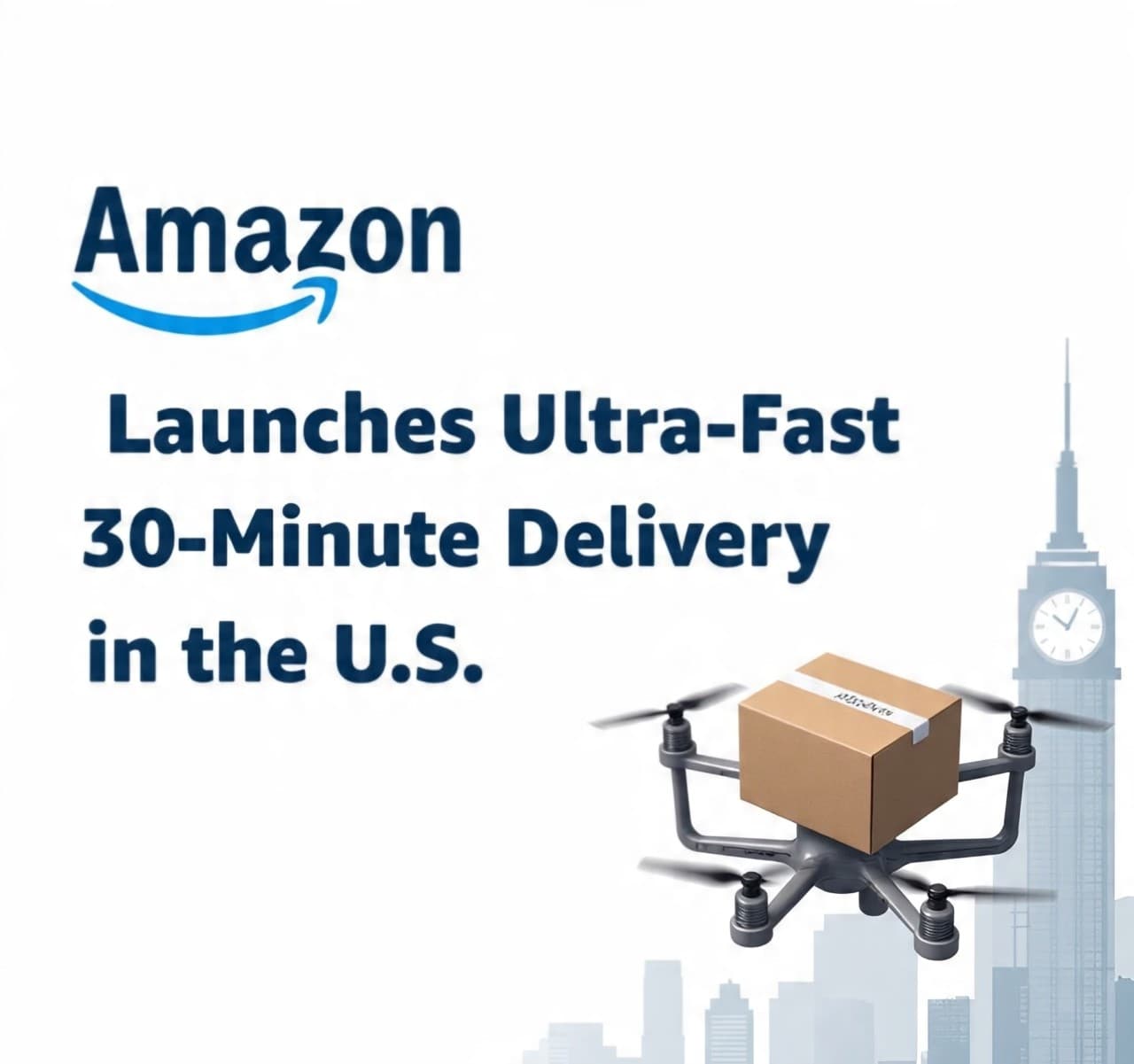
Amazon Now adds 8 cities for 30-minute delivery. The service—available 24/7—charges Prime members $3.99 per order.
Key facts
- Amazon Now expands to 8 additional U.S. cities.
- Prime members pay $3.99 per order; non-Prime pay $13.99.
- Service targets tens of millions of customers by end of 2026.
- Perishable goods are 9 of top 10 same-day delivery items.
- Amazon Now operates 24/7 in most areas.
Amazon is expanding its 30-minute-or-less delivery service, Amazon Now, to eight additional U.S. cities, the company announced Tuesday. [According to Retail Dive] The service, already live in Atlanta, Philadelphia, Seattle, and Dallas-Fort Worth, will reach Houston, Minneapolis, Phoenix, Denver, Oklahoma City, Orlando, and Austin. Amazon says Amazon Now will serve tens of millions of customers by end of 2026.
The logistics behind the speed
Amazon Now relies on a network of smaller fulfillment centers placed close to customers, reducing delivery distances and enabling sub-30-minute turnaround. The service operates 24 hours a day in most areas. Prime members pay $3.99 per order; non-Prime customers pay $13.99. Orders under $15 incur an additional $1.99 fee for Prime members and $3.99 for others.
Why this matters for Amazon's AI and logistics play
This expansion is not just a logistics move—it's a data play. Perishable goods make up nine of the top 10 most-ordered items for same-day delivery, CEO Andy Jassy said on an earnings call last month. [per Retail Dive] That demand signal feeds directly into Amazon's AI-driven inventory forecasting and fulfillment optimization, which increasingly uses retrieval-augmented generation (RAG) and other ML models to predict demand at the sub-warehouse level. The unique take: Amazon Now is the physical-world equivalent of a low-latency inference endpoint—every minute shaved off delivery time tightens the feedback loop between customer behavior and inventory placement. Competitors like Walmart's Sam's Club (one-hour delivery across 600+ locations) and Dollar General (same-day expansion) are racing on similar timelines, but Amazon's advantage lies in its ability to fuse real-time order data with its AI infrastructure (Bedrock, Trainium, SageMaker) to optimize warehouse placement dynamically.
Pricing and competitive landscape
The $3.99 Prime fee is a deliberate anchor: it undercuts most on-demand delivery apps (DoorDash, Uber Eats charge $5–$10) while conditioning users to expect near-instant gratification. Non-Prime pricing at $13.99 effectively forces conversion to Prime membership. Amazon's broader fast-delivery arsenal includes one-hour, three-hour, and drone delivery in select locations, creating a tiered speed hierarchy.
Key Takeaways
- Amazon expands Amazon Now 30-minute delivery to 8 new cities, targeting tens of millions by end of 2026.
- Prime members pay $3.99 per order.
What to watch
Watch for Amazon's Q3 2026 earnings call where Jassy may disclose Amazon Now order volumes and whether the service drives Prime membership conversion. Also track if Amazon opens its fulfillment network to third-party sellers for 30-minute delivery, which would expand SKU count significantly.